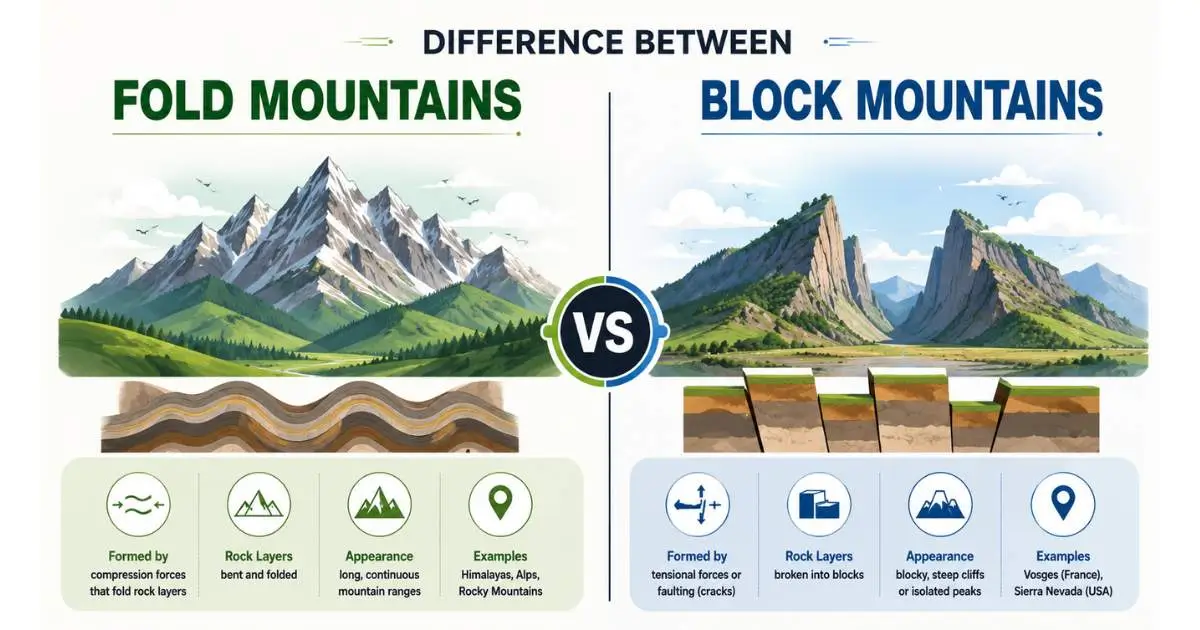
Stand at the base of the Himalayas and then stand at the base of the Sierra Nevada in the United States, and you are looking at two completely different stories written in rock. Both are mountains, but they were not built the same way.
The difference between fold mountains and block mountains comes down to what the tectonic plates were doing when the rock was pushed upward. One forms through squeezing and folding. The other forms through cracking and lifting. Both processes leave very different shapes behind, and examiners love asking students to tell the two apart using named examples.
This guide explains the difference between fold mountains and block mountains clearly, with a comparison table, real examples and a memory trick that has helped my students keep the two processes straight in the exam.
Quick Verdict
Fold mountains form when two tectonic plates push together and compress layers of rock, causing them to buckle and fold upward, like the Himalayas. Block mountains form when tension pulls the crust apart, cracking it along faults, so that one block is pushed up while the surrounding land drops down, like the Sierra Nevada. One is caused by squeezing, the other by stretching and cracking.
Fold Mountains and Block Mountains Comparison Table
| Feature | Fold Mountains | Block Mountains |
|---|---|---|
| Tectonic force | Compression, plates pushed together | Tension, plates pulled apart |
| Plate boundary type | Convergent (plates moving towards each other) | Divergent (plates moving away from each other) |
| Process | Folding, rock layers buckle without breaking | Faulting, rock cracks and blocks shift up or down |
| Shape | Long, curved ridges with rounded or jagged peaks | Steep, flat-topped or angular blocks |
| Rock layers | Bent and wavy, but still continuous | Broken along fault lines, displaced up or down |
| Typical examples | The Himalayas, the Alps, the Andes | The Sierra Nevada, the Vosges Mountains |
What Are Fold Mountains?
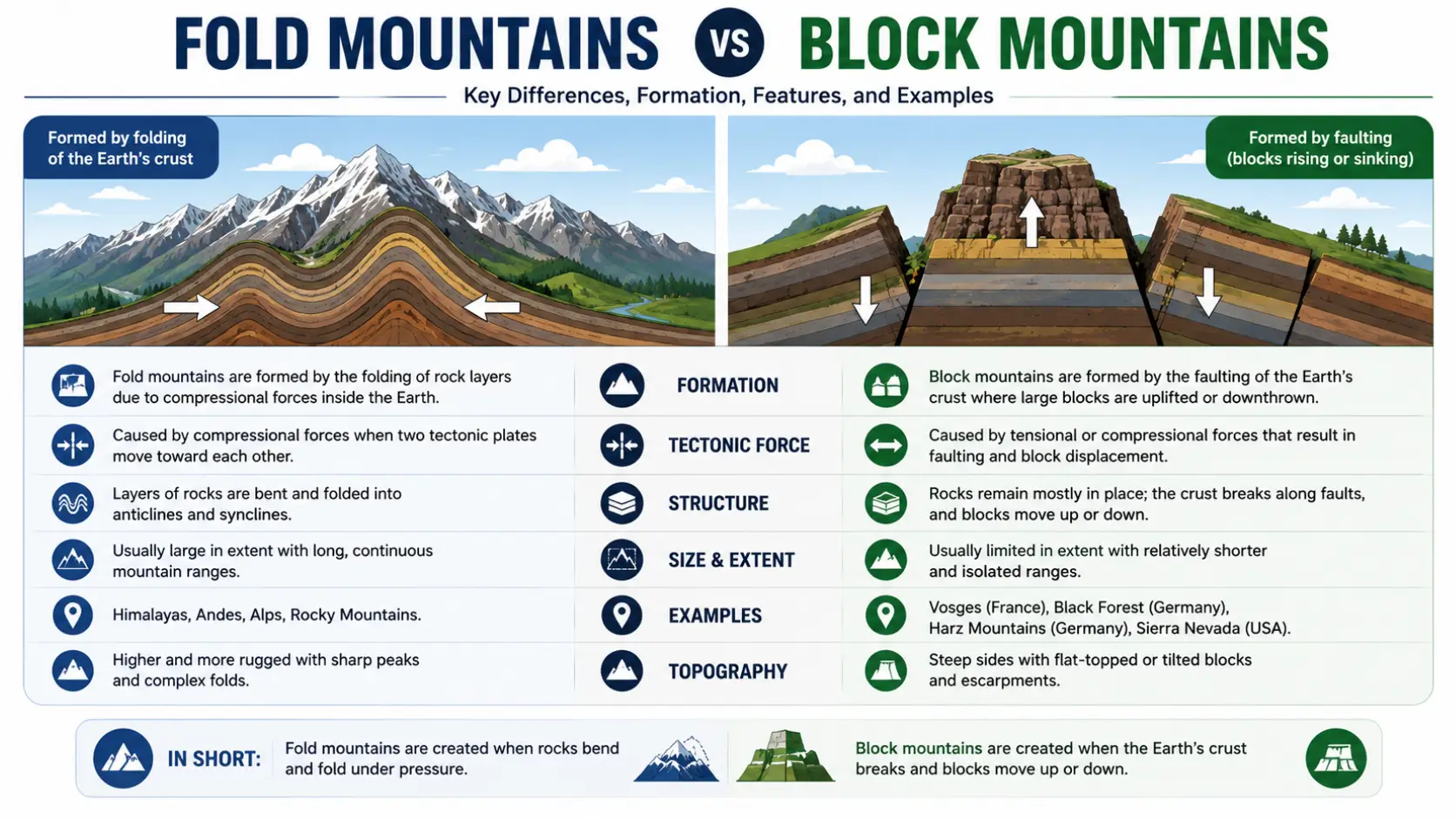
Fold mountains form at convergent plate boundaries, where two tectonic plates move towards each other and collide. As the plates push together, the layers of rock between them are squeezed under enormous pressure.
Rather than breaking, the rock layers bend and buckle, folding upward the way a tablecloth bunches up when pushed from both ends across a table. Upward folds are called anticlines, and downward folds are called synclines.
Fold mountains tend to form the highest and longest mountain ranges on Earth, since the collision of two continental plates can take millions of years and push enormous volumes of rock upward. The Himalayas, formed by the collision of the Indian and Eurasian plates, are the clearest example of this process.
What Are Block Mountains?
Block mountains form through a completely different process. Instead of compression, block mountains are created by tension, where the crust is being stretched or pulled apart.
This stretching causes the crust to crack along lines called faults. Rather than folding smoothly, sections of crust break and move independently of each other. A block that is pushed upward relative to the surrounding land becomes a block mountain, technically known as a horst. A section that drops down between two faults becomes a rift valley, technically known as a graben.
Block mountains typically have steeper, more angular sides than fold mountains, because they are created by a sudden break rather than a gradual bend. The Sierra Nevada in California is a well-known example of a block mountain range formed this way.
The Key Differences Explained
The core difference between fold mountains and block mountains is the type of tectonic force involved. Fold mountains form under compression, where plates are pushed together. Block mountains form under tension, where plates are pulled apart.
This difference in force explains the difference in shape. Compression bends rock layers gradually, producing long, curved ridges. Tension snaps rock layers along fault lines, producing steep, angular blocks with much sharper edges.
The type of plate boundary is another useful clue. Fold mountains are linked to convergent boundaries, where plates move towards each other. Block mountains are linked to divergent boundaries, where plates move apart, or occasionally where tension builds within a single plate.
Why This Difference Matters in Geography
Understanding the difference between fold mountains and block mountains helps explain the physical landscape of entire regions, not just individual peaks. Areas built from fold mountains often have long parallel ridges and valleys running for hundreds of kilometres, shaping settlement patterns, farming and transport routes.
Areas built from block mountains often sit next to rift valleys, since the same tensional forces that lift one block up tend to drop the neighbouring block down. This is why block mountains and rift valleys are frequently studied together in the same topic.
Real World Examples
The Himalayas formed as the Indian Plate collided with the Eurasian Plate, and the collision is still happening today, meaning the Himalayas continue to grow slightly taller each year.
The Sierra Nevada in California formed as tensional forces stretched the crust and lifted a huge block of rock along a major fault line, creating some of the steepest mountain faces in North America.
Memory Trick
Remember it as “FOLD squeezes like paper, BLOCK cracks like glass.” FOLD mountains form from squeezing, just like folding a piece of paper without tearing it. BLOCK mountains form from cracking, like a sheet of glass breaking along a clean line. If you picture paper folding and glass cracking, the difference between fold mountains and block mountains becomes much easier to recall under exam pressure.
Test Yourself: Fold Mountains and Block Mountains Quiz
1. Which force creates fold mountains?
2. Which mountain range is a classic example of fold mountains?
3. What is the process that creates block mountains called?
4. Which type of plate boundary is linked to fold mountains?
Common Mistakes Students Make
The most common mistake students make with the difference between fold mountains and block mountains is mixing up compression and tension. Remember, fold mountains are squeezed together, while block mountains are pulled apart. Getting these the wrong way round is one of the most frequent errors examiners see.
Another common mistake is assuming all mountains are formed by folding. Many well-known ranges are block mountains rather than fold mountains, and naming the wrong process for a named example can cost marks even if the rest of the answer is correct.
Students also sometimes forget that block mountains and rift valleys are formed by the same tensional process happening at the same time, just affecting neighbouring sections of crust in opposite directions.
Frequently Asked Questions
What is the main difference between fold mountains and block mountains?
The main difference between fold mountains and block mountains is the tectonic force involved. Fold mountains form from compression, where plates push together and rock layers buckle. Block mountains form from tension, where plates pull apart and the crust cracks along faults.
Are the Himalayas fold mountains or block mountains?
The Himalayas are fold mountains, formed by the ongoing collision between the Indian Plate and the Eurasian Plate.
What is a horst and what is a graben?
A horst is a block of crust pushed upward between two faults, forming a block mountain. A graben is a block of crust that has dropped down between two faults, forming a rift valley.
Why are fold mountains usually taller than block mountains?
Fold mountains often form from the collision of two continental plates over millions of years, pushing enormous volumes of rock upward gradually. This sustained process tends to build some of the tallest mountain ranges on Earth, though individual block mountains can still be very high.
Can fold mountains and block mountains form in the same region?
Yes. Different regions of the same country, or even the same mountain system, can be shaped by both processes over different geological time periods, depending on the tectonic forces acting on that area at the time.
For more detail on tectonic landforms, Royal Geographical Society teaching resources are a reliable place to continue your revision. You might also want to look at our guide to Igneous, Sedimentary and Metamorphic Rocks to see how rock type affects landscape formation, or revisit Weather and Climate to see how altitude and mountain ranges influence local conditions.
Once you can confidently explain the difference between fold mountains and block mountains, you have a reliable way to identify and explain almost any major mountain range you come across in an exam question. Fold mountains are built by squeezing, block mountains are built by cracking, and both leave a very different shape behind.
Keep the “FOLD squeezes like paper, BLOCK cracks like glass” memory trick close at hand during revision, work through the quiz above until every answer feels automatic, and always back up your answer with a named example such as the Himalayas or the Sierra Nevada, since specific case studies consistently earn higher marks than general descriptions.
