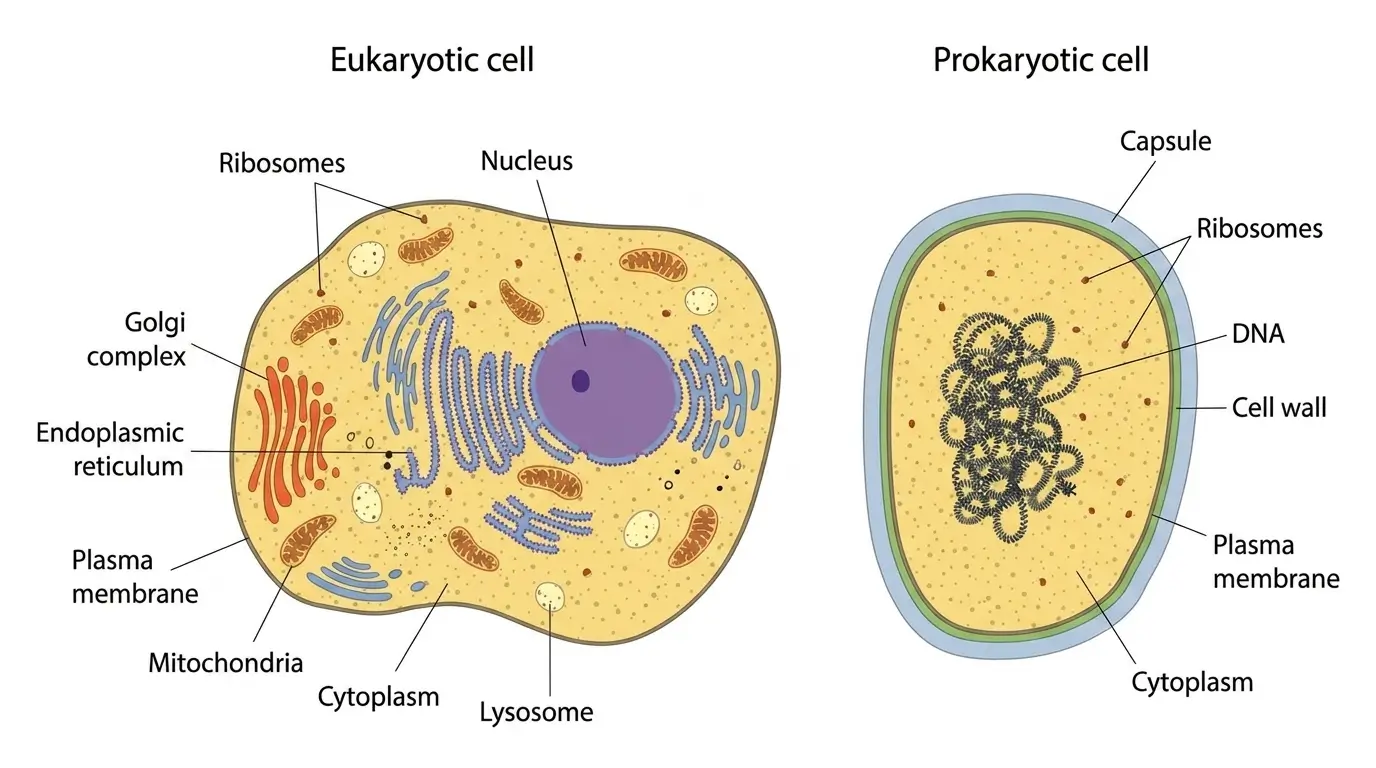
Every living thing on Earth is built from cells, but not all cells are built the same way. I ask my classes this every year: is a bacterium built the same way as a cell in your own body? Almost everyone guesses yes. The real answer is no, and the difference between prokaryotic and eukaryotic cells is one of the biggest dividing lines in all of Biology.
Once you understand the difference between prokaryotic and eukaryotic cells, you can explain why bacteria are so different from animal and plant cells, why antibiotics work on infections without harming your own body, and why some organisms are single celled while others are made of trillions of cells working together.
This guide walks through the difference between prokaryotic and eukaryotic cells step by step, with a comparison table, a diagram, real examples and a memory trick that has stuck with my students long after the exam.
Quick Verdict
Prokaryotic cells are small, simple cells with no nucleus, found only in bacteria and archaea. Eukaryotic cells are larger, more complex cells with a true nucleus, found in animals, plants, fungi and protists. The nucleus is the single biggest clue: no nucleus means prokaryotic, a nucleus means eukaryotic.
Prokaryotic and Eukaryotic Cells Comparison Table
| Feature | Prokaryotic Cells | Eukaryotic Cells |
|---|---|---|
| Nucleus | No true nucleus | True nucleus enclosed by a membrane |
| DNA arrangement | Single circular loop of DNA in the cytoplasm | Linear DNA organised into chromosomes inside the nucleus |
| Size | Very small, usually less than 1 to 5 micrometres | Much larger, usually 10 to 100 micrometres |
| Membrane-bound organelles | None | Many, including mitochondria and the nucleus itself |
| Plasmids | Often present as extra small rings of DNA | Not normally present |
| Examples | Bacteria and archaea | Animal cells, plant cells, fungi, protists |
| Complexity | Simple, single celled organisms only | Can be single celled or multicellular and complex |
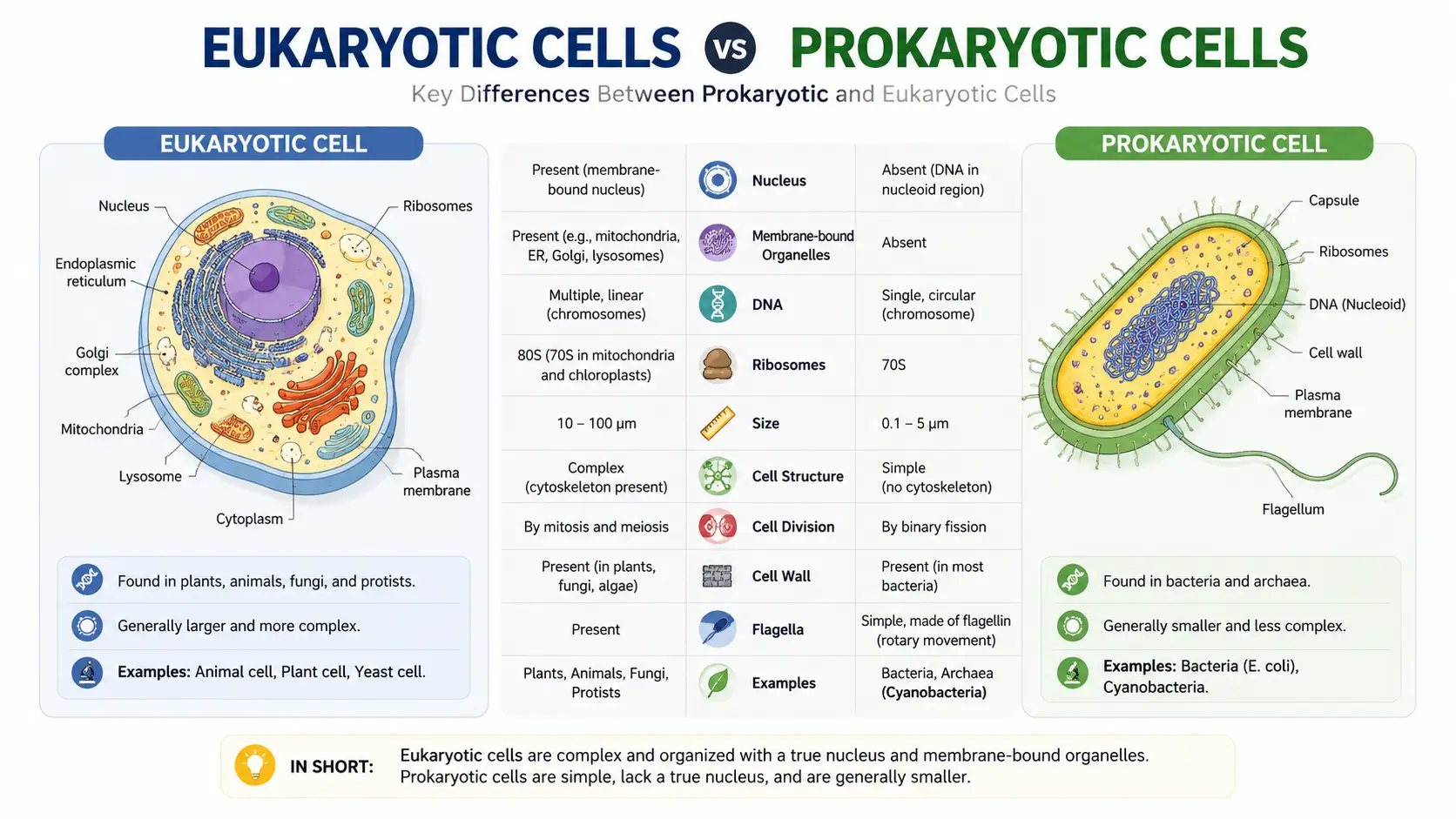
What Is a Prokaryotic Cell?
A prokaryotic cell is a simple type of cell that has no nucleus. Instead of being enclosed in a membrane, the genetic material floats freely inside the cytoplasm in an area called the nucleoid.
Prokaryotic cells are found only in two groups of organisms: bacteria and archaea. Both are always single celled, meaning the entire organism is made from just one prokaryotic cell.
Prokaryotic cells still have the basics needed for life, including a cell membrane, cytoplasm and ribosomes, and most also have a protective cell wall. Some carry small circular rings of extra DNA called plasmids, which is one of the details examiners like to test.
What Is a Eukaryotic Cell?
A eukaryotic cell is a more complex type of cell that has a true nucleus, where the DNA is safely enclosed inside its own membrane. This is the defining feature that separates eukaryotic cells from prokaryotic cells.
Eukaryotic cells are found in animals, plants, fungi and protists. Some eukaryotic organisms are single celled, like amoeba, but many, including humans, are multicellular and made of trillions of cooperating eukaryotic cells.
Inside a eukaryotic cell you will find several membrane-bound organelles, including mitochondria, which release energy, and in plant cells, chloroplasts, which carry out photosynthesis. This internal organisation is what allows eukaryotic cells to carry out far more complex functions than prokaryotic cells.
The Key Differences Explained
The single biggest difference between prokaryotic and eukaryotic cells is the nucleus. Prokaryotic cells have no nucleus at all, while eukaryotic cells keep their DNA safely enclosed inside one. This one feature is where the two names come from: “pro” relates to being before a nucleus existed, and “eu” relates to having a true nucleus.
Size is another major clue. Prokaryotic cells are tiny, often under 5 micrometres, while eukaryotic cells are usually ten times larger or more. If you are ever unsure in an exam which cell is which, size alone is often a reliable hint.
The final major difference is internal organisation. Eukaryotic cells are packed with membrane-bound organelles that each carry out a specific job, almost like separate rooms in a house. Prokaryotic cells have no such internal rooms, so all of their chemical reactions happen freely within one open space.
Why This Difference Matters in Medicine
Understanding the difference between prokaryotic and eukaryotic cells is not just an exam topic, it explains how many medicines actually work. Many antibiotics are designed to target structures found only in prokaryotic cells, such as their cell wall or their type of ribosome.
Because human cells are eukaryotic and do not share these exact structures, antibiotics can attack bacterial infections without seriously damaging our own cells. This is precisely why antibiotics are effective against bacterial infections but completely useless against viruses, which are not cells at all.
Real World Example
Penicillin is a real world example of the difference between prokaryotic and eukaryotic cells in action. Penicillin works by stopping bacteria from building their cell wall properly. Because human cells are eukaryotic and do not have a cell wall at all, penicillin can destroy bacterial infections without harming the eukaryotic cells that make up your own body.
Memory Trick
Remember it as “PRO comes before, EU has it enclosed.” PROkaryotic means before a proper nucleus existed, so there is no nucleus. EUkaryotic contains the letters of “enclosed,” a reminder that the DNA is enclosed inside a true nucleus. If you can recall those two word links, you can work out almost every other difference between prokaryotic and eukaryotic cells in the exam.
Test Yourself: Prokaryotic and Eukaryotic Cells Quiz
1. Which type of cell has no nucleus?
2. Which of these is a prokaryotic organism?
3. Which type of cell is generally larger?
4. Where is DNA found in a prokaryotic cell?
Common Mistakes Students Make
The most common mistake students make with the difference between prokaryotic and eukaryotic cells is assuming prokaryotic simply means “small version of a normal cell.” Prokaryotic cells are not a smaller copy of eukaryotic cells, they are a completely different type of cell with no nucleus at all.
Another common mistake is forgetting that plant and animal cells are both eukaryotic. Students sometimes think only animal cells count as eukaryotic, but fungi, plants and protists are eukaryotic too.
Students also often mix up which cell type has plasmids. Plasmids are typically found in prokaryotic cells, not eukaryotic ones, and this is a detail examiners frequently test directly.
Frequently Asked Questions
What is the main difference between prokaryotic and eukaryotic cells?
The main difference between prokaryotic and eukaryotic cells is the nucleus. Prokaryotic cells have no true nucleus and their DNA floats freely in the cytoplasm, while eukaryotic cells have a true nucleus that encloses the DNA inside its own membrane.
Are bacteria prokaryotic or eukaryotic?
Bacteria are prokaryotic. Along with archaea, bacteria are the only organisms on Earth made of prokaryotic cells.
Are plant cells prokaryotic or eukaryotic?
Plant cells are eukaryotic. They contain a true nucleus along with other membrane-bound organelles such as chloroplasts and mitochondria.
Why are prokaryotic cells smaller than eukaryotic cells?
Prokaryotic cells are smaller because they are simpler in structure and do not need to fit membrane-bound organelles inside them. Eukaryotic cells are larger because they contain multiple internal compartments, including the nucleus, mitochondria and other organelles.
Do prokaryotic cells have mitochondria?
No. Mitochondria are membrane-bound organelles, and prokaryotic cells do not contain any membrane-bound organelles. Only eukaryotic cells have mitochondria.
For more detail on cell structure and organelles, Khan Academy’s cell structure resources are a reliable place to continue your revision. You might also want to look at our guide to DNA and RNA to see how genetic material is packaged differently in these two cell types, or revisit Mitosis and Meiosis to see how eukaryotic cells divide.
Once you can confidently explain the difference between prokaryotic and eukaryotic cells, you have unlocked one of the foundation topics of GCSE Biology. Prokaryotic cells are the small, simple cells found only in bacteria and archaea, while eukaryotic cells are the larger, more organised cells found in everything from a single amoeba to the trillions of cells that make up your own body.
Keep the “PRO comes before, EU has it enclosed” memory trick close at hand during revision, work through the quiz above until every answer feels automatic, and this topic will become one of the most reliable marks you can pick up in the exam.

1 thought on “Difference Between Prokaryotic and Eukaryotic Cells With Diagram: 6 Essential Facts That Are Surprisingly Easy to Master”
Comments are closed.