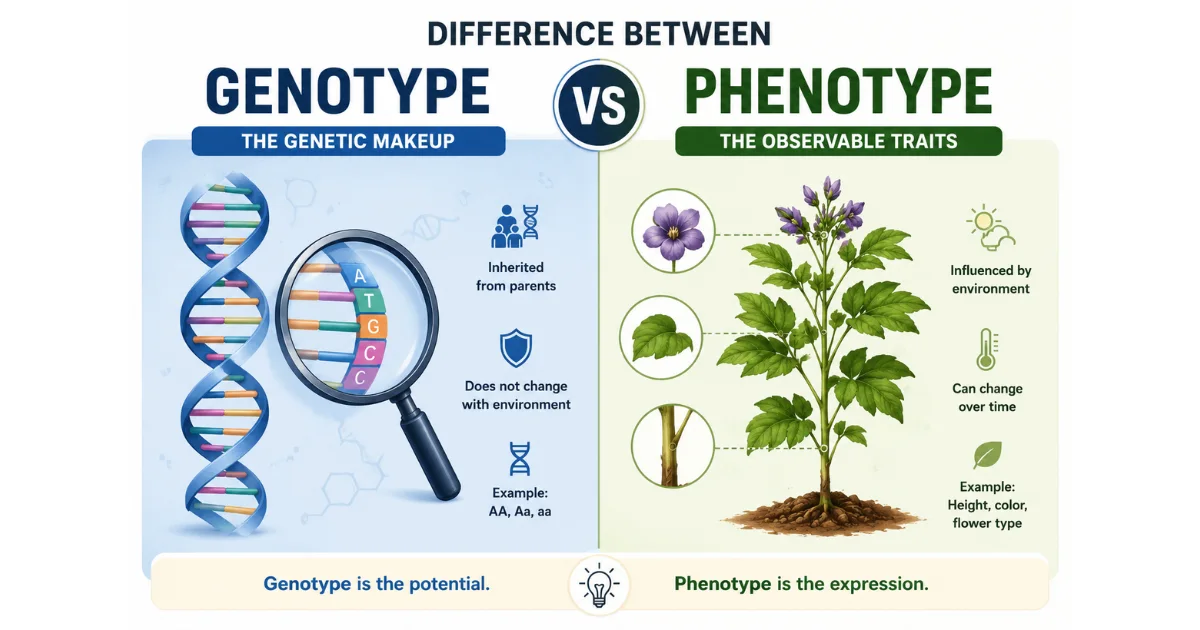
Two students can have completely different eye colours, heights and skin tones, yet still share genes for the exact same conditions without ever showing it. This is where genetics starts to feel confusing, and it all comes down to the difference between genotype and phenotype.
Genotype and phenotype sound similar and are easy to mix up under exam pressure, but they describe two completely different things. One is about the genetic code hidden inside your cells. The other is about the physical traits you can actually see.
This guide breaks the difference between genotype and phenotype down clearly, with a comparison table, a diagram, real examples and a memory trick to help both terms stay separate in your mind before the exam.
Quick Verdict
Genotype is the actual genetic code an organism carries, made up of the alleles inherited from its parents. Phenotype is the observable result of that genetic code, such as physical appearance or characteristics. Genotype is the instruction written in the genes, and phenotype is what those instructions actually produce.
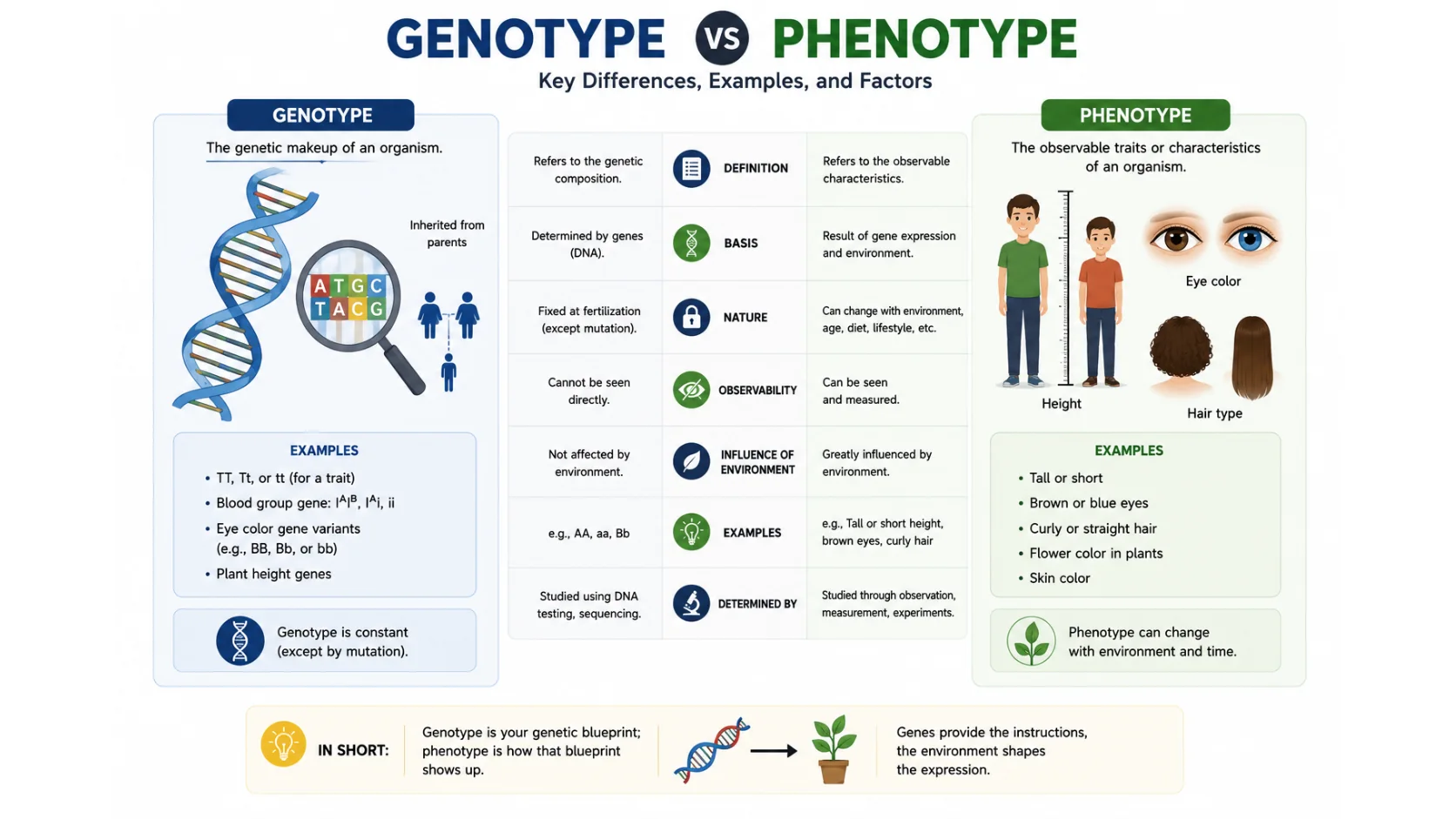
Genotype and Phenotype Comparison Table
| Feature | Genotype | Phenotype |
|---|---|---|
| Definition | The genetic makeup of an organism, made up of its alleles | The observable characteristics produced by that genetic makeup |
| Can you see it directly? | No, it must be determined through genetic testing or breeding | Yes, it can usually be observed directly |
| Example notation | Written using letters, e.g. Bb or bb | Described in words, e.g. brown eyes or blue eyes |
| Influenced by environment | Not directly changed by environment | Can be influenced by both genotype and environment |
| Example | Bb (one dominant, one recessive allele) | Brown eyes (the trait that is actually expressed) |
What Is a Genotype?
A genotype is the actual genetic makeup of an organism, made up of the specific alleles it carries for a particular gene. Every individual inherits one allele from each parent, so a genotype is usually written as a pair of letters, such as Bb or bb.
A capital letter represents a dominant allele, and a lowercase letter represents a recessive allele. If an organism has two identical alleles, its genotype is described as homozygous. If it has two different alleles, its genotype is described as heterozygous.
Genotype cannot usually be seen just by looking at an organism. It has to be worked out through genetic testing, breeding experiments, or by studying family patterns of inheritance across generations.
What Is a Phenotype?
A phenotype is the observable characteristic that results from an organism’s genotype. This includes physical traits such as eye colour, height, flower colour or blood type, essentially anything about an organism that can actually be seen or measured.
Phenotype is the visible outcome of genotype, but it is not always a perfect reflection of it. If an organism is heterozygous, carrying one dominant and one recessive allele, the phenotype will usually show only the dominant trait, even though the recessive allele is still present in the genotype.
Some phenotypes are also influenced by environmental factors, not genotype alone. A plant might carry the genotype for tall growth, but poor soil, limited sunlight or lack of water can still result in a shorter phenotype than the genotype alone would predict.
The Key Differences Explained
The core difference between genotype and phenotype is that genotype is the code, while phenotype is the outcome. Genotype exists at the level of DNA and alleles, hidden inside every cell. Phenotype exists at the level of the whole organism, visible in its appearance and behaviour.
This distinction matters most clearly with dominant and recessive alleles. Two organisms can have different genotypes, such as BB and Bb, but still share the exact same phenotype, because the dominant allele produces the same visible trait in both cases.
Phenotype can also be shaped by more than genotype alone. While genotype is fixed at conception and does not change due to environment, phenotype can shift based on diet, climate, lifestyle and other external factors acting on top of the underlying genetic code.
Why This Difference Matters for Genetic Crosses
Understanding the difference between genotype and phenotype is essential for genetic crosses and Punnett squares, one of the most heavily tested skills in GCSE Biology genetics. A Punnett square predicts the possible genotypes of offspring, but the exam almost always asks you to then work out the resulting phenotypes too.
For example, crossing two heterozygous pea plants (Bb x Bb) predicts a 3:1 ratio of genotypes carrying at least one dominant allele to genotypes with two recessive alleles. Because the dominant allele masks the recessive one, this translates into a 3:1 ratio of dominant phenotype to recessive phenotype among the offspring, even though the underlying genotype ratio is actually 1:2:1.
Real World Examples
Mendel’s pea plant experiments are the classic example used to introduce genotype and phenotype, where purple flower colour is dominant over white. A pea plant with the genotype Pp still shows the purple phenotype, even though it carries a hidden recessive allele for white flowers.
Human blood type is another real world example, controlled by three alleles: A, B and O. A person with the genotype IAIO has the phenotype blood type A, because the A allele is dominant over the O allele, even though the O allele is still present in their genetic code.
Memory Trick
Remember it as “GenoType is the Type of code, PhenoType is what you Physically see.” GENOtype relates to the GENetic code itself, hidden inside the cell. PHENOtype starts similarly to “physical,” a reminder that it describes what you can physically observe. If you link genotype to code and phenotype to physical appearance, the difference between genotype and phenotype becomes far easier to recall.
Test Yourself: Genotype and Phenotype Quiz
1. Which term describes the observable characteristics of an organism?
2. What does the genotype Bb represent?
3. Can phenotype be influenced by the environment?
4. In a Bb pea plant, which allele determines the phenotype if B is dominant?
Common Mistakes Students Make
The most common mistake students make with the difference between genotype and phenotype is assuming the two always match up in an obvious way. A heterozygous genotype like Bb produces the same phenotype as a homozygous genotype like BB, which often catches students out in exam questions.
Another common mistake is forgetting that phenotype can be shaped by environment as well as genotype. A plant’s genotype might code for tall growth, but poor conditions can still produce a shorter phenotype than expected.
Students also sometimes write phenotype using letters instead of words. Genotype should be written using letters, such as Bb, while phenotype should be described in words, such as “brown eyes” or “purple flowers,” since examiners specifically check for this distinction.
Frequently Asked Questions
What is the main difference between genotype and phenotype?
The main difference between genotype and phenotype is that genotype is the genetic code an organism carries, made up of its alleles, while phenotype is the observable trait that results from that genetic code.
Can two organisms have the same phenotype but different genotypes?
Yes. A BB genotype and a Bb genotype can both produce the same dominant phenotype, since only one dominant allele is needed for the dominant trait to be expressed.
Is phenotype always determined only by genotype?
No. While genotype plays the main role, phenotype can also be influenced by environmental factors such as diet, climate and living conditions, especially for traits like height or weight.
How do you write a genotype correctly?
Genotype is usually written as a pair of letters, with a capital letter representing a dominant allele and a lowercase letter representing a recessive allele, such as Bb or bb.
Why is understanding genotype and phenotype important for Punnett squares?
Punnett squares predict the possible genotypes of offspring from a genetic cross, but exam questions almost always ask you to then work out the resulting phenotypes, so understanding both terms is essential to answer fully.
For more detail on genetic inheritance, Khan Academy’s heredity resources are a reliable place to continue your revision. You might also want to look at our guide to DNA and RNA to see how genetic information is stored and copied, or revisit Prokaryotic and Eukaryotic Cells to see how genetic material is organised differently across cell types.
Once you can confidently explain the difference between genotype and phenotype, genetic crosses and Punnett square questions become far more manageable. Genotype is the hidden genetic code written in alleles, and phenotype is the visible trait that code produces once it is expressed.
Keep the “GenoType is the Type of code, PhenoType is what you Physically see” memory trick close at hand during revision, work through the quiz above until every answer feels automatic, and always show both the genotype and the phenotype clearly when answering genetic cross questions in the exam.

1 thought on “Difference Between Genotype and Phenotype With Diagram: Master 4 Fascinating Clues Hidden in Your Genes”
Comments are closed.