If you have ever looked at a Biology textbook and seen the letters DNA and RNA sitting next to each other and wondered why there are two different molecules doing what seems like the same job, you are not alone. I have taught this topic to GCSE classes for over a decade, and it is one of the first genuine “lightbulb moment” topics in the whole course.
The difference between DNA and RNA is not just about spelling. These two molecules are built differently, they are shaped differently, and they do different jobs inside your cells. Once you understand the difference between DNA and RNA, whole sections of genetics, protein synthesis and inheritance suddenly make a lot more sense.
This guide breaks the difference between DNA and RNA down step by step, with a comparison table, a diagram, real examples and a memory trick that has helped hundreds of my students remember it in the exam.
Quick Verdict
DNA is a double-stranded molecule that stores genetic information permanently in the nucleus, while RNA is a single-stranded molecule that copies and carries that information out of the nucleus so proteins can be made. DNA is the permanent library copy. RNA is the working photocopy that gets used and discarded.
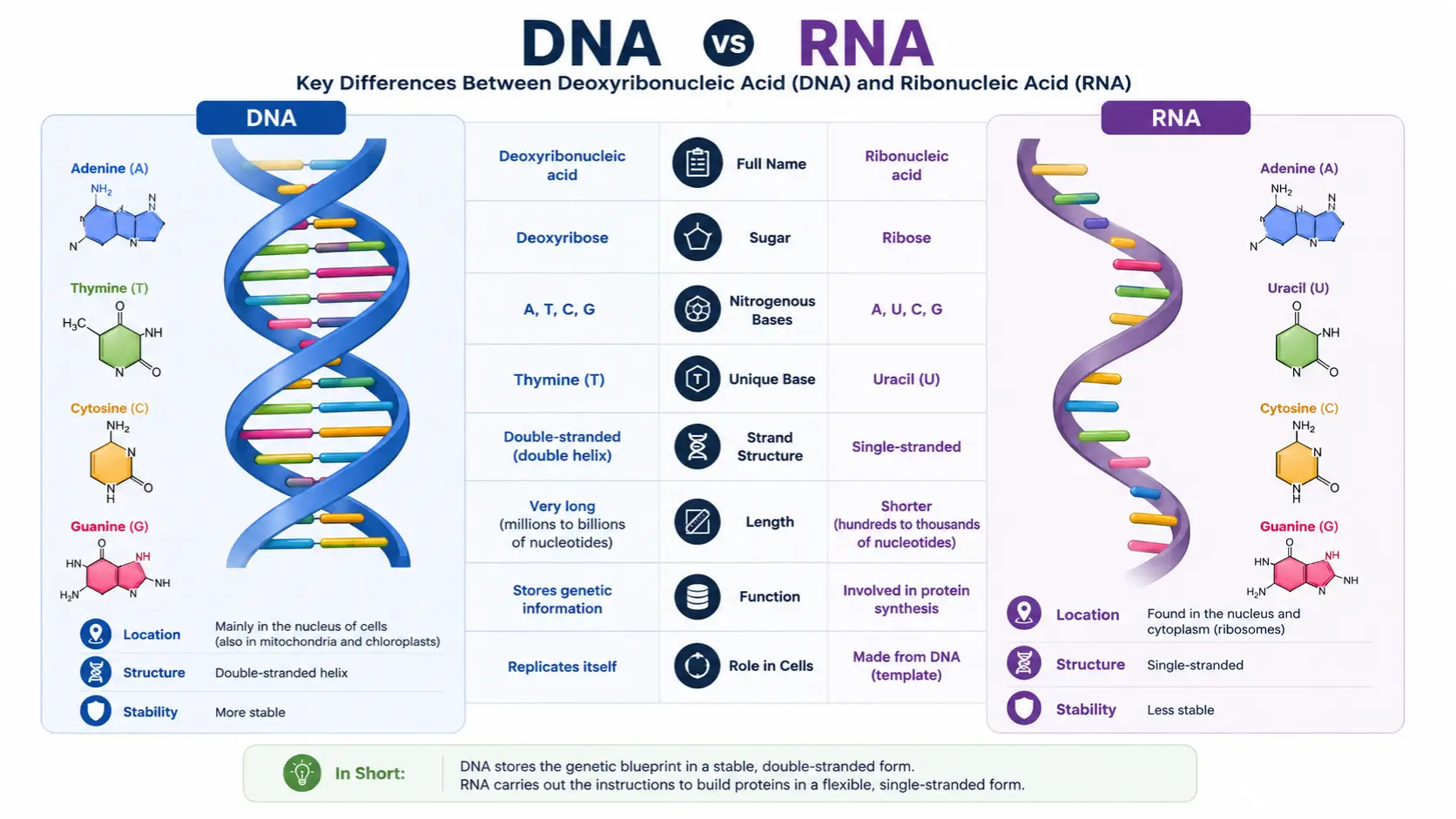
DNA and RNA Comparison Table
| Feature | DNA | RNA |
|---|---|---|
| Full name | Deoxyribonucleic acid | Ribonucleic acid |
| Number of strands | Double stranded (a double helix) | Single stranded |
| Sugar in the backbone | Deoxyribose | Ribose |
| Bases used | Adenine, Thymine, Guanine, Cytosine | Adenine, Uracil, Guanine, Cytosine |
| Main location | Nucleus, stays inside | Made in the nucleus, moves into the cytoplasm |
| Main job | Stores genetic information long term | Carries and translates genetic information to build proteins |
| Stability | Very stable, built to last a lifetime | Short lived, broken down after use |
What Is DNA?
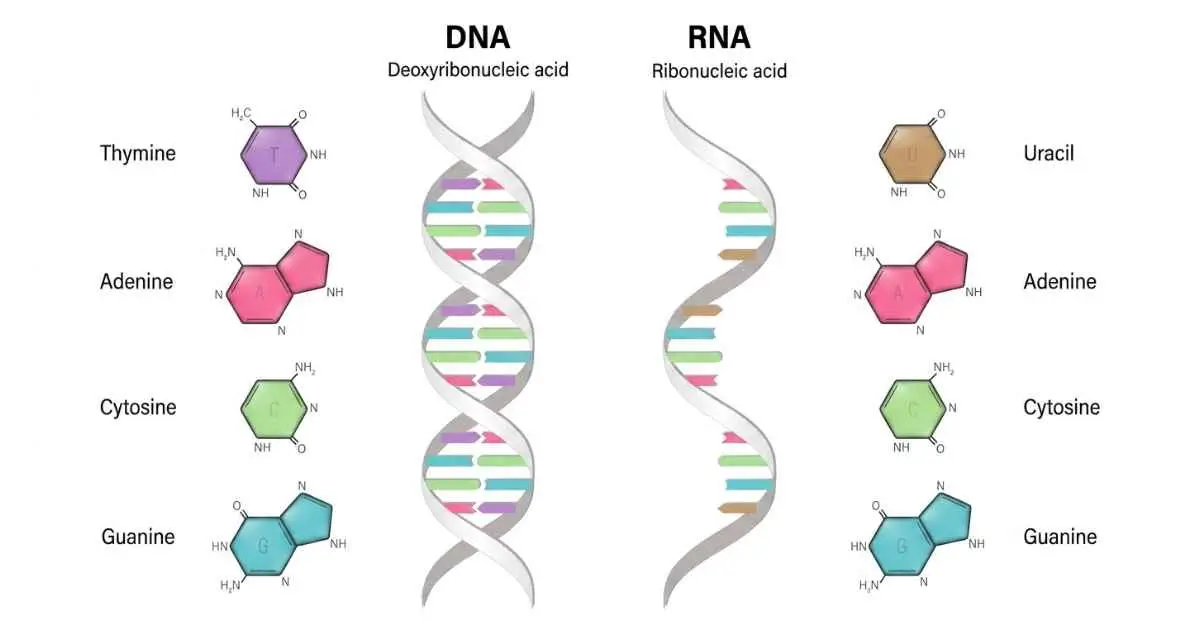
DNA stands for deoxyribonucleic acid, and it is the molecule that holds every genetic instruction your body needs, from eye colour to how your cells repair themselves. DNA is shaped like a twisted ladder, known as a double helix, made up of two strands that wind around each other.
Each strand is built from repeating units called nucleotides, and each nucleotide contains a sugar called deoxyribose, a phosphate group, and one of four bases: adenine, thymine, guanine and cytosine. The two strands of DNA are held together by base pairing, where adenine always pairs with thymine, and guanine always pairs with cytosine.
DNA stays inside the nucleus of the cell where it is protected, because it needs to last for the entire life of the cell and be passed on accurately when cells divide. This is the single biggest reason the difference between DNA and RNA matters: DNA is designed for permanent, secure storage.
What Is RNA?
RNA stands for ribonucleic acid, and its job is completely different from DNA’s. Instead of storing information, RNA carries it. RNA is single stranded rather than double stranded, and it uses a sugar called ribose instead of deoxyribose. RNA also uses a different base: instead of thymine, RNA uses uracil, which pairs with adenine in the same way thymine does in DNA.
When your body needs to make a protein, a section of DNA is copied into a strand of messenger RNA (mRNA) inside the nucleus. That mRNA strand then leaves the nucleus and travels into the cytoplasm, where it is read by a ribosome and used as the instructions to build a specific protein. Once that job is done, the RNA strand is broken down and recycled.
This is the core of the difference between DNA and RNA: DNA sits safely in the archive, while RNA does the active, temporary work of getting instructions where they need to go.
The Key Structural Differences Explained
Three structural features drive almost every other difference between DNA and RNA. The first is the number of strands. DNA is double stranded, which gives it strength and stability, similar to how a twisted rope is stronger than a single thread. RNA is single stranded, which makes it more flexible but also more fragile and short lived.
The second is the sugar. DNA contains deoxyribose, which is missing one oxygen atom compared to the ribose found in RNA, and this small chemical difference makes DNA more chemically stable over long periods.
The third is the bases. DNA uses thymine, while RNA replaces thymine with uracil. Examiners love testing this specific point, because it is easy to forget under exam pressure which molecule uses which base.
Why the Difference Between DNA and RNA Matters for Protein Synthesis
Understanding the difference between DNA and RNA becomes essential once you study protein synthesis, sometimes called gene expression. DNA never leaves the nucleus, so it cannot travel to the ribosomes where proteins are actually built. This is where RNA becomes essential.
In a process called transcription, an enzyme reads a gene on the DNA strand and builds a matching strand of messenger RNA. That mRNA then carries the genetic code out of the nucleus to a ribosome, where a process called translation reads the code in groups of three bases, called codons, and links amino acids together to build a protein.
Without RNA acting as the messenger, the instructions locked inside DNA could never reach the machinery that actually builds anything. This is why students who understand the difference between DNA and RNA early find protein synthesis far easier to learn later on.
Types of RNA You Need to Know
Not all RNA does the same job, which is another reason the difference between DNA and RNA runs deeper than a simple structure comparison. Messenger RNA, or mRNA, carries the genetic code from the DNA in the nucleus to the ribosome. Transfer RNA, or tRNA, carries individual amino acids to the ribosome and matches them to the correct codon on the mRNA strand. Ribosomal RNA, or rRNA, forms part of the structure of the ribosome itself, the site where proteins are actually assembled. Each type of RNA has a specific, temporary role, while DNA remains the single, permanent source of the original instructions for all of them.
Real World Example
The mRNA vaccines used during recent global health efforts are a perfect real world example of the difference between DNA and RNA in action. Scientists did not need to alter a patient’s DNA at all. Instead, they delivered a small strand of messenger RNA that carried instructions for cells to briefly build a harmless piece of a virus, training the immune system to recognise it. Because RNA breaks down naturally after use, the instructions simply disappeared once the job was done, exactly the way RNA behaves inside your own body every day.
Memory Trick
Remember it with “D is for Double, Deep in the nucleus. R is for Roaming, off to the Ribosome.” DNA is Double stranded and stays Deep inside the cell. RNA Roams out to the Ribosome to get the job done. If you can remember those two Ds and two Rs, you can work out almost every other difference between DNA and RNA in the exam.
Test Yourself: DNA and RNA Quiz
1. Which molecule is single stranded?
2. Which base does RNA use instead of thymine?
3. Where does DNA normally stay?
4. Which type of RNA carries amino acids to the ribosome?
Common Mistakes Students Make
The most common mistake students make with the difference between DNA and RNA is mixing up which molecule uses thymine and which uses uracil. Remember, DNA has Thymine, and both words start close together in the alphabet as a small reminder.
Another common mistake is assuming RNA is simply “a smaller version of DNA.” RNA is not a smaller copy, it is a chemically different molecule with a different sugar, a different base, and a different number of strands.
Students also sometimes think DNA leaves the nucleus during protein synthesis. It does not. DNA stays put, and RNA is the molecule that travels. Finally, many students forget that there are three types of RNA, not just one, and each has a different job in building a protein.
Frequently Asked Questions
What is the main difference between DNA and RNA?
The main difference between DNA and RNA is structure and function. DNA is double stranded and stores genetic information permanently in the nucleus, while RNA is single stranded and carries that information to the ribosome so proteins can be built.
Does RNA have thymine?
No. RNA does not contain thymine. It uses uracil instead, which pairs with adenine in the same way thymine does in DNA.
Is DNA or RNA found in the nucleus?
DNA is found in the nucleus and stays there. RNA is made in the nucleus during transcription but then moves out into the cytoplasm to be used.
Why is DNA double stranded but RNA is single stranded?
DNA needs to be extremely stable because it must be copied accurately and last for the entire life of a cell, and the double helix structure provides that stability. RNA only needs to exist temporarily to carry out one task, so a single strand is simpler and more efficient for its short-term role.
What are the three main types of RNA?
The three main types are messenger RNA (mRNA), which carries the genetic code from DNA to the ribosome, transfer RNA (tRNA), which brings amino acids to the ribosome, and ribosomal RNA (rRNA), which forms part of the ribosome’s structure.
For a deeper explanation of nucleotides and genetic coding, Khan Academy’s gene expression resources are a reliable place to continue your revision. You might also want to look at our guide to Mitosis and Meiosis to see how DNA is copied and divided during cell division, or revisit Mitochondria and Chloroplasts to see how other structures inside the cell support the work that DNA and RNA do.
Once you can confidently explain the difference between DNA and RNA, a huge part of GCSE Biology genetics opens up. DNA is the permanent instruction manual locked safely in the nucleus, and RNA is the messenger that gets those instructions out into the cell where they can actually be used.
Keep the “Double, Deep” and “Roaming, Ribosome” memory trick close at hand during revision, work through the quiz above until you get every answer right first time, and this topic will stop being something you dread and start being one of your most reliable exam answers.

2 thoughts on “Difference Between DNA and RNA With Diagram: 7 Essential Facts That Make Genetics Surprisingly Simple”
Comments are closed.