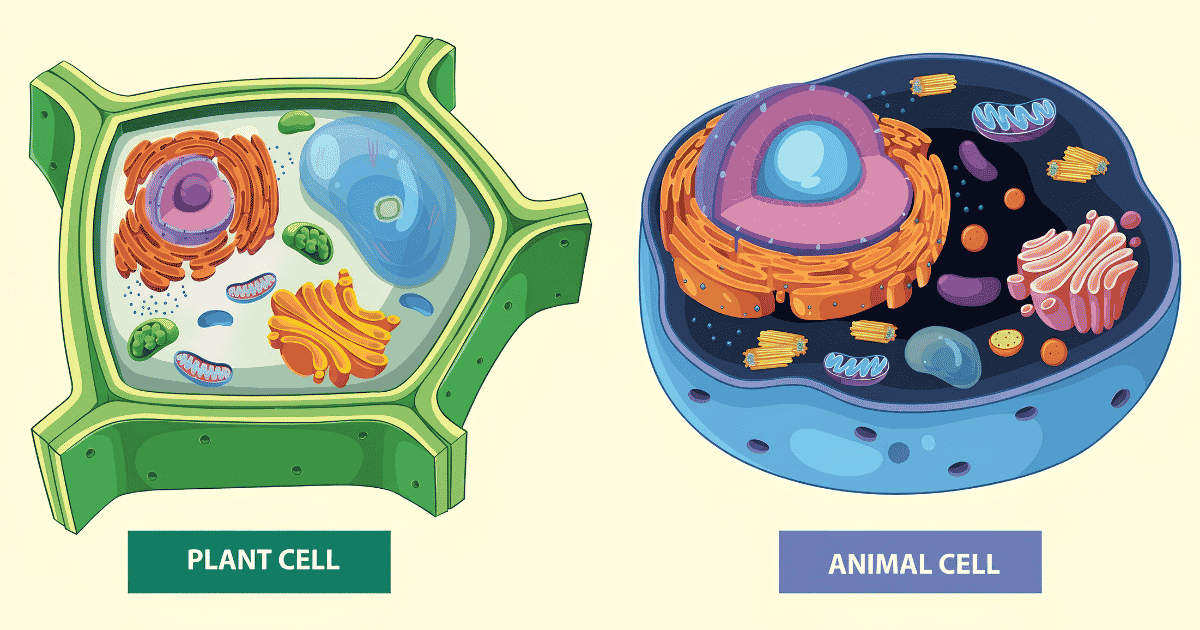
Every living cell needs energy to survive. But not every cell gets its energy the same way. Animal cells get their energy by breaking down food. Plant cells can do that too, but they can also make their own energy from sunlight. These two processes happen in two different organelles, and understanding the difference between mitochondria and chloroplasts is one of the most important topics in GCSE Biology. This guide explains both organelles clearly so you will never mix them up again.
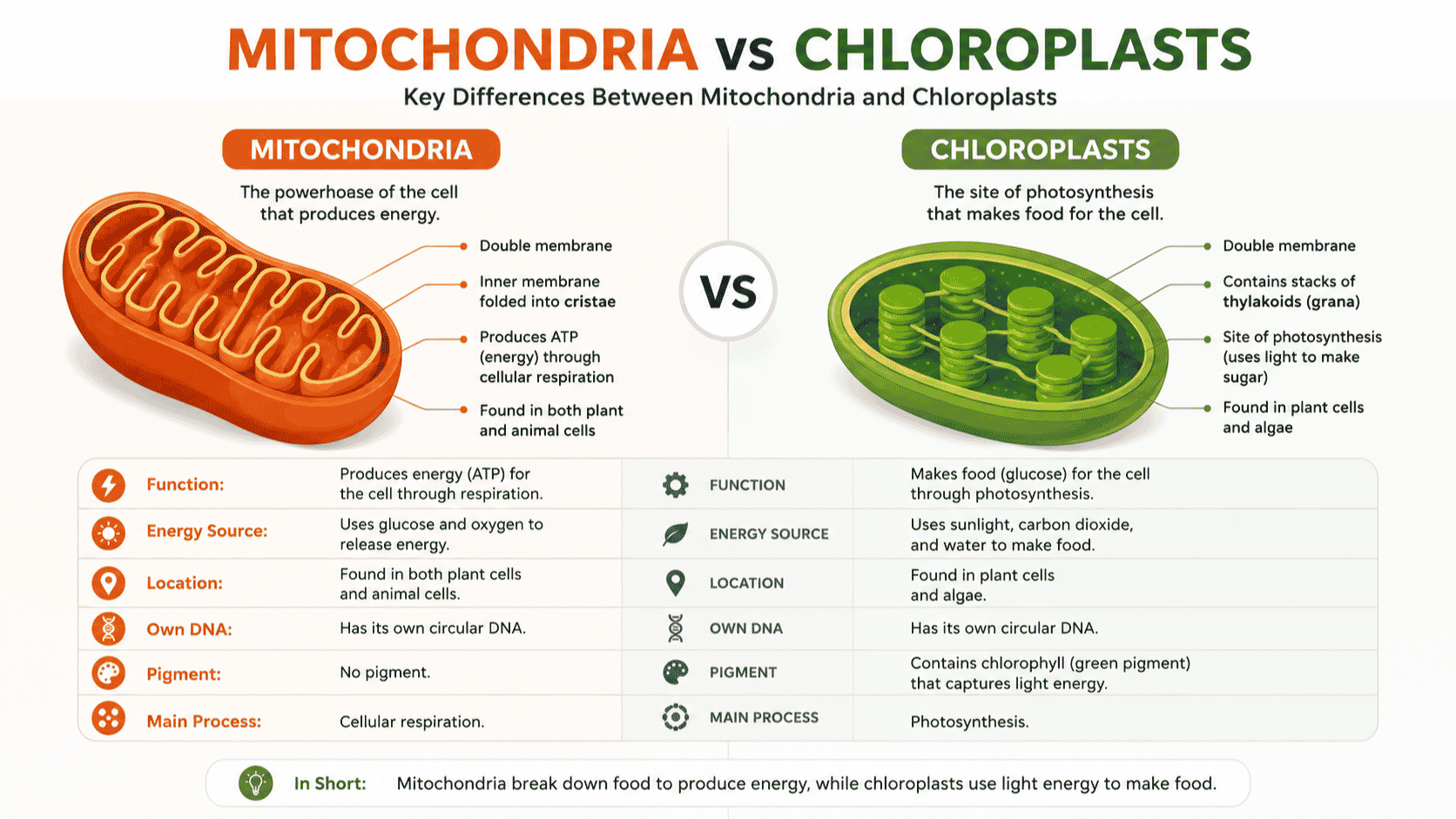
Mitochondria are organelles found in almost all living cells that produce energy through aerobic respiration, breaking down glucose and oxygen to release ATP. Chloroplasts are organelles found only in plant cells and algae that capture energy from sunlight and use it to make glucose through photosynthesis. Mitochondria release energy from food. Chloroplasts make food from sunlight.
Difference Between Mitochondria and Chloroplasts: Comparison Table
| Feature | Mitochondria | Chloroplasts |
|---|---|---|
| Function | Produce energy through aerobic respiration | Produce glucose through photosynthesis |
| Found in | Almost all eukaryotic cells, plant and animal | Only in plant cells and algae |
| What they use | Glucose and oxygen | Carbon dioxide, water, and light energy |
| What they produce | ATP (energy), carbon dioxide, water | Glucose and oxygen |
| Colour | No colour, transparent | Green, due to chlorophyll pigment |
| Size | 1 to 10 micrometres | Larger, 5 to 10 micrometres |
| Inner structure | Cristae, folded inner membrane | Thylakoids arranged in grana, stroma |
| Process name | Aerobic respiration | Photosynthesis |
| Energy input | Chemical energy from glucose | Light energy from the sun |
| When it works | All the time, day and night | Only when light is available |
What are Mitochondria?
To understand the difference between mitochondria and chloroplasts, start with mitochondria. Mitochondria are organelles found in almost all eukaryotic cells, including both plant and animal cells. Their main job is to produce energy in the form of ATP through the process of aerobic respiration.
Aerobic respiration in the mitochondria uses glucose and oxygen to release energy. The equation is:
Glucose + Oxygen → Carbon dioxide + Water + Energy (ATP)
The structure of a mitochondrion is designed to maximise the surface area available for the reactions of respiration. The inner membrane is folded into structures called cristae, which greatly increase the surface area where ATP is produced. The fluid-filled space inside is called the matrix, where the early stages of respiration take place.
Key facts about mitochondria for GCSE:
- Mitochondria are found in almost all eukaryotic cells, plant and animal
- They produce ATP, the energy currency of the cell
- They work all the time, day and night, as long as glucose and oxygen are available
- Cells with high energy demands, such as muscle cells and liver cells, have more mitochondria
- Mitochondria have their own DNA, suggesting they were once free-living bacteria that became incorporated into cells
What are Chloroplasts?
Chloroplasts are the other half of the difference between mitochondria and chloroplasts. Chloroplasts are organelles found only in plant cells and algae. Their job is to capture light energy from the sun and use it to make glucose through the process of photosynthesis.
Photosynthesis in the chloroplast uses carbon dioxide and water, plus light energy, to produce glucose and oxygen. The equation is:
Carbon dioxide + Water + Light energy → Glucose + Oxygen
Chloroplasts are green because they contain a pigment called chlorophyll, which absorbs light energy. Chlorophyll absorbs red and blue light most effectively and reflects green light, which is why plants look green to our eyes. Inside the chloroplast, thylakoids are disc-shaped structures containing chlorophyll. They are stacked in groups called grana. The fluid around the grana is called the stroma, where glucose is produced.
Key facts about chloroplasts for GCSE:
- Chloroplasts are found only in plant cells and algae, not in animal cells
- They contain chlorophyll, the green pigment that absorbs light
- They only work when light is available, so photosynthesis stops at night
- Chloroplasts produce glucose which the plant uses for energy and to build new cells
- Like mitochondria, chloroplasts have their own DNA
The Difference Between Mitochondria and Chloroplasts in Plant Cells
An important point about the difference between mitochondria and chloroplasts is that plant cells contain both organelles, while animal cells only contain mitochondria. This means plant cells can both make their own food through photosynthesis in the chloroplasts and release energy from that food through respiration in the mitochondria.
During the day, plant cells are doing both at the same time. The chloroplasts are producing glucose and oxygen through photosynthesis. The mitochondria are using some of that glucose to produce ATP through respiration. At night, when there is no light, photosynthesis stops but respiration continues. The plant uses stored glucose to keep producing energy through the night.
This is why the relationship between the two organelles is so important in plant biology. They work together as part of the plant’s complete energy system.
Example 1 – Muscle cells (Mitochondria):
Human muscle cells contain thousands of mitochondria because muscles need large amounts of energy to contract. When you exercise, your muscle cells demand more ATP and your mitochondria work harder, increasing the rate of aerobic respiration. Athletes who train regularly develop more mitochondria in their muscle cells over time, which is one reason trained athletes can sustain exercise for longer than untrained people.
Example 2 – Leaf cells (Chloroplasts):
The cells in a green leaf are packed with chloroplasts, particularly in the palisade mesophyll layer near the top of the leaf where light is strongest. A single palisade cell can contain up to 50 chloroplasts. The green colour you see in leaves is entirely due to the chlorophyll inside these chloroplasts. In autumn, as days shorten and temperatures drop, plants break down their chlorophyll, which is why leaves turn yellow, orange, and red before falling.
Example 3 – Sperm cells (Mitochondria only):
Sperm cells need large amounts of energy to swim towards an egg cell. They have a large number of mitochondria concentrated in the middle section of the tail to power this movement. Sperm cells have no chloroplasts because they are animal cells. This is a clear example of how mitochondria are found in animal cells while chloroplasts are not.
Example 4 – Algae (Both, in the same cell):
Algae are simple organisms that contain both mitochondria and chloroplasts, just like plant cells. The green colour of algae in ponds and lakes comes from the chlorophyll in their chloroplasts. Algae produce a significant proportion of the world’s oxygen through photosynthesis in their chloroplasts, and release energy for their own life processes through respiration in their mitochondria.
Example 5 – Root cells (Mitochondria only):
Root cells in plants contain mitochondria but no chloroplasts. This makes sense because roots grow underground where there is no light, so photosynthesis would be impossible. Root cells still need energy for active transport of minerals and for cell growth, so they rely entirely on mitochondria for their ATP supply. The glucose they use comes from the leaves, transported down through the phloem.
M for MUNCHING. C for COOKING.
Mitochondria – think of mitochondria as MUNCHING on glucose. They take glucose in and break it down to release energy. They consume food to make energy. M for Munching, M for Mitochondria.
Chloroplasts – think of chloroplasts as COOKING with sunlight. They use light energy to cook up glucose from carbon dioxide and water. They make food from scratch. C for Cooking, C for Chloroplasts.
Or use this: Mitochondria = powerhouse. Chloroplasts = kitchen. The kitchen makes the food. The powerhouse uses it to generate power. In a plant cell, the chloroplast kitchen makes glucose and the mitochondria powerhouse burns it for energy.
Quick Quiz: Mitochondria or Chloroplasts?
1. An organelle that produces ATP by breaking down glucose and oxygen. Is this a mitochondrion or a chloroplast?
2. A green organelle found only in plant cells that uses sunlight to make glucose. Is this a mitochondrion or a chloroplast?
3. Which organelle is found in both plant cells and animal cells?
4. Which organelle stops working at night when there is no light?
5. Root cells underground need energy but cannot photosynthesise. Which organelle provides their energy?
Difference Between Mitochondria and Chloroplasts in Exams
The difference between mitochondria and chloroplasts is tested regularly in GCSE Biology, particularly in questions on cell structure, photosynthesis, and respiration. Common exam questions ask you to compare the two organelles, explain why plant cells contain both while animal cells only contain one, or describe what would happen to a plant cell if its chloroplasts or mitochondria were removed. Always link the organelle to its process and the process to its equation.
Common Mistakes to Avoid
Saying photosynthesis happens in the mitochondria:
This is the most common mistake in GCSE Biology. Photosynthesis happens in the chloroplasts. Respiration happens in the mitochondria. Students often confuse the two because both organelles are involved in energy processes. Always link chloroplasts to photosynthesis and mitochondria to respiration in exam answers.
Saying plants do not respire:
Plants respire all the time, just like animals. They use their mitochondria to break down glucose and release ATP through aerobic respiration. The difference is that plants can also make their own glucose through photosynthesis in their chloroplasts. During the day, plants photosynthesise more than they respire, so they take in carbon dioxide overall. At night, only respiration continues.
Saying chloroplasts are found in all plant cells:
Chloroplasts are only found in plant cells that are exposed to light. Root cells, for example, have no chloroplasts because they grow underground where there is no light for photosynthesis. Only cells in green parts of the plant that receive light contain chloroplasts.
Frequently Asked Questions
What is the main difference between mitochondria and chloroplasts?
The main difference between mitochondria and chloroplasts is their function and location. Mitochondria produce energy by breaking down glucose through aerobic respiration and are found in almost all cells. Chloroplasts produce glucose by capturing light energy through photosynthesis and are found only in plant cells and algae. Mitochondria release energy from food. Chloroplasts make food from sunlight.
Why do plant cells have both mitochondria and chloroplasts?
Plant cells need both organelles because they serve completely different functions. Chloroplasts make glucose from sunlight during the day. Mitochondria convert that glucose into usable energy in the form of ATP, which the cell needs to carry out all its life processes. The two organelles work together as part of the plant’s complete energy system. Without mitochondria, the plant could not use the glucose its chloroplasts produce. Without chloroplasts, the plant would have to rely entirely on glucose from storage rather than making it fresh from sunlight.
Do mitochondria and chloroplasts have their own DNA?
Yes, both mitochondria and chloroplasts contain their own DNA, separate from the DNA in the cell nucleus. This is strong evidence for the endosymbiotic theory, which proposes that both organelles were once free-living bacteria that were engulfed by larger cells billions of years ago. Instead of being digested, they formed a mutually beneficial relationship with the host cell and eventually became permanent parts of it. This theory is widely accepted by scientists today.
Which has more in common, mitochondria and chloroplasts or mitochondria and the cell nucleus?
Surprisingly, mitochondria and chloroplasts have more in common with each other than either does with the cell nucleus. Both have their own DNA. Both have a double membrane. Both were likely once free-living bacteria. Both produce or process energy for the cell. The cell nucleus, by contrast, is the control centre of the cell and has a very different structure and function from either energy-related organelle.
For more on cell biology, visit BBC Bitesize Biology: Cell Structure.
Also read: Difference Between Photosynthesis and Respiration and Difference Between Aerobic and Anaerobic Respiration to build your complete understanding of GCSE Biology energy topics.
Once you understand the difference between mitochondria and chloroplasts, questions about cell structure and energy processes in your GCSE Biology exam become much more straightforward to answer with confidence.
