You use acids and bases every single day without thinking about it. The vinegar in your kitchen is an acid. The baking soda in your cupboard is a base. The shampoo you use is slightly alkaline. The lemon juice in your drink is acidic. Acids and bases are everywhere, and understanding the difference between acids and bases is one of the most fundamental topics in GCSE Chemistry. This guide explains both clearly with real examples so you can answer any exam question on this topic confidently.
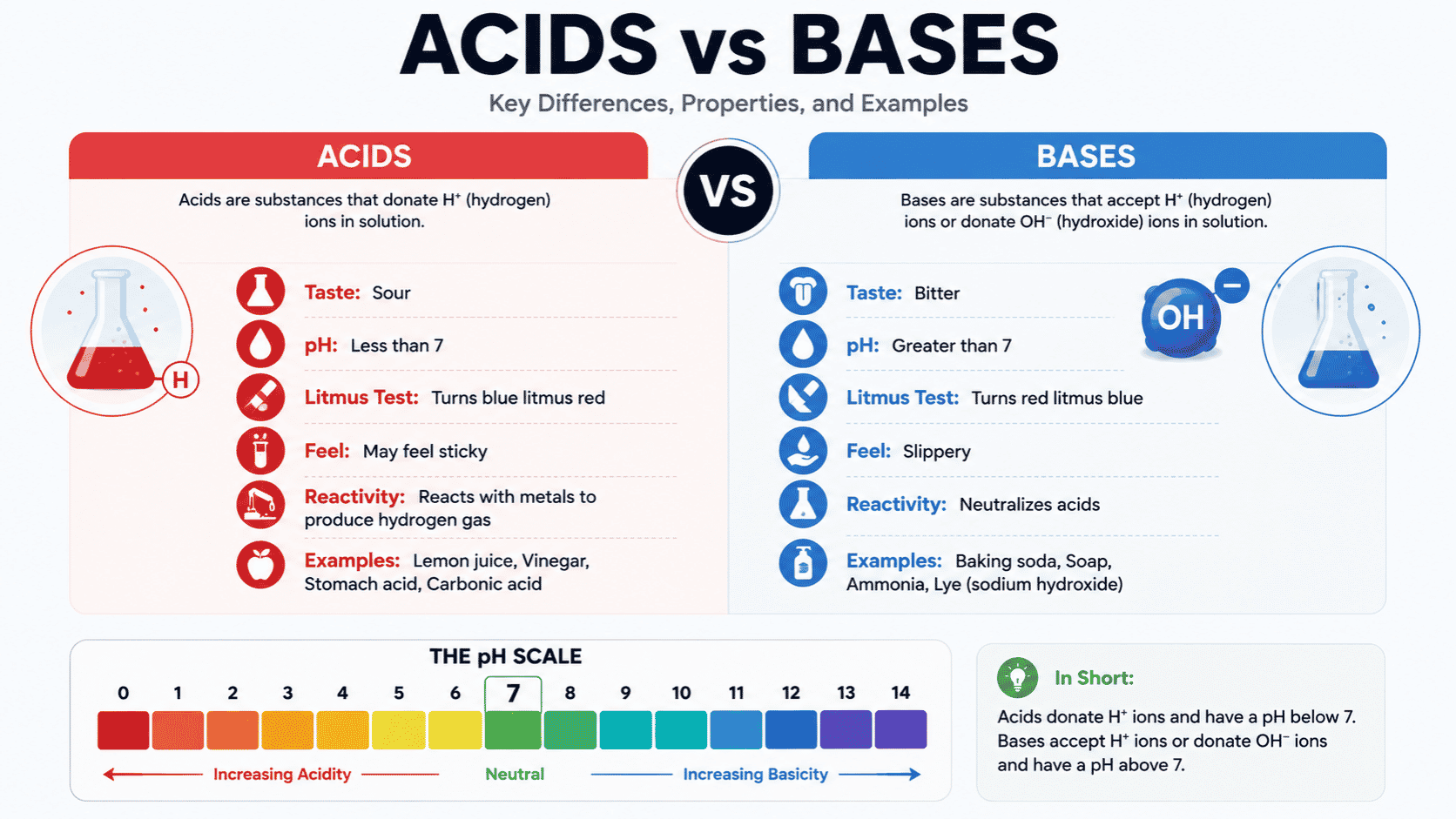
An acid is a substance that produces hydrogen ions (H+) when dissolved in water. A base is a substance that accepts hydrogen ions or produces hydroxide ions (OH-) when dissolved in water. Acids have a pH below 7. Bases have a pH above 7. When an acid and a base react together they neutralise each other, producing a salt and water.
Difference Between Acids and Bases: Comparison Table
| Feature | Acids | Bases |
|---|---|---|
| Definition | Produces H+ ions when dissolved in water | Accepts H+ ions or produces OH- ions in water |
| pH range | Below 7 | Above 7 |
| Taste | Sour | Bitter or soapy |
| Effect on litmus | Turns blue litmus red | Turns red litmus blue |
| Feel | Corrosive on skin | Slippery or soapy feel |
| Reaction with metals | Reacts with metals to produce hydrogen gas | Does not typically react with metals |
| Common examples | Hydrochloric acid, sulfuric acid, vinegar | Sodium hydroxide, ammonia, baking soda |
| Found in | Stomach, vinegar, lemon juice, batteries | Soap, bleach, oven cleaner, antacids |
What is an Acid?
To understand the difference between acids and bases, start with acids. An acid is a substance that releases hydrogen ions (H+) when dissolved in water. The more hydrogen ions an acid releases, the stronger the acid. Strong acids like hydrochloric acid and sulfuric acid release a large number of hydrogen ions and are highly corrosive. Weak acids like vinegar and citric acid release fewer hydrogen ions and are much less dangerous.
Key properties of acids:
- They have a pH below 7, with stronger acids having lower pH values
- They taste sour, like lemon juice or vinegar
- They turn blue litmus paper red
- They react with metals to produce hydrogen gas and a salt
- They react with carbonates to produce carbon dioxide gas, a salt, and water
- Strong acids are corrosive and can burn skin and damage materials
Common acids you need to know for GCSE:
- Hydrochloric acid (HCl) – found in the stomach to help digestion, used in industry
- Sulfuric acid (H2SO4) – used in car batteries and industrial processes, very strong and corrosive
- Nitric acid (HNO3) – used to make fertilisers
- Ethanoic acid (CH3COOH) – the acid in vinegar, a weak acid
- Citric acid – found in lemons and other citrus fruits, a weak acid
What is a Base?
A base is the other half of the difference between acids and bases. A base is a substance that accepts hydrogen ions or releases hydroxide ions (OH-) when dissolved in water. A base that dissolves in water is called an alkali. All alkalis are bases but not all bases are alkalis. For GCSE purposes, the terms base and alkali are often used interchangeably, but it is worth knowing the distinction.
Key properties of bases:
- They have a pH above 7, with stronger bases having higher pH values
- They taste bitter and feel soapy or slippery
- They turn red litmus paper blue
- They neutralise acids when mixed with them, producing a salt and water
- Strong bases like sodium hydroxide are corrosive and can cause serious burns
- They do not typically react with metals the way acids do
Common bases you need to know for GCSE:
- Sodium hydroxide (NaOH) – a strong base used in soap making and drain cleaners
- Potassium hydroxide (KOH) – used in batteries and soap making
- Ammonia (NH3) – a weak base used in cleaning products and fertilisers
- Calcium hydroxide (Ca(OH)2) – also called limewater, used to test for carbon dioxide
- Sodium bicarbonate (NaHCO3) – baking soda, a weak base used in cooking and antacids
The pH Scale and the Difference Between Acids and Bases
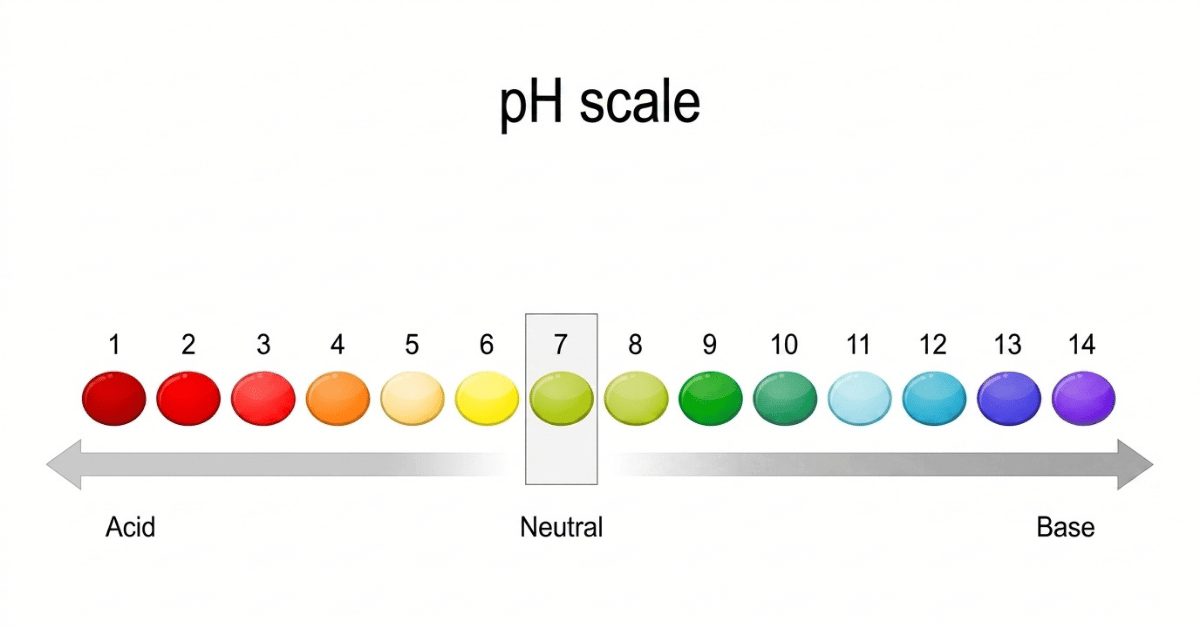
The pH scale is the key tool for understanding the difference between acids and bases in terms of strength. The pH scale runs from 0 to 14. A pH of 7 is neutral, which is pure water. Values below 7 are acidic and values above 7 are basic or alkaline.
The scale is logarithmic, which means each step represents a tenfold change in concentration of hydrogen ions. So a substance with pH 3 is ten times more acidic than a substance with pH 4, and a hundred times more acidic than a substance with pH 5.
Common pH values students need to know:
- pH 1-2 – strong acids, stomach acid, battery acid
- pH 3-4 – weak acids, vinegar, lemon juice, cola
- pH 5-6 – slightly acidic, rain water, black coffee
- pH 7 – neutral, pure water
- pH 8-9 – slightly alkaline, seawater, baking soda
- pH 10-11 – moderately alkaline, milk of magnesia, ammonia
- pH 12-14 – strong bases, bleach, oven cleaner, sodium hydroxide
Neutralisation: When Acids and Bases React
One of the most important reactions in GCSE Chemistry involves what happens when an acid and a base are mixed together. This is called neutralisation. When an acid and a base react, they cancel each other out, producing a salt and water. The pH of the resulting solution moves towards 7.
Acid + Base → Salt + Water
For example, when hydrochloric acid reacts with sodium hydroxide:
HCl + NaOH → NaCl + H2O
The salt produced depends on the acid and base used. Hydrochloric acid always produces chloride salts. Sulfuric acid always produces sulfate salts. Nitric acid always produces nitrate salts.
Example 1 – Stomach acid (Acid):
Your stomach produces hydrochloric acid to help digest food and kill bacteria. Stomach acid has a pH of around 1.5 to 2, making it one of the strongest acids your body encounters. When too much stomach acid is produced, it causes heartburn or acid reflux. Antacids, which are bases, are taken to neutralise the excess acid and relieve the discomfort. This is a real-life example of an acid-base neutralisation reaction happening inside your body.
Example 2 – Vinegar (Weak acid):
Vinegar is a solution of ethanoic acid in water, with a pH of around 2.5 to 3. It is a weak acid, which means it does not fully dissociate in water and is safe to consume in small quantities. Vinegar is used in cooking, food preservation, and cleaning. Its acidic nature allows it to dissolve mineral deposits and kill some bacteria, which is why it is an effective natural cleaner.
Example 3 – Baking soda (Weak base):
Sodium bicarbonate, commonly known as baking soda, is a weak base with a pH of around 8 to 9. In baking, it reacts with acidic ingredients like buttermilk or lemon juice in a neutralisation reaction that produces carbon dioxide gas, which makes cakes and bread rise. Baking soda is also used as an antacid to neutralise stomach acid and relieve indigestion.
Example 4 – Acid rain (Environmental acid):
When sulfur dioxide and nitrogen oxides from burning fossil fuels dissolve in rainwater, they form sulfuric acid and nitric acid, making the rain acidic with a pH of around 4 to 5. Acid rain damages ecosystems by acidifying lakes and rivers, killing fish and other aquatic life. It also corrodes buildings and statues made of limestone and marble, which are bases that react with the acid. This is the difference between acids and bases playing out on an environmental scale.
Example 5 – Soap (Base):
Soap is made by reacting fats or oils with a strong base such as sodium hydroxide in a process called saponification. The resulting soap is slightly alkaline with a pH of around 9 to 10. This alkalinity is what makes soap effective at removing grease and dirt. Acids would not work as well for cleaning because they do not break down the fats and oils that make up most dirt and grease.
Acids ADD hydrogen ions. Bases BORROW them.
Acids – think of the A in Acid as ADD. Acids ADD hydrogen ions (H+) to a solution. More H+ ions means lower pH and stronger acidity.
Bases – think of the B in Base as BORROW. Bases BORROW or accept hydrogen ions from a solution. Removing H+ ions means higher pH and stronger alkalinity.
For the litmus test, remember: Red to Blue, Base is True. Blue to Red, Acid instead. If litmus paper turns from red to blue, you have a base. If it turns from blue to red, you have an acid.
Quick Quiz: Acid or Base?
1. A substance with a pH of 2 that turns blue litmus red. Is this an acid or a base?
2. Sodium hydroxide has a pH of 13 and turns red litmus blue. Is it an acid or a base?
3. When you take an antacid tablet to relieve heartburn, what type of reaction is happening in your stomach?
4. Lemon juice has a sour taste and a pH of 2. Is lemon juice an acid or a base?
5. A substance produces hydroxide ions (OH-) when dissolved in water. Is this an acid or a base?
Difference Between Acids and Bases in Exams
The difference between acids and bases is one of the most tested topics in GCSE Chemistry. Common exam questions ask you to describe the properties of acids and bases, explain what happens during neutralisation, identify substances as acidic or basic based on their pH, or predict the products of acid-base reactions. Always include pH values, litmus test results, and the neutralisation equation in your answers for maximum marks.
Common Mistakes to Avoid
Confusing base and alkali:
All alkalis are bases but not all bases are alkalis. An alkali is specifically a base that dissolves in water to produce hydroxide ions. Some bases do not dissolve in water and so are not alkalis. For GCSE, you need to know that the terms are related but not identical. Sodium hydroxide is both a base and an alkali. Copper oxide is a base but not an alkali because it does not dissolve in water.
Forgetting the products of neutralisation:
When an acid reacts with a base, the products are always a salt and water. Many students forget to include water in their answer. The word equation is always: acid plus base gives salt plus water. Always write both products in exam answers.
Getting the litmus test the wrong way round:
Acids turn blue litmus red. Bases turn red litmus blue. Students frequently reverse this. Use the memory trick above to get it right every time: Red to Blue means Base is True. Blue to Red means Acid instead.
Frequently Asked Questions
What is the main difference between acids and bases?
The main difference between acids and bases is the ions they produce in water. Acids release hydrogen ions (H+) which lower the pH below 7. Bases release hydroxide ions (OH-) or accept hydrogen ions, which raises the pH above 7. When they meet, the H+ and OH- ions combine to form water, neutralising both substances.
What is the difference between a base and an alkali?
A base is any substance that accepts hydrogen ions or neutralises an acid. An alkali is a base that dissolves in water to produce hydroxide ions. All alkalis are bases but not all bases are alkalis. Sodium hydroxide and potassium hydroxide are both bases and alkalis. Copper oxide is a base but not an alkali because it does not dissolve in water.
Why is pure water neutral?
Pure water is neutral because it has a pH of exactly 7. Water molecules partially split into equal numbers of H+ and OH- ions, so neither ions are in excess. Because there is no excess of hydrogen ions or hydroxide ions, water is neither acidic nor basic. It sits exactly in the middle of the pH scale at 7.
Can something be both an acid and a base?
Yes. Some substances can act as either an acid or a base depending on what they are reacting with. These are called amphoteric substances. Water is the most common example. Water can donate a hydrogen ion (acting as an acid) or accept one (acting as a base) depending on the reaction. Amino acids are another example, which is relevant in biology as well as chemistry.
For more on acids and bases, visit BBC Bitesize Chemistry: Acids and Bases.
Also read: Difference Between Elements, Compounds and Mixtures and Difference Between Atoms and Molecules to build your complete understanding of GCSE Chemistry.
Once you understand the difference between acids and bases, questions about pH, neutralisation, and chemical reactions in your GCSE Chemistry exam become much more straightforward to answer with confidence.
