
You will come across facts and opinions every single day, in news articles, in textbooks, in social media posts, and in exam questions. Being able to tell them apart is one of the most practical skills you can have, and it comes up directly in GCSE English Language papers. Many students think they already know the difference, but they still lose marks in exams because they confuse the two. This guide explains the difference between fact and opinion clearly with examples you can use straight away.
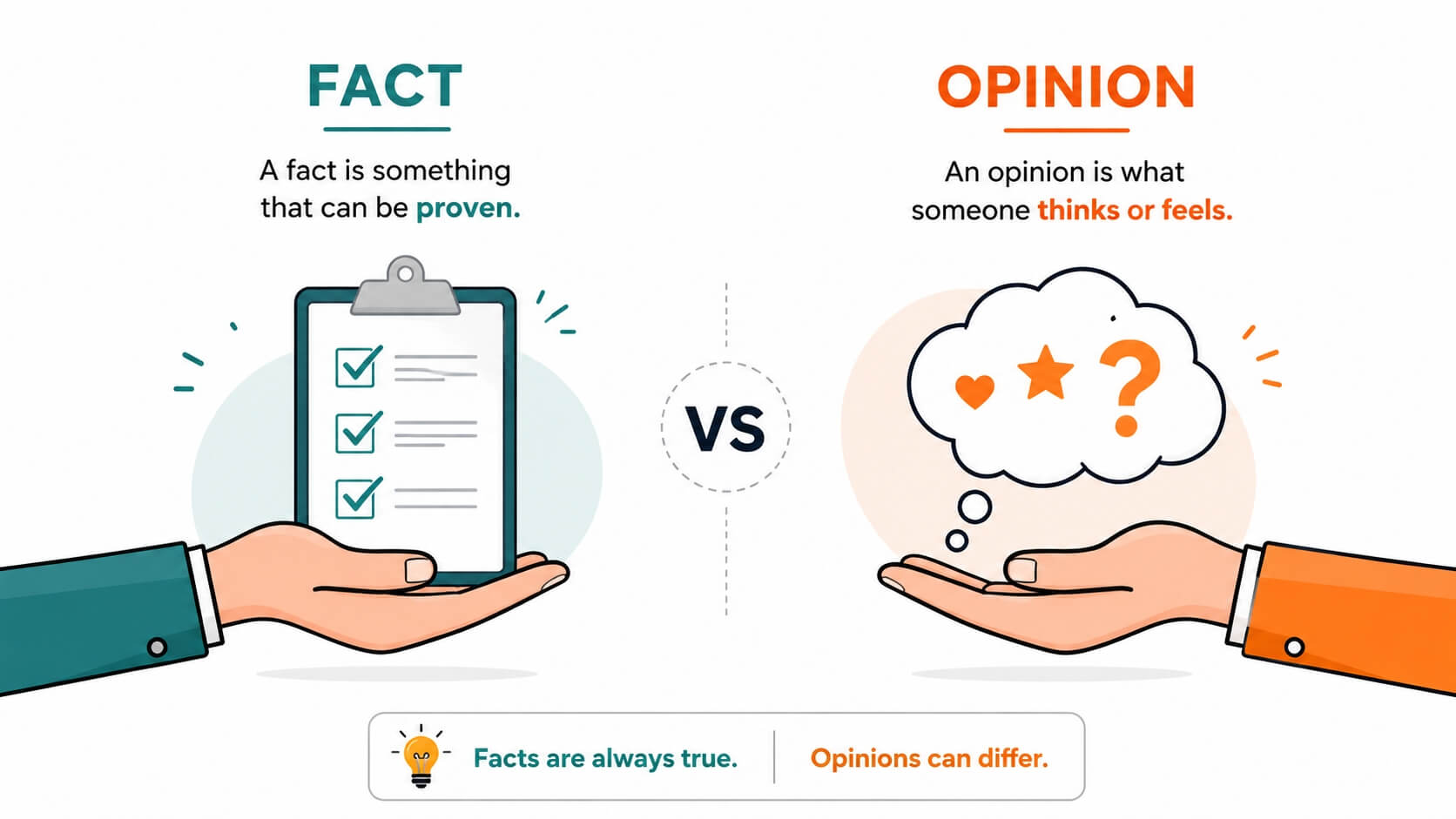
A fact is a statement that can be proven to be true or false using evidence. An opinion is a statement that expresses a personal belief, view, or judgement that cannot be proven true or false. Facts are objective. Opinions are subjective. The key test is always: can this be verified with evidence?
Difference Between Fact and Opinion: Comparison Table
| Feature | Fact | Opinion |
|---|---|---|
| Definition | A statement that can be proven true or false | A personal belief or judgement |
| Can it be proven | Yes, using evidence or data | No, it reflects personal views |
| Objective or subjective | Objective, the same for everyone | Subjective, varies between people |
| Can people disagree | No, facts are verifiable | Yes, people can hold different opinions |
| Language used | Precise, neutral, measurable | Evaluative words like best, worst, should, believe |
| Examples | Water boils at 100 degrees Celsius at sea level | Coffee tastes better than tea |
| In exam questions | Used to support arguments with evidence | Used to persuade or express a viewpoint |
What is a Fact?
To understand the difference between fact and opinion, start with facts. A fact is a statement that describes something that is objectively true and can be verified using evidence. It does not matter who you are or what you believe. A fact is the same for everyone.
Facts can be checked. You can look them up, measure them, test them, or observe them. If someone challenges a fact, you can prove it using evidence. This is what makes a fact different from an opinion.
Key features of a fact:
- It can be proven true or false using evidence
- It is objective, meaning it does not depend on personal feelings
- It uses precise, neutral language such as numbers, dates, and measurements
- Everyone who checks the evidence will reach the same conclusion
- It can come from research, data, observation, or historical record
Examples of facts:
- The Earth is approximately 4.5 billion years old
- William Shakespeare was born in Stratford-upon-Avon in 1564
- There are 206 bones in the adult human body
- The speed of light is approximately 300,000 kilometres per second
What is an Opinion?
An opinion is the other half of the difference between fact and opinion. An opinion is a statement that expresses a personal view, belief, or judgement. It cannot be proven true or false because it reflects how someone feels or what they think about something.
Opinions vary between people. Two people can look at exactly the same situation and reach completely different conclusions based on their values, experiences, and preferences. Neither person is necessarily wrong because opinions are not about what is objectively true. They are about personal perspective.
Key features of an opinion:
- It cannot be proven true or false with evidence
- It is subjective, meaning it reflects personal feelings or values
- It often uses evaluative language such as best, worst, should, believe, think, feel
- Different people can hold different opinions on the same topic
- It can change over time as a person’s views develop
Examples of opinions:
- Summer is the best season of the year
- The government should invest more money in education
- Shakespeare’s plays are difficult to understand
- Science is more important than art as a school subject
The Difference Between Fact and Opinion in GCSE English
The difference between fact and opinion is tested directly in GCSE English Language exams, particularly in questions that ask you to analyse how writers use language to persuade. Writers mix facts and opinions deliberately. They use facts to make their argument seem credible and trustworthy. They use opinions to push a viewpoint and influence the reader.
When analysing a non-fiction text in your exam, you need to be able to:
- Identify which statements are facts and which are opinions
- Explain how the writer uses facts to support their argument
- Explain how the writer presents opinions as if they were facts to persuade the reader
- Comment on the effect this has on the reader
One of the most important skills in GCSE English is spotting when a writer disguises an opinion as a fact. For example, a newspaper headline that says “This government has failed the country” sounds authoritative but is actually an opinion. Being able to spot this in exam texts will earn you marks in the analysis questions.
Why the Difference Between Fact and Opinion Matters Beyond Exams
Understanding the difference between fact and opinion is not just useful in English exams. It is an essential life skill. Every day you are exposed to news articles, social media posts, advertisements, and political speeches that mix facts and opinions together. Being able to separate them helps you think critically about what you read and hear rather than accepting everything at face value.
Example 1 – News reporting:
A news article might state “Three hundred people attended the protest yesterday”. That is a fact, verifiable by counting. But the same article might also say “The protest was a powerful demonstration of public anger”. That is an opinion. The journalist has made a judgement about the significance of the event. Students reading the article need to recognise which parts are factual reporting and which parts are the journalist’s interpretation.
Example 2 – Advertising:
An advert for a soft drink might say “Contains 25mg of vitamin C per serving”. That is a fact that can be verified by testing the product. But the same advert might also say “The most refreshing drink you will ever taste”. That is an opinion. No one can prove it is the most refreshing drink for everyone. Adverts deliberately mix facts and opinions to make their claims seem more credible than they are.
Example 3 – History:
In a History lesson you might read “The First World War began in 1914”. That is a fact. But you might also read “The First World War was caused primarily by German aggression”. That is a historical opinion that historians have debated for over a century. Recognising the difference helps you evaluate historical sources critically rather than accepting every interpretation as established truth.
Example 4 – Social media:
A post might say “Studies show that teenagers spend an average of 7 hours a day on screens”. If backed by a real study, that is a fact. But the same post might say “Social media is destroying a generation”. That is an opinion. The problem with social media is that opinions are often presented with the same confidence as facts, which makes the difference between fact and opinion harder to spot but more important than ever to recognise.
Example 5 – GCSE exam texts:
A persuasive article in a GCSE exam might say “Air pollution causes 40,000 deaths per year in the UK”. That is a fact, verifiable with data. Then it might say “The government is doing absolutely nothing to solve this crisis”. That is an opinion, presented dramatically to make the reader feel angry. Recognising this pattern in exam texts is exactly what the mark scheme rewards.
FACT = Find A Checking Test. OPINION = Only Personal, It Never Is Neutral.
For a fact: ask yourself “Can I Find A Checking Test for this?” Can I measure it, look it up, or test it? If yes, it is a fact.
For an opinion: ask yourself “Is this Only Personal?” Could someone else reasonably disagree with this based on their own values and experiences? If yes, it is an opinion.
Or use the simplest test of all: could two reasonable people disagree about this? If yes, it is an opinion. If the evidence makes it clear-cut, it is a fact.
Quick Quiz: Fact or Opinion?
1. “The Amazon rainforest covers approximately 5.5 million square kilometres.” Is this a fact or an opinion?
2. “Football is the greatest sport ever invented.” Is this a fact or an opinion?
3. “The Second World War ended in 1945.” Is this a fact or an opinion?
4. “The government should ban all single-use plastics immediately.” Is this a fact or an opinion?
5. “Smoking causes lung cancer.” Is this a fact or an opinion?
Common Mistakes to Avoid
Thinking that a strongly stated opinion is a fact:
Just because something is said with confidence does not make it a fact. A newspaper columnist who writes “This is without doubt the worst government in living memory” is stating an opinion, even though it sounds authoritative. The language of certainty does not make something objectively true. Always ask whether the statement can be verified with evidence.
Thinking that statistics are always facts:
Numbers and statistics look factual but can be used in misleading ways. “Nine out of ten dentists recommend this toothpaste” sounds like a fact but raises questions: which dentists, how many were surveyed, and who paid for the research? Statistics presented without context can be used to support opinions dressed up as facts. Always consider the source.
Confusing a widely held opinion with a fact:
Just because most people believe something does not make it a fact. For most of human history, most people believed the Sun orbited the Earth. That was a widely held belief but it was wrong. The difference between fact and opinion is not about how many people hold a view but whether it can be proven with evidence.
Frequently Asked Questions
What is the difference between fact and opinion in English Language exams?
In GCSE English Language exams, the difference between fact and opinion is tested in reading questions that ask you to analyse how writers use language to argue, persuade, or advise. You need to identify facts used as evidence, spot opinions presented as facts, and explain the effect on the reader. This skill is also essential for writing your own persuasive and argumentative pieces.
Can something be both a fact and an opinion?
Not exactly, but a statement can contain both elements. “Climate change is happening and we should all become vegetarian to stop it” contains a fact (climate change is happening, supported by scientific evidence) and an opinion (everyone should become vegetarian, which is a personal judgement about the best response). Writers often combine the two to make their opinions seem more credible by linking them to verified facts.
How do I spot an opinion in a text?
Look for evaluative language: words like best, worst, should, must, believe, think, feel, clearly, obviously, and undoubtedly often signal an opinion. Also look for sweeping generalisations like “everyone knows” or “it is obvious that” which are designed to make an opinion sound like a universally accepted truth. If the statement could reasonably be challenged by someone with different values or experiences, it is an opinion.
Is a prediction a fact or an opinion?
A prediction is an opinion about the future. Since the future has not happened yet, a prediction cannot be verified as true or false at the time it is made. “Scientists predict that global temperatures will rise by 2 degrees by 2100” is a statement of what scientists believe based on current evidence, but it remains an opinion until it can be verified. However predictions based on strong scientific evidence carry more weight than predictions based on personal feeling.
For more on language analysis skills, visit BBC Bitesize English Language: Reading Non-Fiction.
Also read: Difference Between Formal and Informal Language and Difference Between Active and Passive Voice to build your complete understanding of GCSE English Language.
Once you are confident about the difference between fact and opinion, you will find that reading and writing questions in your GCSE English Language exam become much more straightforward to answer.
