Your body produces hundreds of different chemicals that control everything from your heart rate to your digestion to how you respond to stress. These chemicals are produced by glands, and there are two completely different types of gland in the human body. One type releases its products directly into the bloodstream. The other releases its products through a duct onto a surface or into a cavity. Students often mix these two up because both are glands that produce secretions. This guide explains the difference between endocrine and exocrine glands clearly so you will not confuse them in your GCSE Biology exam.
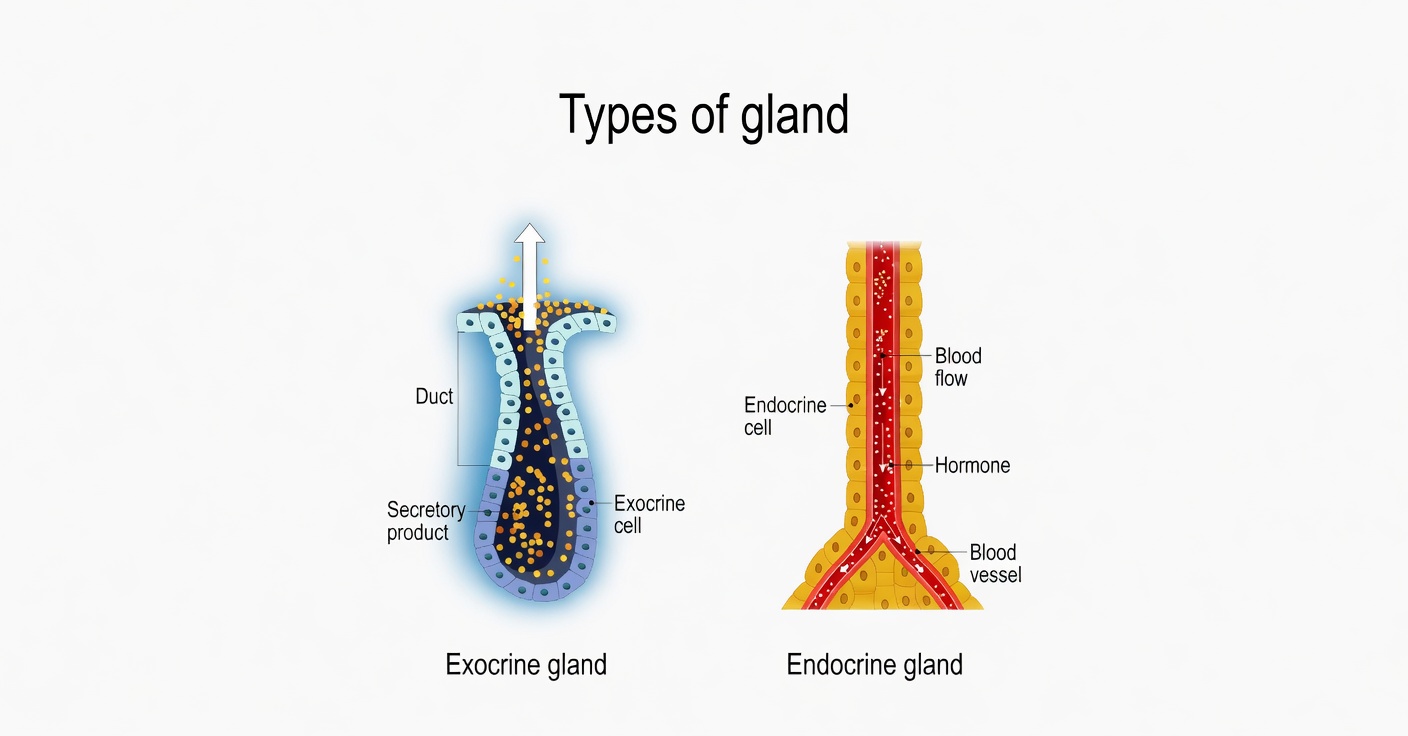
Endocrine glands are ductless glands that release hormones directly into the bloodstream. The hormones travel through the blood to target organs around the body. Exocrine glands have ducts and release their secretions through those ducts onto a body surface or into a body cavity. Endocrine glands work slowly over long distances via the blood. Exocrine glands work locally through ducts.
Difference Between Endocrine and Exocrine Glands: Comparison Table
| Feature | Endocrine Glands | Exocrine Glands |
|---|---|---|
| Definition | Ductless glands that release hormones into the blood | Glands with ducts that release secretions onto surfaces |
| Do they have ducts | No, they are ductless | Yes, they have ducts |
| What they release | Hormones | Enzymes, sweat, saliva, mucus, bile |
| How secretions travel | Through the bloodstream | Through ducts to target location |
| Speed of action | Slow, takes seconds to minutes | Fast, acts immediately at local site |
| Range of action | Long range, affects distant organs | Short range, acts locally |
| Examples | Pituitary, thyroid, adrenal, pancreas (islets) | Salivary glands, sweat glands, pancreas (acini) |
| Target | Specific target organs anywhere in the body | Local surfaces, cavities, or ducts |
What are Endocrine Glands?
To understand the difference between endocrine and exocrine glands, start with endocrine glands. Endocrine glands are glands that have no ducts. Instead of releasing their products through a tube, they release hormones directly into the bloodstream that surrounds them. The blood then carries those hormones to target organs elsewhere in the body.
Because endocrine glands use the bloodstream as their delivery system, they can affect organs that are far away from the gland itself. The pituitary gland in the brain, for example, releases hormones that travel all the way to the kidneys, the thyroid, and the reproductive organs.
Key facts about endocrine glands for GCSE:
- Endocrine glands are ductless and release hormones directly into the blood
- Hormones travel through the blood to reach specific target organs
- The effects of endocrine glands are slow but long lasting
- The endocrine system works alongside the nervous system to control body functions
- Too much or too little hormone from an endocrine gland causes disease
The main endocrine glands in the human body are the pituitary gland, thyroid gland, adrenal glands, pancreas (the islets of Langerhans), ovaries, and testes.
What are Exocrine Glands?
Exocrine glands are the other half of the difference between endocrine and exocrine glands. Unlike endocrine glands, exocrine glands have ducts. They release their secretions through these ducts onto a body surface or into a body cavity. The secretions do not enter the bloodstream.
Exocrine glands produce a wide range of substances depending on their location and function. Salivary glands produce saliva containing digestive enzymes. Sweat glands produce sweat to cool the body. The pancreas produces digestive enzymes that travel through a duct into the small intestine. Mucous glands line the airways and digestive tract.
Key facts about exocrine glands for GCSE:
- Exocrine glands have ducts that carry secretions to their target location
- Secretions do not enter the bloodstream
- Exocrine glands act locally and quickly at their target site
- They produce enzymes, sweat, saliva, mucus, bile, and other secretions
- Most glands you encounter in everyday life are exocrine glands
The Difference Between Endocrine and Exocrine Glands in the Pancreas
The pancreas is the most important example when explaining the difference between endocrine and exocrine glands because it is both at the same time. This makes it a favourite topic in GCSE Biology exams.
The pancreas has two completely separate functions:
- Exocrine function – the acinar cells of the pancreas produce digestive enzymes including amylase, lipase, and protease. These enzymes travel through the pancreatic duct into the small intestine where they help break down food.
- Endocrine function – the islets of Langerhans are clusters of cells within the pancreas that produce the hormones insulin and glucagon. These hormones are released directly into the bloodstream to control blood sugar levels.
The same organ doing both jobs at the same time makes the pancreas the clearest single example of the difference between endocrine and exocrine function in the human body.
Example 1 – The adrenal glands (Endocrine):
The adrenal glands sit on top of each kidney and are classic endocrine glands. When you are frightened or in danger, they release adrenaline directly into the bloodstream. Adrenaline travels rapidly through the blood to the heart, lungs, and muscles, increasing heart rate, widening airways, and redirecting blood to muscles. This is the fight or flight response, and it is controlled entirely by endocrine secretion with no ducts involved.
Example 2 – Salivary glands (Exocrine):
The salivary glands in your mouth are exocrine glands. When you eat or even think about food, they produce saliva containing the enzyme amylase. The saliva travels through salivary ducts into your mouth where it immediately begins breaking down starch in your food. The secretion goes through a duct directly to where it is needed, not into the bloodstream.
Example 3 – The thyroid gland (Endocrine):
The thyroid gland in your neck produces thyroxine, a hormone that controls your metabolic rate. Thyroxine is released directly into the bloodstream and travels to cells throughout the body, controlling how quickly they use energy. Too little thyroxine causes fatigue and weight gain. Too much causes rapid heartbeat and weight loss. The thyroid is a pure endocrine gland with no ducts.
Example 4 – Sweat glands (Exocrine):
Sweat glands are found all over the skin and are exocrine glands. They produce sweat which travels up through sweat ducts and onto the surface of the skin. As the sweat evaporates it cools the body down. The secretion travels through a duct to the skin surface, not into the blood.
Example 5 – The pancreas (Both):
As explained above, the pancreas acts as both an endocrine and an exocrine gland. Its islets of Langerhans release insulin and glucagon into the blood (endocrine). Its acinar cells release digestive enzymes through the pancreatic duct into the small intestine (exocrine). One organ, two completely different types of secretion, two completely different delivery systems.
EN-docrine goes EN-to the blood. EX-ocrine goes EX-it through a duct.
Endocrine – the EN at the start reminds you that hormones go EN-to the bloodstream directly. No duct, straight into the blood.
Exocrine – the EX at the start reminds you that secretions EX-it through a duct. They leave the gland through a tube and go to a local surface or cavity.
Or remember it this way: Endocrine = internal delivery (blood). Exocrine = external delivery (duct). Internal versus external is the core of the difference.
Quick Quiz: Endocrine or Exocrine?
1. A gland releases insulin directly into the bloodstream to control blood sugar. Is this endocrine or exocrine?
2. A gland produces saliva which travels through a duct into the mouth. Is this endocrine or exocrine?
3. The thyroid gland releases thyroxine into the blood to control metabolic rate. Is this endocrine or exocrine?
4. The pancreas releases digestive enzymes through the pancreatic duct into the small intestine. Is this endocrine or exocrine?
5. Sweat glands produce sweat that travels through ducts onto the skin surface. Is this endocrine or exocrine?
Difference Between Endocrine and Exocrine Glands in Exams
The difference between endocrine and exocrine glands appears regularly in GCSE Biology papers covering hormones, the endocrine system, and digestion. The pancreas question is the most common because it involves both types and tests whether students understand the distinction clearly. Always state whether a gland has a duct or not, what it produces, and how its secretion reaches its target.
Common Mistakes to Avoid
Thinking all glands work the same way:
Students often assume all glands release their products into the blood. This is only true for endocrine glands. Exocrine glands release their products through ducts and never enter the bloodstream. Always check whether a gland has a duct before deciding which type it is.
Forgetting the pancreas is both:
The pancreas is the most commonly tested gland in GCSE Biology precisely because it is both endocrine and exocrine. Many students know one function but forget the other. Always mention both when the pancreas comes up in an exam question about the difference between endocrine and exocrine glands.
Confusing hormones with enzymes:
Endocrine glands produce hormones. Exocrine glands often produce enzymes. These are not the same thing. Hormones are chemical messengers that travel in the blood and affect target organs. Enzymes are biological catalysts that speed up chemical reactions at a local site. Mixing these up in an exam answer will cost you marks.
Frequently Asked Questions
What is the main difference between endocrine and exocrine glands?
The main difference between endocrine and exocrine glands is whether they have a duct. Endocrine glands are ductless and release hormones directly into the bloodstream. Exocrine glands have ducts and release their secretions through those ducts onto a body surface or into a body cavity. The presence or absence of a duct is the single most important distinguishing feature.
Is the liver an endocrine or exocrine gland?
The liver is primarily an exocrine gland. It produces bile which travels through the bile duct into the small intestine to help digest fats. However the liver also releases some substances into the bloodstream, so it has limited endocrine functions too. For GCSE purposes, the liver is generally classified as an exocrine gland because its main secretion, bile, travels through a duct.
Why does it matter whether a gland has a duct?
Whether a gland has a duct determines how its secretion reaches its target. Without a duct, secretions must enter the bloodstream and travel to distant target organs. With a duct, secretions are delivered directly and locally to exactly where they are needed. This is the fundamental difference between endocrine and exocrine glands and explains why they produce such different effects in the body.
Can a gland be both endocrine and exocrine?
Yes. The pancreas is the clearest example. It contains two completely separate types of secretory tissue. The islets of Langerhans produce insulin and glucagon which enter the blood, making that part of the pancreas an endocrine gland. The acinar cells produce digestive enzymes that travel through the pancreatic duct, making that part of the pancreas an exocrine gland. Both functions happen simultaneously in the same organ.
For more on the endocrine system, visit BBC Bitesize Biology: The Endocrine System.
Also read: Difference Between Osmosis and Diffusion and Difference Between Aerobic and Anaerobic Respiration to build your complete understanding of GCSE Biology.
Once you understand the difference between endocrine and exocrine glands, questions about hormones, digestion, and the pancreas in your GCSE Biology exam become much easier to answer confidently.
