Place a raisin in a bowl of water and leave it for an hour. Come back and it will have swollen. Place a grape in a very salty solution and it will shrink. Both of these everyday observations are driven by osmosis, one of the most important processes in all of Biology. Students frequently confuse osmosis with diffusion because both involve the movement of particles from one place to another. But they are distinct processes with important differences, and mixing them up in a GCSE exam will cost you marks on questions that should be among the most straightforward in the paper. This guide makes the difference between osmosis and diffusion clear once and for all.
Diffusion is the net movement of particles from an area of high concentration to an area of low concentration. It applies to any particles — gases, solutes, even water molecules — and does not require a membrane. Osmosis is a specific type of diffusion that applies only to water molecules moving across a partially permeable membrane from an area of high water concentration (dilute solution) to an area of low water concentration (concentrated solution). Osmosis is a special case of diffusion. All osmosis is diffusion but not all diffusion is osmosis.
Difference Between Osmosis and Diffusion: Comparison Table
| Feature | Diffusion | Osmosis |
|---|---|---|
| Definition | Movement of particles from high to low concentration | Movement of water molecules across a partially permeable membrane |
| What moves? | Any particles (gases, solutes, water) | Water molecules only |
| Membrane required? | No membrane needed | Yes, requires a partially permeable membrane |
| Direction | High concentration to low concentration | Dilute solution to concentrated solution |
| Type of process | General process | Specific type of diffusion |
| Energy required? | No, passive process | No, passive process |
| Examples | Oxygen entering blood, smell spreading in air | Water entering plant roots, red blood cells in salt water |
| Affected by | Concentration gradient, temperature, particle size | Water potential gradient, temperature, membrane permeability |
What is Diffusion?
Diffusion is the net movement of particles from a region of high concentration to a region of low concentration. It is a passive process, meaning it requires no energy input from the cell. Particles move because of their own random kinetic energy — they are constantly vibrating and moving, and over time this random movement results in them spreading from where they are concentrated to where they are less concentrated.
Think of a drop of food colouring added to a glass of still water. The dye molecules start concentrated in one spot but gradually spread throughout the water until the concentration is even everywhere. Nobody pushed them. They moved entirely because of the random motion of particles down a concentration gradient. That is diffusion.
The concentration gradient is the difference in concentration between two regions. The steeper the gradient (the bigger the difference in concentration), the faster diffusion occurs. Other factors that affect the rate of diffusion include:
- Temperature – higher temperature gives particles more kinetic energy, increasing the rate of diffusion
- Surface area – a larger surface area allows more particles to diffuse across at once
- Distance – shorter distances mean faster diffusion
- Particle size – smaller particles diffuse faster than larger ones
Diffusion is essential for life. Oxygen diffuses from the air sacs in your lungs into your blood. Carbon dioxide diffuses from your blood into your lungs to be exhaled. Glucose diffuses from your gut into your bloodstream. Waste products diffuse out of cells. Every gas exchange in living organisms relies on diffusion.
What is Osmosis?
Osmosis is a specific type of diffusion that applies only to water molecules. It is the net movement of water molecules from a region of high water concentration (a dilute solution) to a region of low water concentration (a concentrated solution) across a partially permeable membrane.
The partially permeable membrane is essential to osmosis. It is a membrane with tiny pores that allow water molecules to pass through but are too small for larger solute molecules. Cell membranes are partially permeable, which is why osmosis is one of the most important processes in biology.
The key concept that helps explain osmosis is water potential. Water potential is a measure of the tendency of water to move from one place to another. Pure water has the highest water potential. When solutes are dissolved in water, the water potential decreases. Water always moves from higher water potential (more dilute) to lower water potential (more concentrated) by osmosis.
Three important situations in osmosis:
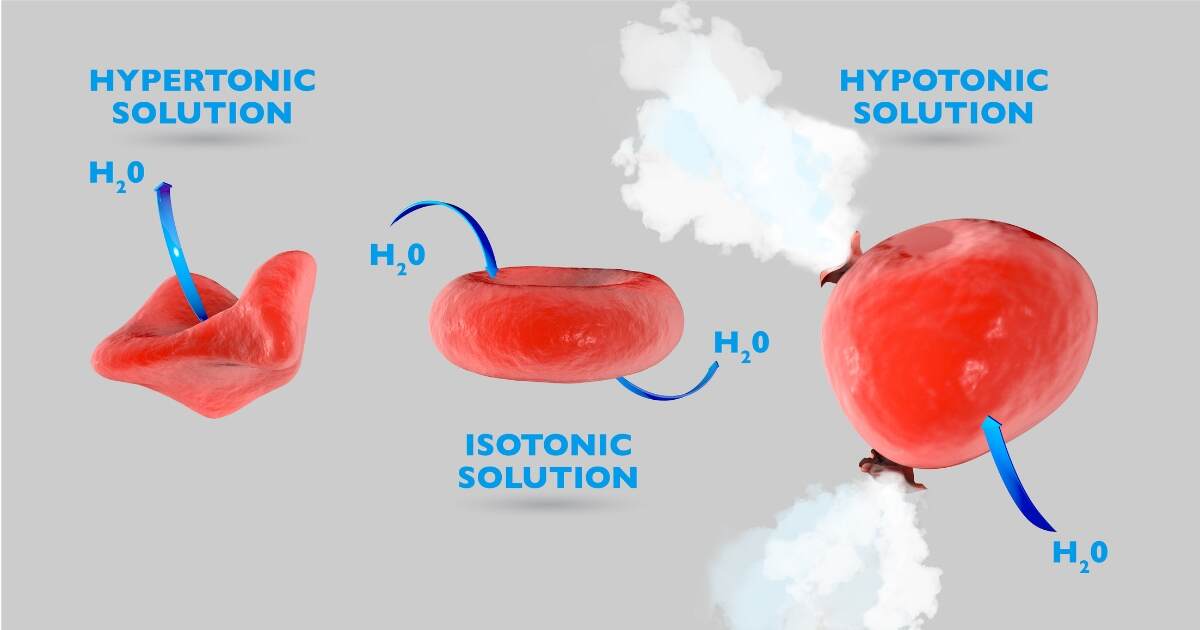
- Hypotonic solution – the solution outside the cell has a lower solute concentration than inside. Water moves into the cell by osmosis. Animal cells swell and may burst (lysis). Plant cells become turgid
- Hypertonic solution – the solution outside the cell has a higher solute concentration than inside. Water moves out of the cell by osmosis. Animal cells shrink (crenation). Plant cells become plasmolysed
- Isotonic solution – the solution outside the cell has the same solute concentration as inside. No net movement of water. Cells maintain their normal shape
Example 1 – Oxygen in the lungs (Diffusion):
When you breathe in, air rich in oxygen enters your lungs. The concentration of oxygen in the air sacs is higher than the concentration in the surrounding blood capillaries. Oxygen therefore diffuses down its concentration gradient from the air sacs into the blood. At the same time, carbon dioxide is more concentrated in the blood than in the air sacs, so it diffuses in the opposite direction into the lungs to be exhaled. This gas exchange relies entirely on diffusion across the thin walls of the alveoli.
Example 2 – Raisin in water (Osmosis):
A raisin placed in water swells because osmosis draws water into it. The raisin contains a concentrated solution of sugars and other solutes inside its cells. The surrounding water is more dilute. Water moves by osmosis from the dilute water (high water potential) across the partially permeable cell membranes into the raisin cells (low water potential). The raisin swells as water enters. This is a simple and observable demonstration of osmosis that you can do at home.
Example 3 – Red blood cells in different solutions (Osmosis):
Place red blood cells in pure water (hypotonic solution) and they swell and burst as water enters by osmosis. Place them in a very salty solution (hypertonic solution) and they shrink and become crenated as water leaves by osmosis. Place them in a 0.9% saline solution (isotonic, matching the concentration inside the cells) and they maintain their normal biconcave shape with no net water movement. This is why intravenous drips in hospitals use 0.9% saline — to prevent osmotic damage to blood cells.
Example 4 – Water absorption by plant roots (Osmosis):
Plants absorb water from the soil through their root hair cells by osmosis. The cell contents of root hair cells contain dissolved minerals and sugars, making the cell sap more concentrated than the soil water surrounding it. Water therefore moves by osmosis from the dilute soil water into the root hair cells. This is how plants take up the water they need for photosynthesis, transport, and support without using any energy to pump it in.
Example 5 – Preserving food with salt (Osmosis):
Salt has been used to preserve food for thousands of years. When food is packed in salt, the highly concentrated salt solution surrounding bacteria draws water out of bacterial cells by osmosis. The bacterial cells lose so much water that they cannot function and die. This is osmosis used as a natural preservative. The same principle explains why slugs shrivel when salt is poured on them — the salt draws water out of their bodies by osmosis.
Example 6 – Smell spreading across a room (Diffusion):
When you spray perfume in one corner of a room, within minutes you can smell it in every corner. The perfume molecules diffuse from where they are concentrated (near the spray) to where they are less concentrated (the rest of the room). No membrane is involved and the molecules that move are not water molecules. This is straightforward diffusion, not osmosis. It illustrates the key difference: diffusion applies to any particles spreading through any medium, while osmosis specifically involves water across a membrane.
The special case trick:
Diffusion is the general rule. Any particles, any medium, no membrane needed. High concentration to low concentration. Simple.
Osmosis is the special case with three extra requirements. Remember them as W-M-D:
Water only — osmosis only applies to water molecules
Membrane — a partially permeable membrane must be present
Dilute to concentrated — water moves from the more dilute solution to the more concentrated one
If all three conditions are met, it is osmosis. If any one is missing, it is just diffusion.
Quick Quiz: Osmosis or Diffusion?
1. Oxygen moves from the air sacs in the lungs into the blood. This is:
2. Water moves from dilute soil water into root hair cells across the cell membrane. This is:
3. A red blood cell placed in pure water swells and bursts. This is because:
4. Perfume molecules spread from one side of a room to the other. This is:
5. A plant cell in a concentrated salt solution loses water and the membrane pulls away from the cell wall. This is called:
6. Which of these is essential for osmosis but not for diffusion?
Difference Between Osmosis and Diffusion in Exams
The difference between osmosis and diffusion is tested in virtually every GCSE Biology and Combined Science paper. Questions ask you to define both processes, explain the role of the partially permeable membrane in osmosis, predict what will happen to cells placed in solutions of different concentrations, describe and explain the results of osmosis experiments, and explain how osmosis is used in biological contexts like water uptake in plants and kidney function.
One of the most common practical experiments involves placing pieces of potato in solutions of different salt concentrations and measuring the change in mass. Potato pieces in dilute solutions gain mass as water enters by osmosis. Potato pieces in concentrated solutions lose mass as water leaves by osmosis. Being able to explain these results precisely is a key exam skill.
Common Mistakes to Avoid
Saying osmosis is the movement of water from low to high concentration:
This is the single most common osmosis error. Water moves from where it is MORE concentrated (the dilute solution, which contains more water molecules) to where it is LESS concentrated (the concentrated solution, which contains fewer water molecules because solute particles take up space). The confusion arises because students think about the solute concentration rather than the water concentration. Always think about where the water molecules are most concentrated.
Forgetting that diffusion does not require a membrane:
Students sometimes describe diffusion as requiring a membrane because they learn osmosis and diffusion together. Diffusion can occur freely in any medium. Gases diffuse through air. Solutes diffuse through water. No membrane is needed. The membrane is what makes osmosis a specific and distinct type of diffusion.
Describing osmosis as active transport:
Both osmosis and diffusion are passive processes that require no energy. Active transport is different — it moves substances against the concentration gradient and does require energy in the form of ATP. Never describe osmosis as requiring energy in an exam answer.
Frequently Asked Questions
What is the difference between osmosis and active transport?
Osmosis and diffusion are both passive processes that move substances down a concentration gradient without requiring energy. Active transport moves substances against the concentration gradient (from low to high concentration) and requires energy in the form of ATP. Root hair cells use active transport to absorb mineral ions from the soil even when the concentration of minerals in the soil is lower than inside the cell. This is why plants need energy from respiration to absorb minerals but can absorb water by osmosis without using energy.
What is water potential and why does it matter?
Water potential is a measure of the tendency of water molecules to move from one place to another. Pure water has the highest water potential, given a value of zero. Adding solutes to water lowers its water potential, giving a negative value. Water always moves by osmosis from higher water potential (less negative, more dilute) to lower water potential (more negative, more concentrated). Understanding water potential helps explain the direction of osmosis precisely and is essential for A-Level Biology, where it becomes even more important.
Why do plant cells not burst when they absorb water by osmosis?
Animal cells burst when they absorb too much water because they have no rigid outer wall. Plant cells have a rigid cellulose cell wall surrounding the cell membrane. As water enters by osmosis and the cell swells, the cell wall resists the expansion and creates a pressure called turgor pressure. The cell becomes turgid rather than bursting. This turgor pressure is what keeps plant cells firm and gives non-woody plants their structural rigidity. A wilted plant has lost turgor pressure because its cells have lost water by osmosis.
How is osmosis important in the human body?
Osmosis is critical to many functions in the human body. The kidneys use osmosis to reabsorb water from urine filtrate back into the blood, allowing the body to control its water balance. Red blood cells maintain their shape because the blood plasma is isotonic with the cell contents. The small intestine absorbs water by osmosis after digestion. Dehydration occurs when the body loses so much water that cells begin to lose water by osmosis to the more concentrated blood plasma, causing them to shrink and malfunction.
For more on transport in cells including diffusion, osmosis, and active transport, visit Khan Academy: Passive Transport and Osmosis.
This topic connects directly to other Biology guides on this site. The guide on the difference between photosynthesis and respiration shows how the substances transported by diffusion and osmosis are used in these fundamental biological processes, giving you a complete picture of how materials move through and are used by living organisms.
The difference between osmosis and diffusion is one of those topics that rewards careful thinking. Once you have the W-M-D trick firmly in place and you can visualise water moving from dilute to concentrated across a membrane, the difference between osmosis and diffusion will never cause confusion again. Every osmosis exam question you encounter will feel manageable because the underlying logic is always the same. Keep that logic clear and the difference between osmosis and diffusion will be one of the most reliable marks available to you throughout GCSE Biology.
The best way to cement the difference between osmosis and diffusion in your memory is to practise applying both concepts to new situations rather than just memorising definitions. When you encounter any biological transport question, ask yourself three things: what is moving, is there a membrane, and which direction is the concentration gradient? Those three questions will always lead you to the correct answer. The difference between osmosis and diffusion becomes instinctive very quickly once you start thinking that way, and once it is instinctive it is one of the most reliable topics in GCSE Biology. No student who truly understands the difference between osmosis and diffusion should ever drop marks on this topic.

2 thoughts on “Difference Between Osmosis and Diffusion: 2 Critical Processes That Unlock GCSE Biology”
Comments are closed.