When you look at the world’s governments, two systems come up again and again in History and Citizenship lessons: monarchies and republics. Most students can name a few examples of each but struggle to explain exactly what makes them different. The difference between monarchy and republic comes down to one key question: who holds power at the top, and how did they get it? This guide explains both systems clearly so you can answer any exam question on this topic with confidence.
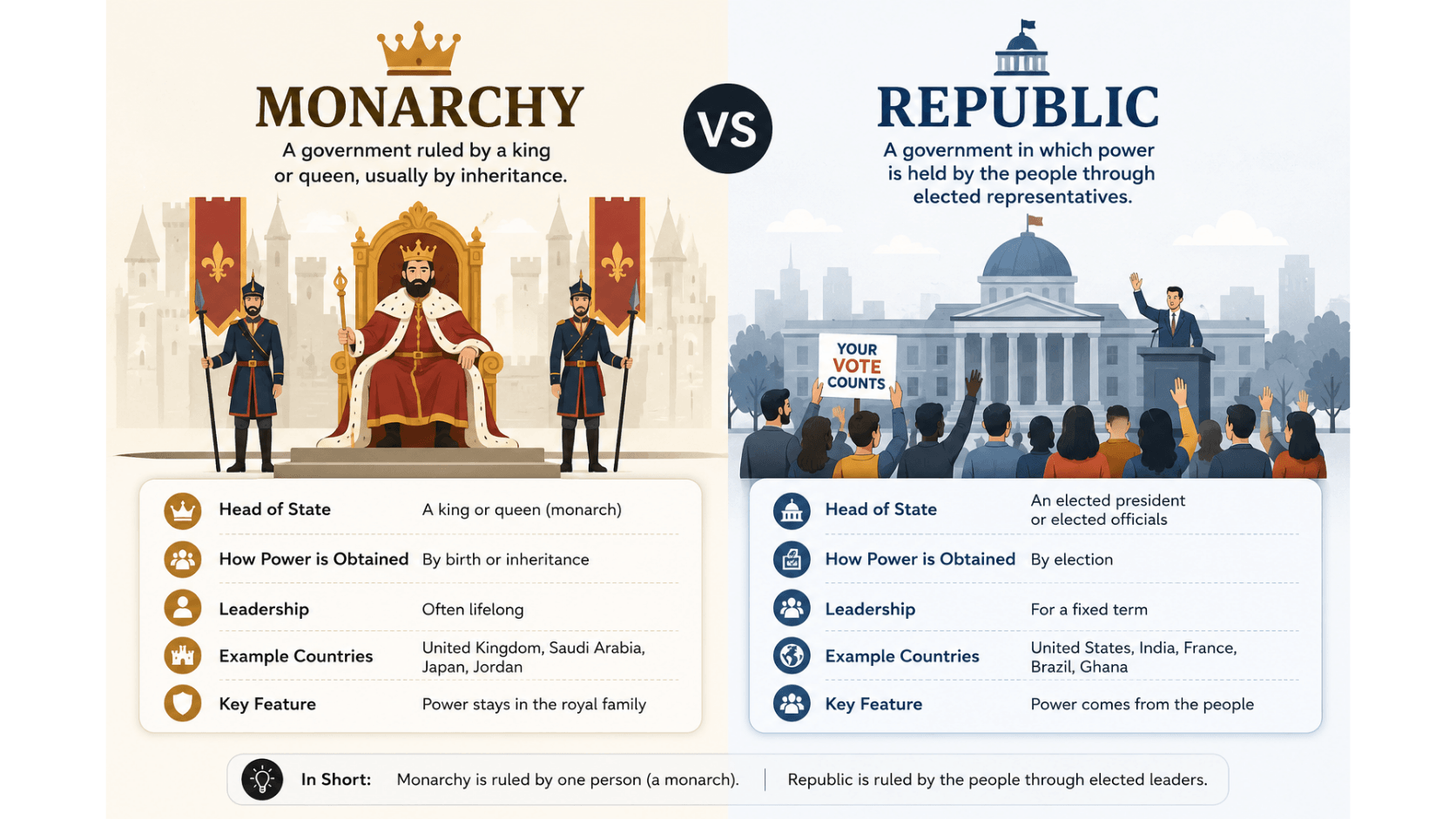
A monarchy is a system of government where a king, queen, or emperor holds the position of head of state, usually by hereditary succession, meaning the role is passed down through a royal family. A republic is a system of government where the head of state is elected or appointed rather than inheriting the position. In a republic, power ultimately comes from the people rather than from a royal bloodline.
Difference Between Monarchy and Republic: Comparison Table
| Feature | Monarchy | Republic |
|---|---|---|
| Head of state | King, queen, or emperor | President or elected official |
| How leader is chosen | Hereditary succession, born into the role | Elected or appointed by the people or parliament |
| Source of power | Royal bloodline and tradition | The people through elections or constitution |
| Is the role permanent | Usually for life | Usually for a fixed term |
| Can citizens choose the head of state | No, in most cases | Yes, directly or indirectly |
| Types | Absolute monarchy, constitutional monarchy | Presidential republic, parliamentary republic |
| Examples | United Kingdom, Saudi Arabia, Japan | United States, France, Germany, India |
| Role of constitution | Varies, some monarchies have constitutions | Almost always governed by a constitution |
What is a Monarchy?
To understand the difference between monarchy and republic, start with monarchy. A monarchy is a system of government where a single person, a monarch, holds the position of head of state. In most monarchies, this position is inherited rather than earned or elected. When a king or queen dies or abdicates, the crown passes to the next in line within the royal family according to rules of succession.
There are two main types of monarchy that students need to know:
- Absolute monarchy – the monarch holds supreme power over the government and the country. There is no parliament or constitution limiting what they can do. Saudi Arabia is a modern example of a country where the royal family holds near-absolute power.
- Constitutional monarchy – the monarch is the head of state but their powers are limited by a constitution and a parliament. Most modern monarchies are constitutional. The United Kingdom is the most well-known example, where the King is head of state but the elected parliament and Prime Minister hold actual governing power.
Key features of a monarchy:
- The head of state inherits their position through royal birth
- The role is usually held for life
- Citizens cannot vote to remove or replace the monarch
- The monarch represents national identity, tradition, and continuity
- In constitutional monarchies, the monarch has a ceremonial role with limited real power
What is a Republic?
A republic is the other side of the difference between monarchy and republic. In a republic, the head of state is not a hereditary monarch. Instead, the position is filled by election or appointment. The word republic comes from the Latin “res publica” meaning “public affair” or “the public thing,” reflecting the idea that the state belongs to the people rather than to a royal family.
There are two main types of republic:
- Presidential republic – the president is both head of state and head of government, elected directly by the people. The United States is the most well-known example. The president holds significant executive power and is elected every four years.
- Parliamentary republic – the president is head of state but a prime minister holds most governing power. Germany and India are examples. The president is often elected by parliament rather than directly by the public.
Key features of a republic:
- The head of state is elected or appointed, not born into the role
- The position is held for a fixed term, not for life
- Citizens have a say in who leads the country
- Power comes from a constitution and the will of the people
- No hereditary privilege determines who can become head of state
The Difference Between Monarchy and Republic in Practice
In practice, the difference between monarchy and republic is not always as clear as the definitions suggest. Many modern monarchies are democratic and give their citizens more political freedom than some republics. The United Kingdom, Sweden, and Norway are all monarchies but are also functioning democracies where citizens vote freely and governments are held accountable. Meanwhile, some countries that call themselves republics, such as North Korea which is officially the Democratic People’s Republic of Korea, are in practice authoritarian states with no meaningful democracy.
This is why it is important to understand that monarchy versus republic describes the nature of the head of state position, not necessarily how democratic or free the country is. A constitutional monarchy can be highly democratic. A republic can be deeply undemocratic. The two concepts are related but not identical.
Example 1 – United Kingdom (Constitutional Monarchy):
The United Kingdom is a constitutional monarchy. King Charles III is the head of state, having inherited the position from Queen Elizabeth II in 2022. However the King does not govern the country. Parliament is elected by citizens, and the Prime Minister leads the government. The monarch performs ceremonial duties, represents national identity, and formally approves laws, but does not make policy decisions. This is the most common form of monarchy in the modern world.
Example 2 – Saudi Arabia (Absolute Monarchy):
Saudi Arabia is one of the few remaining absolute monarchies in the world. The Al Saud royal family has ruled since 1932. The King holds supreme executive, legislative, and judicial authority. There is no elected parliament with real power, and citizens cannot vote for their head of state. This represents a very different type of monarchy from constitutional examples like the UK.
Example 3 – United States (Presidential Republic):
The United States became a republic after declaring independence from the British monarchy in 1776. Citizens elect the President every four years through a democratic process. No one can inherit the presidency, and the constitution strictly limits how long any individual can hold the office. The US was specifically designed as a republic to avoid the concentration of hereditary power that the founders had experienced under British rule.
Example 4 – France (Republic after Monarchy):
France is a powerful historical example of the transition from monarchy to republic. France was an absolute monarchy under Louis XVI until the French Revolution of 1789, when the monarchy was abolished and the King was executed. France has since moved between monarchies and republics several times in its history, but is now firmly a republic. The French President is elected directly by citizens every five years.
Example 5 – Japan (Constitutional Monarchy):
Japan is a constitutional monarchy where the Emperor holds a purely ceremonial role. The Emperor does not participate in politics or government. Real power lies with the elected parliament, called the Diet, and the Prime Minister. Japan’s Emperor is considered a symbol of the state and of the unity of the Japanese people, but has no political authority.
M for MADE (born into it). R for RACE (everyone can compete).
Monarchy – the head of state is MADE by birth. You are born into a royal family and the role comes to you. You do not compete for it or earn it through votes.
Republic – in theory, anyone can RACE for the top position. The head of state is chosen through a process that is open to candidates rather than reserved for one family by birth.
Or use the simplest distinction: Monarchy = inherited. Republic = elected or appointed. That one sentence covers the core of the difference between monarchy and republic in every exam question you will face.
Quick Quiz: Monarchy or Republic?
1. A country where the head of state inherited their position from a parent. Is this a monarchy or a republic?
2. Citizens vote every four years to choose their head of state. Is this country more likely a monarchy or a republic?
3. The United Kingdom has a King as head of state but citizens elect parliament and the Prime Minister governs. What type of system is this?
4. France abolished its royal family during the Revolution and now elects its head of state. What is France?
5. In which system does the head of state typically hold their position for life?
Difference Between Monarchy and Republic in Exams
The difference between monarchy and republic comes up in GCSE History, Citizenship, and Politics. Exam questions often ask you to define each system, compare their features, explain how countries have moved from one to the other, or evaluate the strengths and weaknesses of each. Always make sure you distinguish between absolute and constitutional monarchies, and between presidential and parliamentary republics, as these distinctions show a deeper level of understanding that earns higher marks.
Common Mistakes to Avoid
Thinking all monarchies are undemocratic:
Many students assume that because a monarchy has a hereditary head of state, the country cannot be democratic. This is wrong. The UK, Sweden, Denmark, Norway, the Netherlands, Japan, and many others are constitutional monarchies that are also fully functioning democracies. The elected parliament and government hold real power. The monarch’s role is largely ceremonial.
Thinking all republics are democratic:
Just because a country calls itself a republic does not mean it is democratic. North Korea calls itself the Democratic People’s Republic of Korea but is one of the most authoritarian states in the world. China is officially the People’s Republic of China but does not hold free elections. Always look at how power is actually exercised, not just what a country calls itself.
Confusing the head of state with the head of government:
In many countries these are different people. In the UK, the King is head of state but the Prime Minister is head of government. In Germany, the President is head of state but the Chancellor is head of government. In the US, the President is both. Understanding this distinction is important for exam answers on the difference between monarchy and republic.
Frequently Asked Questions
What is the main difference between monarchy and republic?
The main difference between monarchy and republic is how the head of state gets their position. In a monarchy, the head of state inherits the role through royal birth. In a republic, the head of state is elected or appointed through a formal process. This is the single most important distinction and the one most likely to appear in exam questions.
Can a country be both a monarchy and a democracy?
Yes, absolutely. Most European monarchies are also fully functioning democracies. The United Kingdom, Sweden, Norway, Denmark, the Netherlands, Belgium, and Spain are all constitutional monarchies with free elections, independent courts, and democratic governments. The monarch acts as a ceremonial head of state while elected politicians govern the country.
Why did many countries move from monarchy to republic?
Countries moved from monarchy to republic for various reasons throughout history. Revolutions driven by demands for political equality and an end to hereditary privilege were common, as in France in 1789 and Russia in 1917. Some countries became republics after gaining independence from colonial powers and choosing not to keep a monarchy. Others transitioned more gradually through constitutional reforms that reduced the monarch’s power until the role became purely ceremonial or was abolished altogether.
Is the UK a monarchy or a republic?
The UK is a constitutional monarchy. King Charles III is the head of state, having succeeded Queen Elizabeth II in September 2022. However the UK is also a parliamentary democracy where citizens elect Members of Parliament and the Prime Minister leads the government. The monarch’s role is largely ceremonial. The UK has never been a republic, though there was a brief period of republican government under Oliver Cromwell after the English Civil War in the 1640s and 1650s.
For more on systems of government, visit History.com: Government and Politics.
Also read: Difference Between Democracy and Dictatorship and Difference Between Primary and Secondary Sources to build your complete understanding of GCSE History.
Once you are confident about the difference between monarchy and republic, questions about systems of government in your GCSE History and Citizenship exams become much more straightforward to answer.
