
Every country in the world keeps track of two key population statistics: how many people are being born and how many people are dying. These two numbers control whether a population is growing, shrinking, or staying the same. Students often use these terms without really understanding what they mean or how they are measured. This guide explains the difference between birth rate and death rate clearly so you can use both terms accurately in your GCSE Geography exam.
Birth rate is the number of live births per 1,000 people in a population per year. Death rate is the number of deaths per 1,000 people in a population per year. When the birth rate is higher than the death rate, the population grows. When the death rate is higher than the birth rate, the population shrinks.
Difference Between Birth Rate and Death Rate: Comparison Table
| Feature | Birth Rate | Death Rate |
|---|---|---|
| Definition | Number of live births per 1,000 people per year | Number of deaths per 1,000 people per year |
| What it measures | How many people are entering the population | How many people are leaving the population |
| Also known as | Crude birth rate (CBR) | Crude death rate (CDR) |
| High rate means | Many babies being born relative to population size | Many people dying relative to population size |
| Low rate means | Fewer babies being born relative to population size | Fewer people dying relative to population size |
| Typical in developed countries | Low birth rate (around 10-12 per 1,000) | Low to medium death rate (around 9-11 per 1,000) |
| Typical in developing countries | High birth rate (around 30-40 per 1,000) | Variable, often higher than developed countries |
| Effect on population | High birth rate increases population | High death rate decreases population |
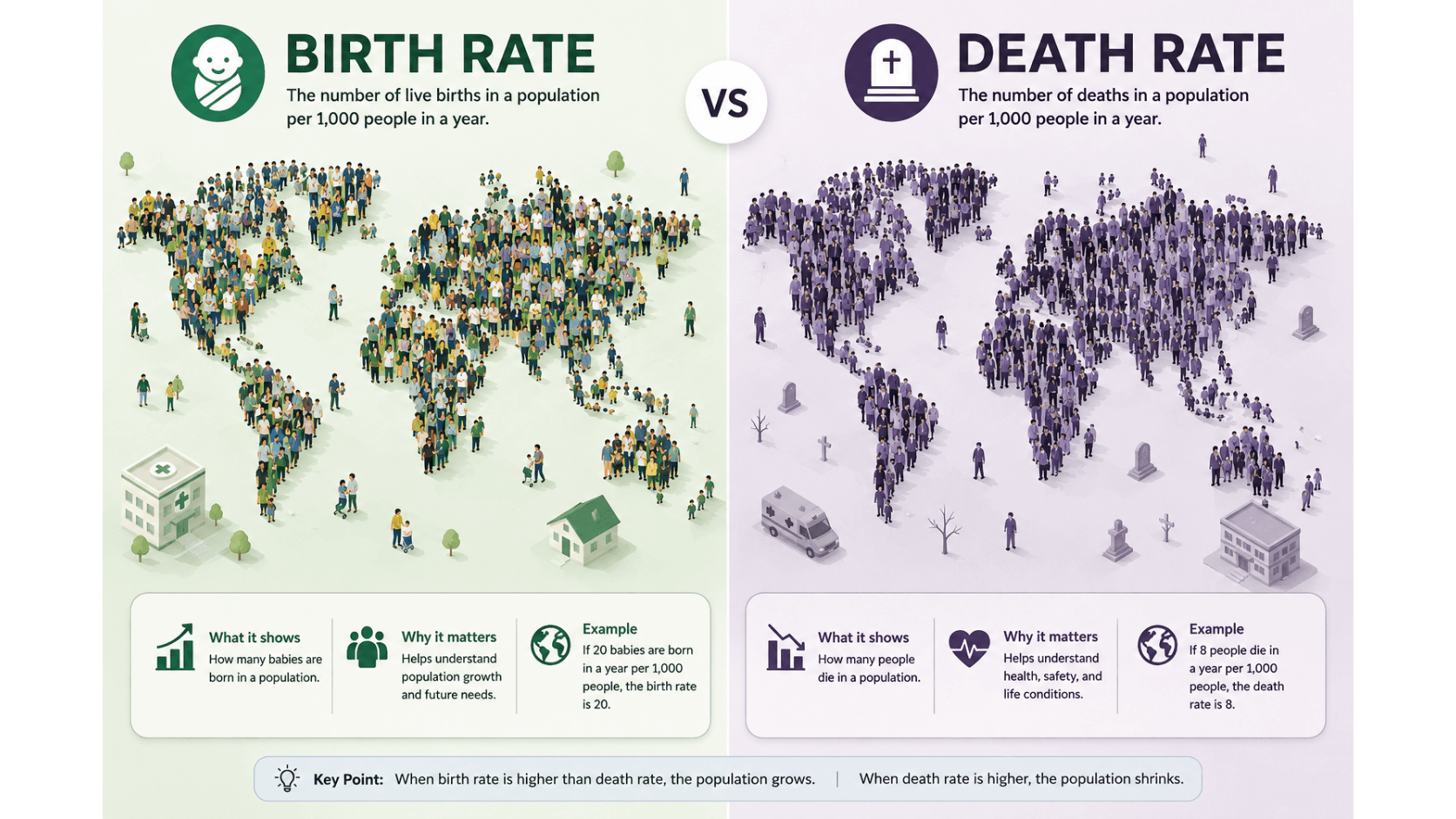
What is Birth Rate?
To understand the difference between birth rate and death rate, start with birth rate. Birth rate is the number of live births that occur per 1,000 people in a population in a single year. It is also called the crude birth rate, or CBR, and it is one of the most important statistics used in population geography.
Birth rate is affected by several factors:
- Access to contraception – where contraception is widely available and used, birth rates tend to be lower
- Education levels – higher levels of education, particularly for women, are strongly linked to lower birth rates
- Cultural and religious beliefs – in some societies, large families are culturally valued or encouraged by religious teaching
- Economic factors – in poorer countries where children contribute to family income or provide security in old age, birth rates tend to be higher
- Government policy – some governments actively encourage or discourage births through policy, such as China’s former one-child policy
- Infant mortality rate – where many children die young, families tend to have more children to ensure some survive to adulthood
Countries with high birth rates include Niger, Mali, and Chad in sub-Saharan Africa, where birth rates can exceed 40 per 1,000. Countries with low birth rates include Japan, South Korea, and most of Western Europe, where birth rates are often below 12 per 1,000.
What is Death Rate?
Death rate is the second half of the difference between birth rate and death rate. Death rate is the number of deaths that occur per 1,000 people in a population in a single year. It is also called the crude death rate, or CDR.
Death rate is affected by several factors:
- Access to healthcare – better hospitals, medicines, and doctors reduce death rates significantly
- Nutrition and food security – adequate nutrition reduces deaths from malnutrition and diseases linked to poor diet
- Clean water and sanitation – access to clean water dramatically reduces deaths from waterborne diseases
- Age structure of the population – countries with older populations tend to have higher death rates because older people are more likely to die in any given year
- Conflict and natural disasters – wars and disasters can cause sudden spikes in death rates
- Standard of living – higher living standards are generally associated with lower death rates
It is important to note that developed countries do not always have the lowest death rates. Countries like Japan and Germany have relatively high death rates compared to some developing countries, not because healthcare is poor but because their populations are older. An older population means more people are at the age where death is more likely.
The Difference Between Birth Rate and Death Rate and Natural Population Change
The difference between birth rate and death rate gives you the natural increase or decrease in a population. This is calculated as:
Natural increase = Birth rate – Death rate
If the birth rate is 30 per 1,000 and the death rate is 10 per 1,000, the natural increase is 20 per 1,000, meaning the population is growing. If the birth rate is 10 per 1,000 and the death rate is 12 per 1,000, the natural increase is -2 per 1,000, meaning the population is shrinking. This natural change does not include migration, which is a separate factor in population change.
Birth Rate and Death Rate in the Demographic Transition Model
The demographic transition model, or DTM, is one of the most important models in GCSE Geography population topics. It shows how birth rates and death rates change as a country develops over time. Understanding the difference between birth rate and death rate is essential for understanding the DTM.
The model has five stages:
- Stage 1 – both birth rate and death rate are high. Population stays roughly stable. Example: isolated tribal communities
- Stage 2 – death rate falls due to improvements in healthcare and food supply. Birth rate stays high. Population grows rapidly. Example: many sub-Saharan African countries
- Stage 3 – birth rate begins to fall as women gain education and access to contraception. Death rate continues to fall. Population still grows but more slowly. Example: India, Brazil
- Stage 4 – both birth rate and death rate are low. Population growth slows or stops. Example: UK, USA, France
- Stage 5 – birth rate falls below death rate. Population begins to decline. Example: Japan, Germany, Italy
Example 1 – Niger (High birth rate, high death rate):
Niger in West Africa has one of the highest birth rates in the world at around 47 per 1,000. Death rates are also relatively high at around 11 per 1,000, but the gap between the two is enormous, meaning the population is growing very rapidly. Factors behind the high birth rate include low levels of female education, limited access to contraception, cultural preference for large families, and high infant mortality that encourages families to have many children.
Example 2 – Japan (Low birth rate, high death rate):
Japan has one of the lowest birth rates in the world at around 7 per 1,000, combined with a relatively high death rate of around 12 per 1,000. This means Japan’s population is actually shrinking. The high death rate is not because healthcare is poor. Japan has excellent healthcare and one of the longest life expectancies in the world. The high death rate reflects an ageing population where a large proportion of people are in older age groups where death is more common.
Example 3 – United Kingdom (Low birth rate, low death rate):
The UK has a birth rate of around 11 per 1,000 and a death rate of around 9 per 1,000, giving a small natural increase of around 2 per 1,000. The UK is in Stage 4 of the demographic transition model. Population growth in the UK comes mainly from migration rather than natural increase, since the difference between birth rate and death rate is very small.
Example 4 – Kenya (Falling birth rate, falling death rate):
Kenya is an example of a country moving through Stage 3 of the demographic transition model. Birth rates have fallen from around 50 per 1,000 in the 1970s to around 27 per 1,000 today. Death rates have also fallen significantly due to improvements in healthcare, clean water access, and food security. Kenya’s population is still growing but at a slower rate than in previous decades, illustrating how the difference between birth rate and death rate narrows as a country develops.
B is for Babies. D is for Deaths. B minus D equals growth.
Birth rate – B for Babies coming IN to the population. A high B means lots of babies being born.
Death rate – D for Deaths going OUT of the population. A high D means lots of people dying.
Subtract D from B to get natural increase. If B is bigger than D, the population grows. If D is bigger than B, the population shrinks. B minus D is the formula you need to remember for every population question in your GCSE Geography exam.
Quick Quiz: Birth Rate or Death Rate?
1. The number of live births per 1,000 people per year is called what?
2. Japan has an ageing population and more people are dying each year than are being born. Which rate is higher in Japan?
3. A country has a birth rate of 35 per 1,000 and a death rate of 12 per 1,000. Is this country’s population growing or shrinking?
4. Improved access to healthcare and clean water would most directly reduce which rate?
5. In Stage 2 of the demographic transition model, which rate falls first?
Common Mistakes to Avoid
Thinking a high death rate always means a country is poor or undeveloped:
This is one of the most common mistakes students make. Japan and Germany both have relatively high death rates but are among the most developed countries in the world. Their high death rates are caused by ageing populations, not poor healthcare. Always consider the age structure of the population before drawing conclusions from death rate figures alone.
Confusing natural increase with total population change:
Natural increase is the difference between birth rate and death rate and only accounts for births and deaths. It does not include migration. A country can have a negative natural increase but still have a growing population if large numbers of people are moving in. Always separate natural change from migration when discussing population change in exam answers.
Forgetting the units when writing about birth rate and death rate:
Birth rate and death rate are always measured per 1,000 people per year, not per 100 or as a percentage. Writing “the birth rate is 30%” is incorrect. Writing “the birth rate is 30 per 1,000” is correct. This is an easy mark to lose in an exam so always include the correct units.
Frequently Asked Questions
What is the difference between birth rate and death rate in simple terms?
The difference between birth rate and death rate in simple terms is this: birth rate counts how many people are being added to a population through births, and death rate counts how many people are being removed from a population through deaths. Both are measured per 1,000 people per year. The gap between the two determines whether a population is growing or shrinking.
Why do developing countries have higher birth rates?
Developing countries tend to have higher birth rates for several reasons. Access to contraception is often limited. Levels of female education are lower, and educated women tend to have fewer children. In agricultural societies, children provide labour and economic security. High infant mortality rates also encourage families to have more children to ensure some survive. As countries develop and these factors change, birth rates typically fall.
Can a country have a high birth rate and a high death rate at the same time?
Yes. This was the situation for most of human history and is represented by Stage 1 of the demographic transition model. When both birth rate and death rate are high, the population stays relatively stable because the two roughly cancel each other out. Today this pattern is rare but was common before modern medicine and food production transformed death rates around the world.
What is the difference between birth rate and fertility rate?
Birth rate measures the number of births per 1,000 people in the total population per year. Fertility rate measures the average number of children a woman is expected to have over her lifetime. Fertility rate is considered a more accurate measure of reproductive behaviour because it is not affected by the overall age structure of the population the way crude birth rate is. Both are used in population geography but fertility rate gives a more detailed picture of long-term population trends.
For more on population geography, visit National Geographic: Population.
Also read: Difference Between Immigration and Emigration and Difference Between Developed and Developing Countries to build your complete understanding of GCSE Geography population topics.
Once you are confident about the difference between birth rate and death rate, population questions in your GCSE Geography exam become much more straightforward to answer.

1 thought on “Difference Between Birth Rate and Death Rate: 5 Clear Facts Every Geography Student Must Know”
Comments are closed.