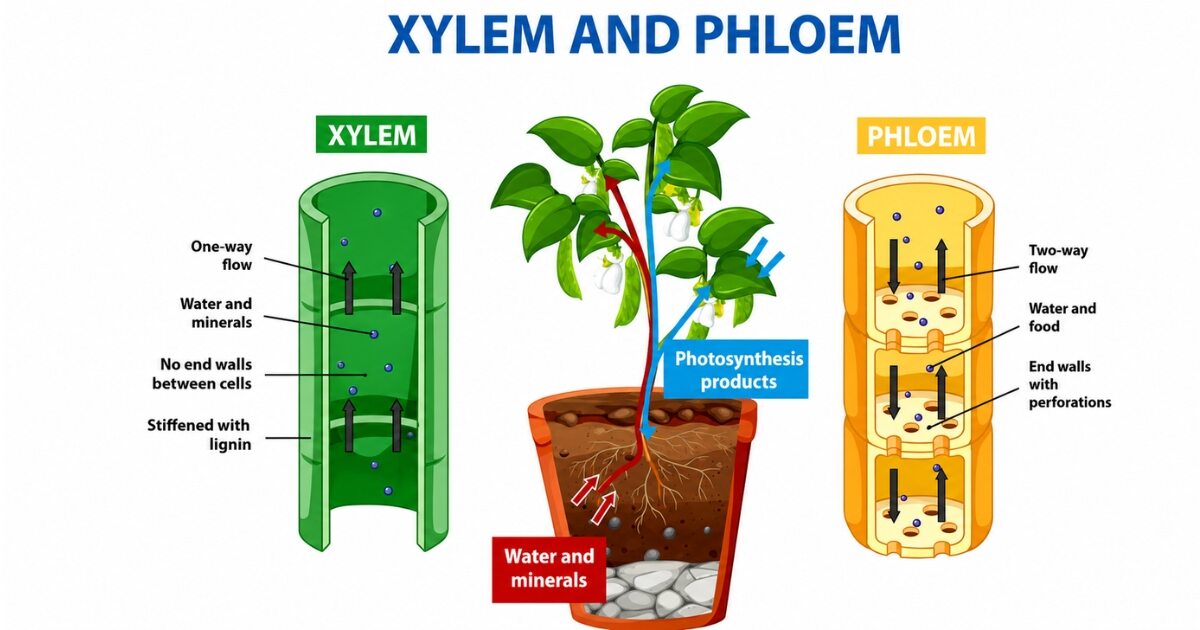
Plants need to move two things around their bodies: water and food. They have two separate transport vessels to do this, and each one does a completely different job. Xylem carries water up from the roots. Phloem carries dissolved sugars from the leaves to wherever the plant needs them. Students often mix these two up in exams because they sound similar and sit next to each other inside the plant stem. This guide explains the difference between xylem and phloem clearly so you will not mix them up again.
Xylem transports water and dissolved minerals from the roots up to the leaves and stems. Phloem transports dissolved sugars and other nutrients made during photosynthesis from the leaves to the rest of the plant. Xylem moves in one direction only, upward. Phloem moves in both directions depending on where the plant needs food.
Difference Between Xylem and Phloem: Comparison Table
| Feature | Xylem | Phloem |
|---|---|---|
| What it transports | Water and dissolved minerals | Dissolved sugars and nutrients |
| Direction of transport | One direction only, upward from roots to leaves | Both directions, up and down the plant |
| Source of material | Water absorbed from soil by roots | Sugars produced in leaves during photosynthesis |
| Cell structure | Dead cells with no cell contents | Living cells with companion cells |
| Cell walls | Thick walls strengthened with lignin | Thin walls, no lignin |
| Process name | Transpiration | Translocation |
| Found in | Roots, stems, leaves | Roots, stems, leaves |
| Main function | Water transport and structural support | Food transport throughout the plant |
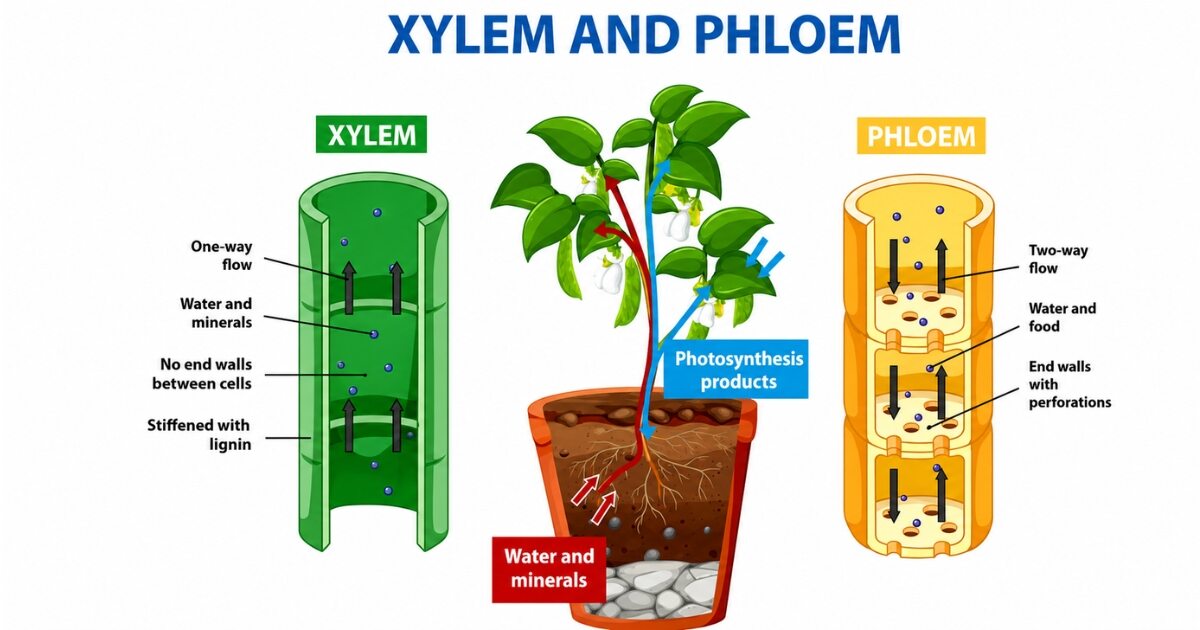
What is Xylem?
To understand the difference between xylem and phloem, start with xylem. Xylem is a transport tissue found in all vascular plants. Its main job is to carry water and dissolved minerals from the roots up through the stem and into the leaves. This movement of water upward through the plant is called transpiration.
Xylem vessels are made from dead cells. When xylem cells mature, they lose their cell contents and their end walls break down, creating long hollow tubes that water can flow through easily. The walls of xylem cells are thickened with a tough waterproof material called lignin, which also gives the plant structural support and helps it stand upright.
Key facts about xylem you need to know for GCSE:
- Xylem cells are dead at maturity with no cell contents
- Water moves through xylem by a process called transpiration pull, driven by water evaporating from the leaves
- Xylem only moves water in one direction, upward from roots to leaves
- The lignin in xylem walls makes wood, which is why trees are rigid and strong
- Xylem vessels are found in bundles alongside phloem throughout the plant
What is Phloem?
Phloem is the second transport tissue in plants and the other half of the difference between xylem and phloem. Where xylem carries water, phloem carries food. Specifically, phloem transports dissolved sugars, mainly sucrose, that are produced in the leaves during photosynthesis. This movement of sugars through phloem is called translocation.
Unlike xylem, phloem cells are living. They are called sieve tube cells and they have special sieve plates at each end that allow substances to pass through from one cell to the next. Each sieve tube cell has a companion cell alongside it which provides the energy needed to actively move sugars through the phloem.
Key facts about phloem you need to know for GCSE:
- Phloem cells are living and require energy to function
- Sugars move through phloem by a process called translocation
- Phloem can move substances in both directions, up or down depending on where the plant needs food
- Phloem transports food to growing areas, storage organs, and fruits
- Companion cells sit alongside phloem sieve tubes and provide energy for active transport
The Difference Between Xylem and Phloem in Plant Structure
In a plant stem, xylem and phloem are found together in structures called vascular bundles. In a typical dicotyledonous plant stem, xylem is on the inside of the bundle and phloem is on the outside. In roots, xylem forms a central star shape with phloem between the points of the star. In leaves, xylem and phloem run together through the veins you can see when you hold a leaf up to the light.
This arrangement means the difference between xylem and phloem is not just functional but also structural. They are separate tissues doing separate jobs but always found together because the plant needs both water and food delivered to the same places.
Example 1 – Water moving up a celery stalk (Xylem):
If you place a stick of celery in coloured water, the water travels up through the xylem vessels and eventually colours the leaves. This is a classic classroom demonstration of xylem transport. The coloured water moves upward through the dead hollow xylem tubes driven by transpiration pull from the leaves above.
Example 2 – Sugar moving to a growing fruit (Phloem):
When a tomato plant is producing fruit, sugars made in the leaves during photosynthesis are transported downward through the phloem to the developing tomatoes. The fruit grows because phloem delivers the dissolved sugars it needs to build new cells. This is translocation in action and a clear example of phloem moving substances downward.
Example 3 – A tree trunk (Xylem):
The wood in a tree trunk is almost entirely made up of old xylem vessels. As trees grow, new xylem forms each year on the outside of the old xylem, creating the annual rings you can count to find the age of a tree. The lignin in the xylem walls gives wood its strength and rigidity.
Example 4 – Aphids feeding on phloem (Phloem):
Aphids are small insects that pierce plant stems with their mouthparts and feed directly from phloem vessels. They target phloem specifically because it contains the dissolved sugars they need for energy. Scientists have actually used aphids to collect phloem sap for research by allowing them to pierce the stem and then removing them, leaving their mouthparts in place as a tiny tap into the phloem.
Example 5 – Wilting in a drought (Xylem):
When a plant does not have enough water, the xylem vessels cannot maintain a continuous column of water from roots to leaves. The leaves lose more water through transpiration than the xylem can replace, and the plant wilts. This shows how essential xylem is for keeping plants upright and healthy.
Example 6 – Ring barking killing a tree (Phloem):
If the bark of a tree is removed in a complete ring around the trunk, the tree will die even though the xylem inside is undamaged. This is because phloem runs in the bark layer just beneath the surface. Removing the bark cuts off phloem transport, which means sugars from the leaves can no longer reach the roots. The roots starve and eventually the whole tree dies. This shows how vital phloem is even though it is less visible than xylem.
X goes UP. PH goes both ways.
Xylem – think of the letter X as two lines crossing upward. Xylem carries water UP from roots to leaves. One direction only, always upward.
Phloem – think of PH as in PHood (food). Phloem carries PHood (food) around the plant. Food goes wherever the plant needs it, up or down.
Or use this simple rule: X for water, PH for food. Xylem carries water. Phloem carries food. If you can remember that one fact, everything else follows from it.
Quick Quiz: Xylem or Phloem?
1. Water absorbed by the roots is transported up to the leaves. Which tissue does this?
2. Dissolved sugars made during photosynthesis are carried to a growing fruit. Which tissue does this?
3. A transport tissue made of dead cells strengthened with lignin. Is this xylem or phloem?
4. A transport tissue that can move substances both up and down the plant. Is this xylem or phloem?
5. Aphids pierce plant stems to feed from this tissue because it contains dissolved sugars. Which tissue is it?
6. The process by which water moves through this tissue from roots to leaves is called transpiration. Which tissue is this?
Difference Between Xylem and Phloem in Exams
The difference between xylem and phloem comes up in almost every GCSE Biology paper that covers plant biology. The most common question types ask you to compare the two tissues, explain the process of transpiration or translocation, or describe what would happen if one tissue was damaged. Always make sure you use the correct process names: transpiration for xylem and translocation for phloem.
Common Mistakes to Avoid
Saying phloem only moves downward:
Many students think phloem only moves sugars downward from leaves to roots. This is wrong. Phloem moves substances in both directions depending on where the plant needs food. Sugars go to wherever they are needed most, whether that is upward to a growing shoot tip or downward to storage roots.
Saying xylem cells are living:
Xylem cells are dead at maturity. This is actually what makes them good at their job. Dead cells have no cell contents blocking the tube, so water can flow through freely. Students often assume that because xylem is doing an important job it must be made of living cells, but the opposite is true.
Confusing transpiration and translocation:
Transpiration is the movement of water through xylem. Translocation is the movement of sugars through phloem. These two words come up constantly in exam questions on the difference between xylem and phloem and mixing them up will cost you marks every time.
Frequently Asked Questions
What is the main difference between xylem and phloem?
The main difference between xylem and phloem is what they transport. Xylem transports water and minerals upward from the roots. Phloem transports dissolved sugars in both directions around the plant. Xylem cells are dead and strengthened with lignin. Phloem cells are living and require energy from companion cells.
Why does xylem only move in one direction?
Xylem moves water upward because the driving force is transpiration pull from the leaves. Water evaporates from the leaves through tiny pores called stomata, and this creates a pulling force that draws water up through the xylem from the roots. Gravity pulls water down but transpiration pull is stronger, so the net movement is always upward.
What would happen if the phloem was blocked?
If phloem was blocked, sugars produced in the leaves during photosynthesis could not be transported to the rest of the plant. Roots, stems, and fruits would be starved of the food they need to grow and function. The plant would eventually die. This is exactly what happens when a tree is ring barked and the phloem in the bark layer is destroyed.
Are xylem and phloem found in all plants?
Xylem and phloem are found in all vascular plants, which includes flowering plants, conifers, ferns, and horsetails. Simple non-vascular plants like mosses and liverworts do not have xylem or phloem. They are small enough to transport water and nutrients by diffusion alone without needing dedicated transport vessels.
For more on plant biology, visit BBC Bitesize Biology: Transport in Plants.
Also read: Difference Between Osmosis and Diffusion and Difference Between Photosynthesis and Respiration to build your complete understanding of plant biology.
Once you know the difference between xylem and phloem, questions about plant transport in your GCSE Biology exam become much more straightforward to answer.
