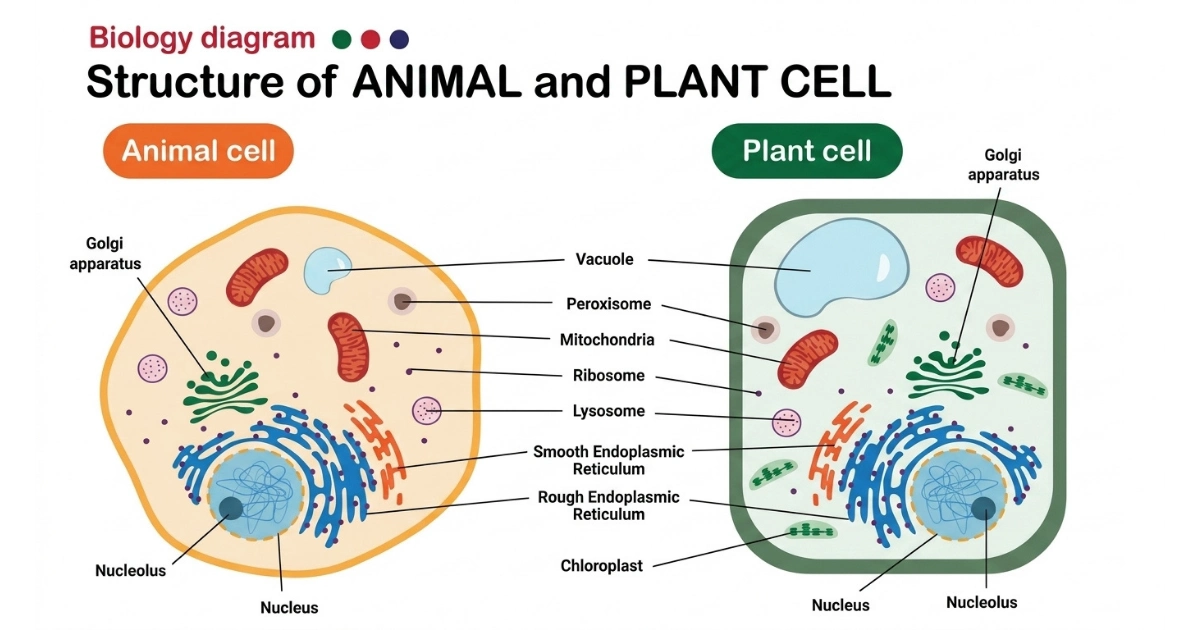
Look down a microscope at an onion cell and then look at a cheek cell scraped from the inside of your mouth, and you will immediately spot that something is different. Both are living cells, both are eukaryotic, and both carry out the basic functions of life, yet they are clearly built differently.
The difference between animal and plant cells is one of the first comparisons students meet in Biology, and it forms the foundation for topics like photosynthesis, respiration and osmosis later in the course. Once you can confidently label and compare the two, a huge part of cell biology becomes much easier.
This guide breaks the difference between animal and plant cells down clearly, with a comparison table, real examples and a memory trick that helps students keep the extra plant structures straight in the exam.
Quick Verdict
Animal cells are flexible, irregularly shaped cells with no cell wall, no chloroplasts and no permanent vacuole. Plant cells have a rigid cell wall, chloroplasts for photosynthesis, and a large permanent vacuole, giving them a fixed, regular shape. The extra structures in plant cells all exist to support a life that makes its own food and needs to stay upright without a skeleton.
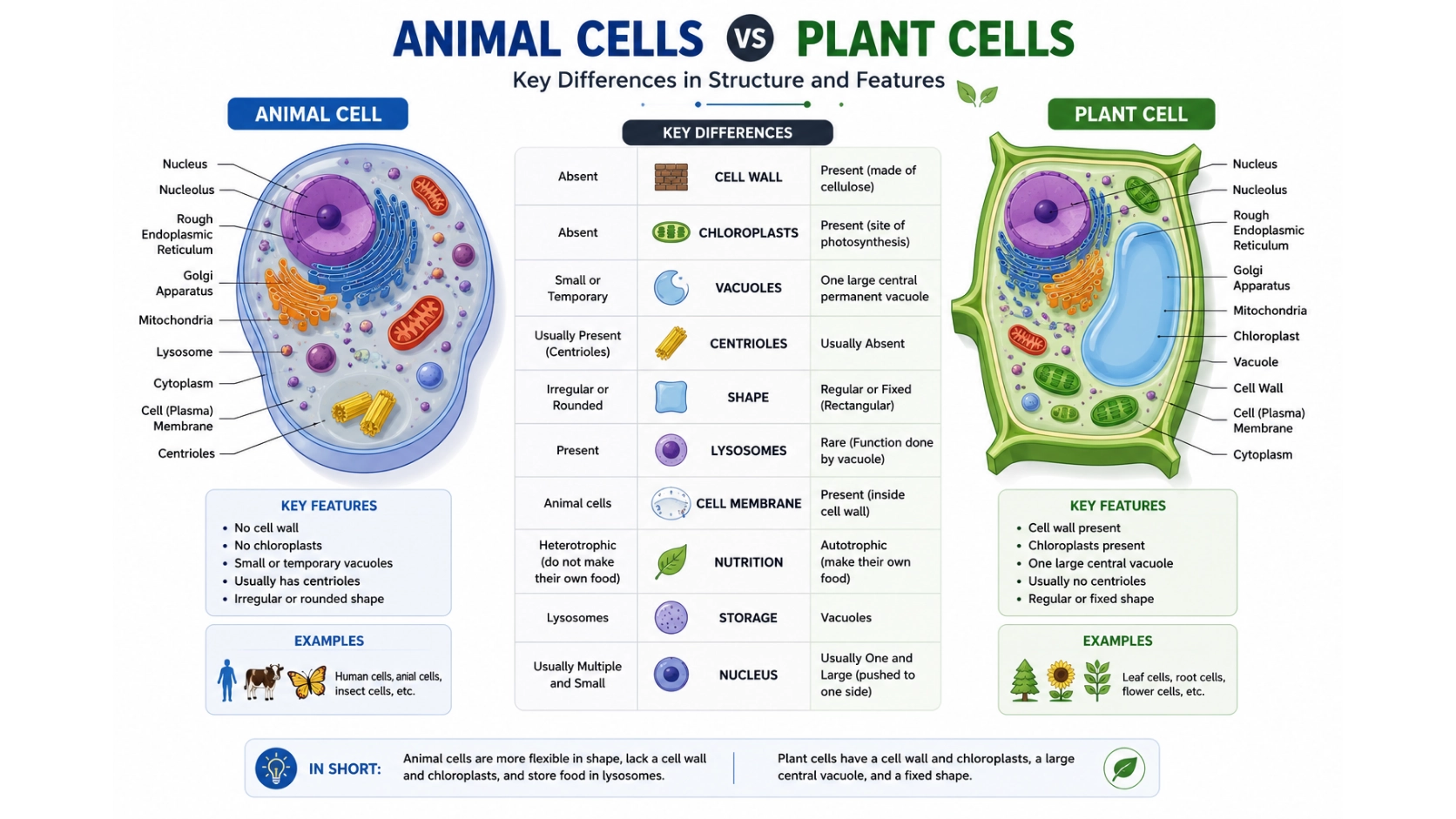
Animal and Plant Cells Comparison Table
| Feature | Animal Cells | Plant Cells |
|---|---|---|
| Cell wall | Absent | Present, made of cellulose |
| Shape | Irregular, rounded | Fixed, regular, often rectangular |
| Chloroplasts | Absent | Present, used for photosynthesis |
| Vacuole | Small and temporary, if present at all | Large, permanent, filled with cell sap |
| Energy storage | Stored as glycogen | Stored as starch |
| Nucleus and mitochondria | Present | Present |
What Makes Up an Animal Cell?
An animal cell is a type of eukaryotic cell with a flexible outer boundary called the cell membrane, rather than a rigid cell wall. This flexibility allows animal cells to take on a wide range of irregular shapes, suited to the many different jobs animal tissues perform.
Inside, an animal cell contains a nucleus that holds the genetic material, mitochondria that release energy, and ribosomes that build proteins. Animal cells may contain small, temporary vacuoles, but they are nothing like the large permanent vacuole found in plant cells.
Because animals move around and rely on other organisms for food, their cells are not built to photosynthesise or support a fixed structure the way plant cells are.
What Makes Up a Plant Cell?
A plant cell shares the same basic eukaryotic features as an animal cell, including a nucleus, mitochondria and ribosomes, but it also has several extra structures that reflect a very different way of living.
A rigid cell wall made of cellulose surrounds the cell membrane, giving plant cells a fixed, regular shape and helping the whole plant stay upright without a skeleton. Chloroplasts, containing the green pigment chlorophyll, allow plant cells to carry out photosynthesis and produce their own food using sunlight.
A large permanent vacuole, filled with a liquid called cell sap, takes up much of the interior space, helping to keep the cell firm and supporting the structure of the whole plant through a process called turgor pressure.
The Key Differences Explained
The clearest difference between animal and plant cells comes down to three extra structures found only in plant cells: the cell wall, chloroplasts and the large permanent vacuole. Animal cells simply do not have these features at all.
The cell wall explains why plant cells keep a fixed shape while animal cells can appear rounded or irregular. Chloroplasts explain why plants are green and able to make their own food, something animal cells cannot do. The permanent vacuole explains why plant cells can stay rigid and support the whole plant, even without a skeleton.
Energy storage is another useful clue examiners like to test. Animal cells store excess energy as glycogen, while plant cells store it as starch, both of which are simply different arrangements of glucose molecules built for storage.
Why This Difference Matters for the Rest of Biology
Understanding the difference between animal and plant cells sets up several major GCSE topics that follow later in the course. Photosynthesis only makes sense once you know that chloroplasts exist specifically in plant cells and not animal cells.
The concept of turgor pressure, used to explain how plants stay upright and how wilting happens, depends entirely on the permanent vacuole and cell wall working together, neither of which exist in animal cells. Even topics like osmosis are usually explained using plant cells first, because the rigid cell wall creates a clear, visible response that is easy to observe under a microscope.
Real World Examples
The onion cell microscope practical is one of the most common ways GCSE students observe plant cells directly, staining a thin layer of onion skin to clearly see the cell wall, nucleus and large vacuole under a light microscope.
The cheek cell microscope practical is the classic animal cell equivalent, where a gentle scrape from the inside of the cheek reveals cells with a visible nucleus but no cell wall, no chloroplasts and no permanent vacuole, making the contrast with the onion cell immediately obvious.
Memory Trick
Remember plant cells with “WCV”: Wall, Chloroplasts, Vacuole. These are the three extra structures a plant cell has that an animal cell does not. If you can recall “WCV” in an exam, you can quickly list every major structural difference between animal and plant cells without missing one.
Test Yourself: Animal and Plant Cells Quiz
1. Which structure is found in plant cells but not animal cells?
2. Which organelle allows plant cells to photosynthesise?
3. How do animal cells store excess energy?
4. Which cell type generally has a fixed, regular shape?
5. What is the large permanent structure filled with cell sap called?
Common Mistakes Students Make
The most common mistake students make with the difference between animal and plant cells is thinking plant cells simply have “more parts” without understanding why. Every extra structure exists for a reason connected to how plants live, make food and support themselves without a skeleton.
Another common mistake is forgetting that plant and animal cells share far more in common than they differ. Both are eukaryotic, both have a nucleus, mitochondria and ribosomes, and both carry out the same basic life processes.
Students also sometimes assume all plant cells contain chloroplasts. Root cells, for example, do not photosynthesise and typically contain very few or no chloroplasts, since they are underground and receive no sunlight.
Frequently Asked Questions
What is the main difference between animal and plant cells?
The main difference between animal and plant cells is that plant cells have a rigid cell wall, chloroplasts and a large permanent vacuole, none of which are found in animal cells.
Do plant cells have mitochondria?
Yes. Plant cells contain mitochondria, just like animal cells, since both need to release energy through respiration.
Why don’t animal cells have a cell wall?
Animal cells do not need a rigid cell wall because animals typically have an internal or external skeleton for support and rely on movement rather than staying fixed in one place like plants.
Do all plant cells contain chloroplasts?
No. Only plant cells exposed to light, such as those in leaves and stems, typically contain chloroplasts. Root cells, for example, usually contain very few or none, since they do not carry out photosynthesis underground.
What is the function of the vacuole in a plant cell?
The vacuole stores cell sap and helps keep the cell firm through turgor pressure, supporting the structure of the whole plant. Without enough water in the vacuole, plant cells become soft and the plant begins to wilt.
For more detail on cell structure, BBC Bitesize’s Biology resources are a reliable place to continue your revision. You might also want to look at our guide to Prokaryotic and Eukaryotic Cells to see how animal and plant cells compare to simpler bacterial cells, or revisit DNA and RNA to see how genetic material is organised inside the nucleus both cell types share.
Once you can confidently explain the difference between animal and plant cells, you have a solid foundation for photosynthesis, respiration, osmosis and several other major Biology topics. Animal cells are flexible and mobile, while plant cells are rigid, self-feeding, and built to stay upright without a skeleton.
Keep the “WCV: Wall, Chloroplasts, Vacuole” memory trick close at hand during revision, work through the quiz above until every answer feels automatic, and picture the onion cell and cheek cell side by side whenever this topic comes up in the exam.
