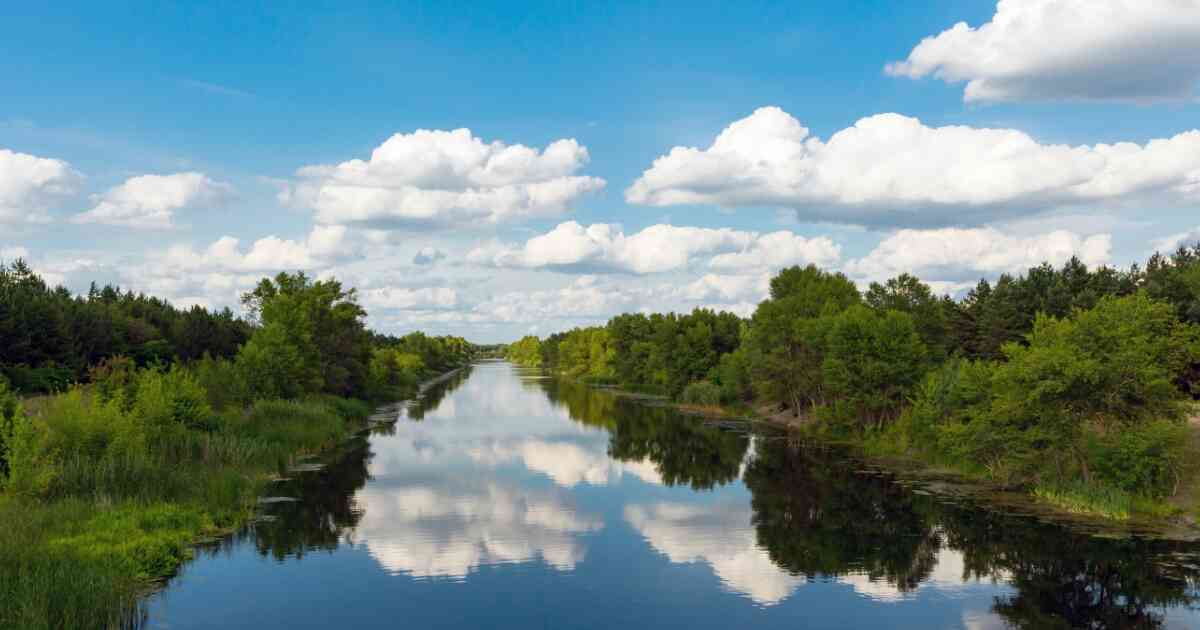
River and lake are two words most people learn as young children, yet when asked to explain exactly what makes them different, many students struggle. They both involve large bodies of fresh water. They both appear on maps. But they are fundamentally different things. The difference between a river and a lake comes down to movement, shape, and how water flows through them. This guide explains both clearly with real examples, a comparison table, a memory trick, and a quiz.
A river is a flowing body of water that moves continuously in one direction, from a source (usually high ground) to a mouth (usually the sea or another body of water). A lake is a large body of water that is surrounded by land on all sides and does not flow in a fixed direction. Rivers move. Lakes stay still.
Difference Between a River and a Lake: Comparison Table
| Feature | River | Lake |
|---|---|---|
| Movement | Flows continuously in one direction | Still water, does not flow in one direction |
| Shape | Long and narrow channel | Wide and roughly circular or oval |
| Surrounded by land? | No, has two banks but flows to the sea | Yes, completely surrounded by land |
| Source | Springs, glaciers, rainfall on high ground | Rivers, rainfall, groundwater, glaciers |
| Outlet | Flows into sea, ocean, or another river | May have a river outlet or lose water by evaporation |
| Water type | Usually fresh water | Usually fresh water, some are saltwater |
| Examples | Amazon, Nile, Thames, Mississippi | Caspian Sea, Superior, Victoria, Baikal |
| Used for | Transport, irrigation, hydroelectric power | Drinking water, fishing, recreation |
What is a River?
A river is a natural flowing watercourse that moves continuously from its source to its mouth. The source is where the river begins, usually in high ground where rainfall collects or where a spring emerges. The mouth is where the river ends, usually where it meets the sea, an ocean, or a larger river.
Rivers shape the landscape around them over thousands of years. They erode rock and soil, carry sediment downstream, and deposit it when they slow down. The wide flat areas around rivers (called floodplains) are some of the most fertile land on Earth, which is why the earliest human civilisations grew up along rivers like the Nile, the Tigris, and the Euphrates.
Key features of a river include:
- Source – where the river begins, often on high ground
- Tributary – a smaller river or stream that joins the main river
- Channel – the bed and banks the river flows through
- Floodplain – the flat land either side of the river that floods during high water
- Mouth – where the river meets the sea or another body of water
- Delta – a triangular deposit of sediment formed where some rivers meet the sea
What is a Lake?
A lake is a large body of still water that is surrounded by land on all sides. Unlike a river, a lake does not flow in one continuous direction. The water in a lake may have currents caused by wind, but overall it stays in one place rather than moving from a source to a mouth.
Lakes form in several different ways. Some formed when glaciers carved out hollows in the land during the last ice age, which then filled with meltwater. Others formed in volcanic craters, in depressions caused by tectonic activity, or where rivers widened into large basins. Some lakes are artificial, created by building dams across rivers.
Key features of a lake include:
- Shore – the land around the edge of the lake
- Inlet – where water flows into the lake, often from a river or stream
- Outlet – where water flows out of the lake, often as a river
- Depth – lakes vary enormously in depth, from shallow ponds to Lake Baikal which is over 1,600 metres deep
- Endorheic lake – a lake with no outlet, where water only leaves by evaporation. The Caspian Sea and the Dead Sea are examples
Example 1 – The River Nile (River):
The Nile is the longest river in the world at approximately 6,650 kilometres. It flows northward through northeastern Africa from its source in the highlands of Burundi to its mouth in the Mediterranean Sea in Egypt. It has sustained human civilisation for thousands of years and is one of the most studied rivers on Earth.
Example 2 – Lake Victoria (Lake):
Lake Victoria is the largest lake in Africa and the second largest freshwater lake in the world by surface area. It sits on the borders of Uganda, Kenya, and Tanzania. It is surrounded by land on all sides and is fed by many rivers. Interestingly, the River Nile actually begins at Lake Victoria, making it both a lake and the source of a famous river.
Example 3 – The River Thames (River):
The Thames flows 346 kilometres through southern England, passing through Oxford and London before emptying into the North Sea. It is one of the most historically important rivers in the world. Unlike a lake, it is constantly moving, carrying water from its source in the Cotswold Hills all the way to the sea.
Example 4 – Lake Baikal (Lake):
Lake Baikal in Siberia, Russia is the world’s deepest lake at over 1,600 metres and contains approximately 20% of the world’s unfrozen surface fresh water. It is completely landlocked and surrounded by mountains. Despite its enormous size, it stays in place rather than flowing in one direction like a river.
Example 5 – The Amazon River (River):
The Amazon in South America is the world’s largest river by water volume. It carries more water than the next seven largest rivers combined. It flows from the Andes mountains eastward across Brazil to the Atlantic Ocean. The sheer movement and flow of the Amazon illustrates perfectly what makes a river different from a lake.
The movement trick:
River = Runs. Rivers run from source to sea. The water is always moving, always going somewhere.
Lake = Lies still. Lakes lie in their basin, surrounded by land, going nowhere in particular.
Or think of it this way: a river has a journey to complete. It starts somewhere high and ends somewhere low, and it never stops moving until it gets there. A lake has already arrived. It sits in its hollow and stays put.
Quick Quiz: River or Lake?
1. A body of water flows continuously from mountains to the sea. This is:
2. A large body of still water is completely surrounded by land. This is:
3. The Amazon in South America is an example of:
4. Lake Baikal in Russia is the world’s deepest what?
5. Which has a source and a mouth?
Difference Between a River and a Lake in Exams
The difference between a river and a lake appears in Geography exams at Key Stage 3 and GCSE level. Questions typically ask you to define each feature, identify them on maps, describe how they form, and explain how they are used by humans. Knowing specific examples like the Nile, Thames, Amazon, Lake Victoria, and Lake Baikal will help you write stronger, more precise exam answers.
Common Mistakes to Avoid
Calling the sea a lake:
The Caspian Sea is technically the world’s largest lake because it is completely surrounded by land. Despite being called a sea, geographers classify it as a lake. Do not let the name confuse you. What matters is whether the water is surrounded by land and whether it flows continuously in one direction.
Thinking all lakes are fresh water:
Most lakes contain fresh water but some are saltwater, particularly endorheic lakes that have no outlet. The Caspian Sea, the Dead Sea, and the Great Salt Lake in Utah are all saltwater lakes. Water enters but never leaves (except by evaporation), causing salt to accumulate over thousands of years.
Confusing a river with a stream:
A stream is simply a small river. There is no precise scientific definition of when a stream becomes a river, but generally rivers are larger, deeper, and carry more water. In exam answers, use the word river for the larger examples and stream or tributary for smaller ones feeding into them.
Frequently Asked Questions
Can a river flow into a lake?
Yes, and this is very common. Many lakes are fed by rivers and streams that flow into them. Lake Victoria, for example, is fed by many rivers. A lake can also have a river flowing out of it as an outlet. The River Nile famously flows out of Lake Victoria. So rivers and lakes are often connected as part of the same water system.
What is the difference between a lake and a pond?
There is no strict scientific definition separating lakes from ponds. Generally, a pond is smaller and shallower than a lake, and sunlight reaches the bottom of a pond but not a lake. In everyday language, ponds are small enough to be man-made in a garden, while lakes are natural and much larger. The boundary between the two is not fixed.
Which is the longest river in the world?
The Nile in Africa and the Amazon in South America compete for the title, depending on how the length is measured. The Nile is generally listed as the longest at approximately 6,650 kilometres. The Amazon carries far more water by volume. Both are significantly longer than the third longest river, the Yangtze in China.
Which is the largest lake in the world?
The Caspian Sea is the largest lake in the world by surface area at approximately 371,000 square kilometres. However, if it is not counted because of its name, Lake Superior in North America is the largest freshwater lake by surface area. Lake Baikal in Russia contains the most fresh water by volume despite not being the largest by surface area.
Why do rivers always flow downhill?
Rivers flow downhill because of gravity. Water naturally moves from higher elevation to lower elevation, taking the path of least resistance through the landscape. This is why rivers always begin on high ground and end at sea level or lower. It is also why rivers curve and meander rather than flowing in straight lines — they follow the contours of the land as they descend.
For more Geography help visit National Geographic: Rivers.
Also read: Difference Between Weather and Climate | Difference Between Longitude and Latitude | Difference Between Speed and Velocity
The difference between a river and a lake is ultimately about movement and containment. A river is always going somewhere. A lake has already arrived. Understanding the difference between a river and a lake helps you read maps, understand landscapes, and answer Geography questions with confidence. The difference between a river and a lake is one of those geographical fundamentals that once learned, helps everything else in physical Geography make more sense.
Next time you look at a map, try spotting the difference between river and lake features in the landscape. The difference between river and lake becomes very obvious once you start looking for it in real geography. Rivers carve paths across the land while lakes sit quietly in their basins. Knowing the difference between river and lake geography will help you read maps and answer exam questions with much more confidence.
The difference between a river and a lake is ultimately about movement and containment. A river is always going somewhere. A lake has already arrived. Understanding the difference between a river and a lake helps you read maps, understand landscapes, and answer Geography questions with confidence. The difference between a river and a lake is one of those geographical fundamentals that once learned, helps everything else in physical Geography make more sense. Every time you see flowing water on a map, you are looking at the difference between a river and a lake in action.

2 thoughts on “Difference Between a River and a Lake: 5 Brilliant Facts Every Geography Student Must Know”
Comments are closed.