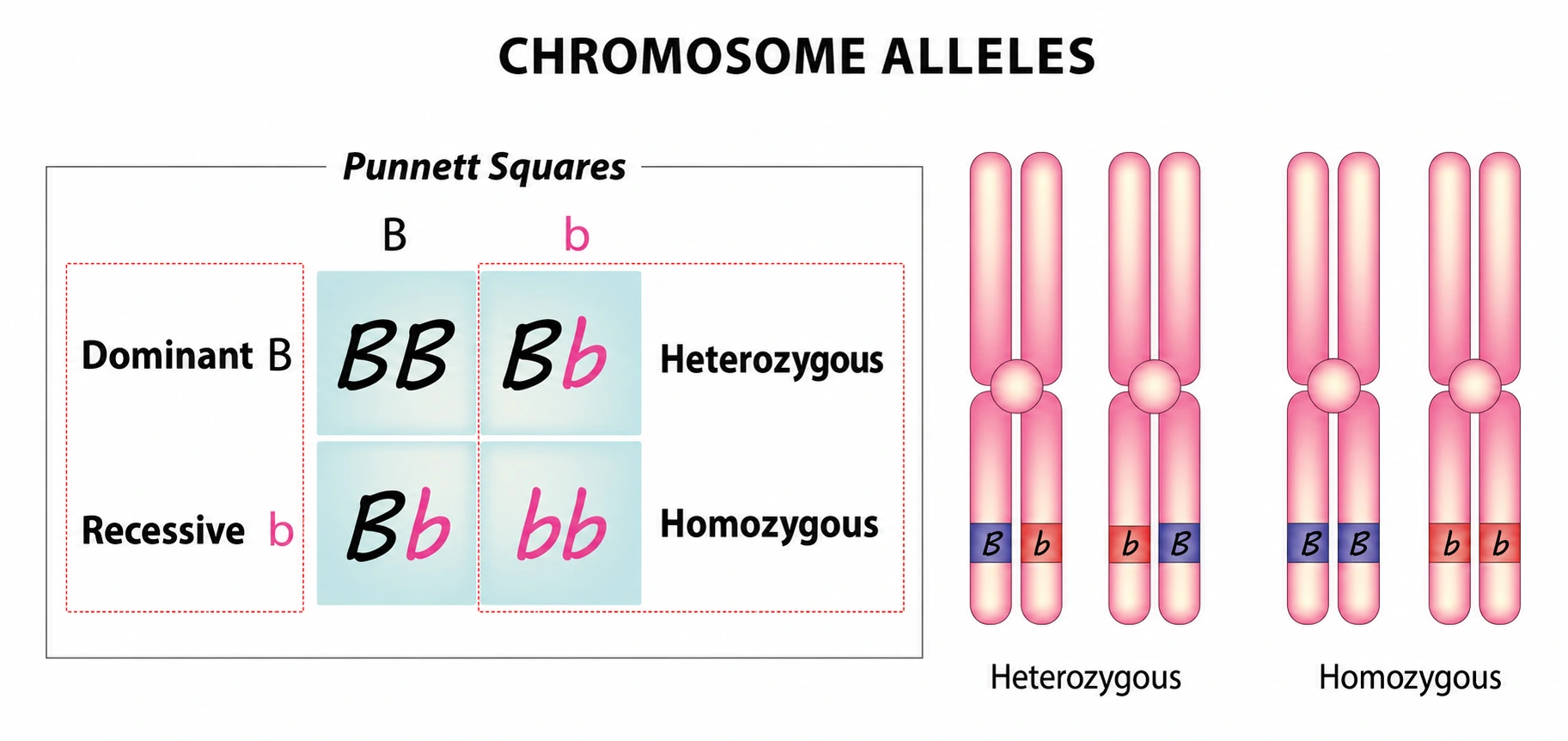
Two brown-eyed parents can sometimes have a blue-eyed child, and students always want to know how that is possible. The answer lies in the difference between dominant and recessive alleles, one of the most useful ideas in the whole of GCSE genetics.
Every trait you inherit is controlled by a pair of alleles, one from each parent, and which allele is dominant and which is recessive decides which trait actually gets shown. Once you understand the difference between dominant and recessive alleles, genetic crosses and family inheritance patterns finally start to make sense.
This guide breaks the difference between dominant and recessive alleles down clearly, with a comparison table, real examples and a memory trick to help both terms stay separate in your mind before the exam.
Quick Verdict
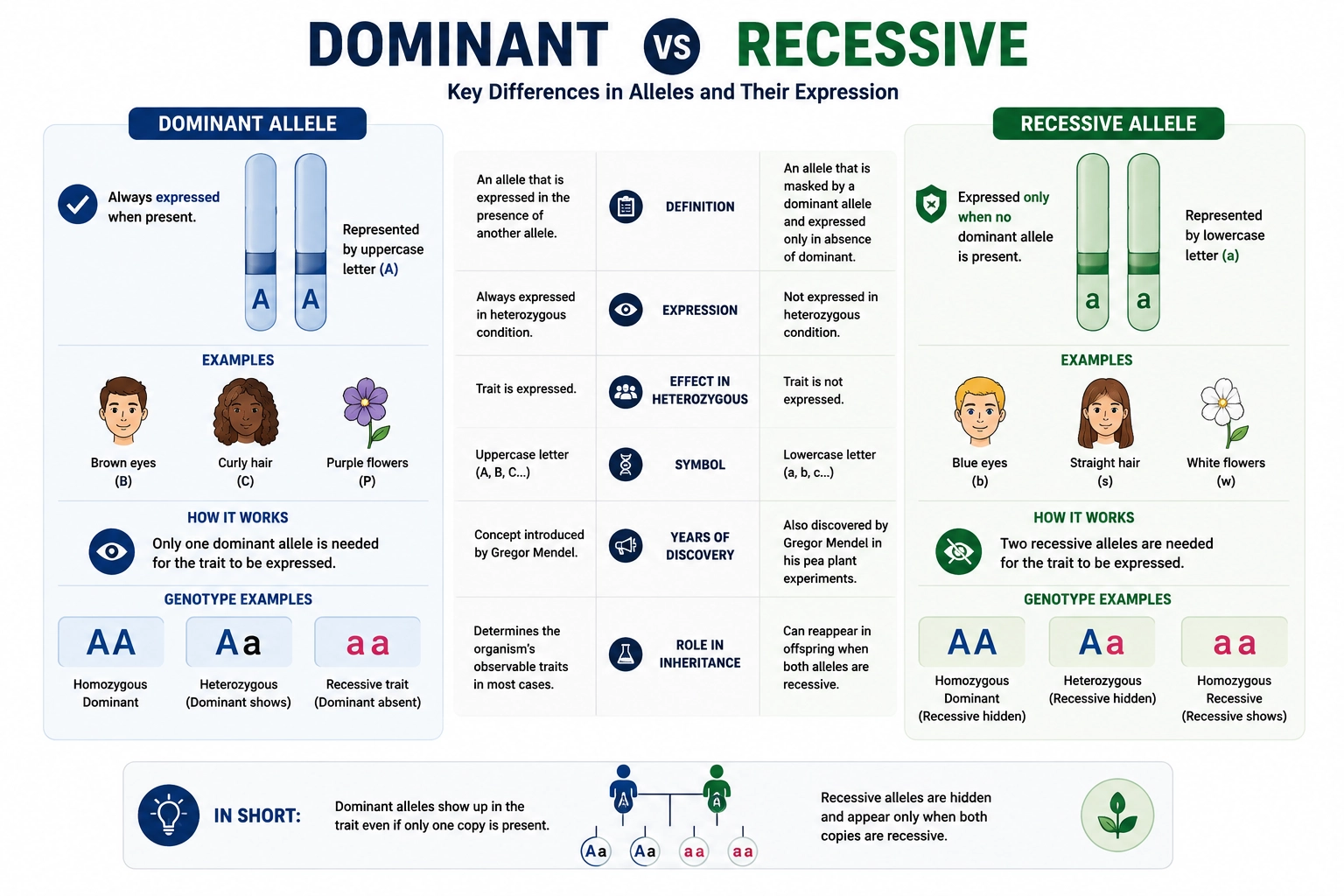
A dominant allele is one that is always expressed in the phenotype if present, even when paired with a different allele. A recessive allele is only expressed in the phenotype when two copies of it are present, since a dominant allele will always mask it otherwise. Dominant alleles win by default. Recessive alleles only show up when there is no dominant allele to hide behind.
Dominant and Recessive Alleles Comparison Table
| Feature | Dominant Allele | Recessive Allele |
|---|---|---|
| Notation | Written as a capital letter, e.g. B | Written as a lowercase letter, e.g. b |
| Copies needed to be expressed | Just one copy is enough | Two copies are needed |
| Effect when paired together | Masks the recessive allele | Hidden if paired with a dominant allele |
| Genotype examples | BB or Bb both show the dominant trait | Only bb shows the recessive trait |
| Typical human example | Brown eyes | Blue eyes |
What Is a Dominant Allele?
A dominant allele is a version of a gene that will always be expressed in the phenotype whenever it is present, regardless of what the other allele in the pair happens to be. This means an organism only needs one copy of a dominant allele for its trait to show.
Dominant alleles are represented using a capital letter in genetic diagrams. If an organism’s genotype is BB or Bb, the dominant trait linked to the B allele will be visible in the phenotype either way, since the dominant allele overrides any recessive allele it is paired with.
Many common human traits are controlled by dominant alleles, including having brown eyes rather than blue, and being able to roll your tongue rather than not being able to.
What Is a Recessive Allele?
A recessive allele is a version of a gene that is only expressed in the phenotype when two copies of it are present, one from each parent. If a recessive allele is paired with a dominant allele, the dominant allele is expressed instead, and the recessive allele is effectively hidden.
Recessive alleles are represented using a lowercase letter in genetic diagrams. Only a genotype of bb will produce the recessive trait, since any presence of a dominant B allele would mask it completely.
This is exactly how two brown-eyed parents can have a blue-eyed child. If both parents carry the genotype Bb, meaning they each carry one hidden recessive allele for blue eyes, there is a chance their child could inherit two recessive alleles and end up with the genotype bb, resulting in blue eyes despite neither parent showing that trait.
The Key Differences Explained
The core difference between dominant and recessive alleles comes down to how many copies are needed for the trait to actually appear. A dominant allele only needs one copy to control the phenotype. A recessive allele needs two copies, since a single dominant allele will always mask it.
This is why recessive traits can seem to “skip” a generation. A parent can be a carrier of a recessive allele without showing the recessive trait themselves, simply because their other allele is dominant. That hidden recessive allele can then be passed on and combined with another recessive allele from the other parent, producing a child who shows a trait that neither parent visibly had.
Dominant does not mean “better” or “more common” in a population. It simply means the allele takes priority in determining the phenotype whenever it is present alongside a recessive allele.
Why This Difference Matters for Genetic Disorders
Understanding the difference between dominant and recessive alleles becomes especially important when studying inherited genetic disorders. Some conditions are caused by dominant alleles, meaning only one copy is needed for a person to be affected. Others are caused by recessive alleles, meaning a person needs to inherit two copies, one from each parent, to actually develop the condition.
This distinction explains why some genetic disorders can appear even when neither parent shows any symptoms. If both parents are unaffected carriers of a single recessive allele, there is still a chance their child could inherit two recessive alleles and develop the condition, even though neither parent was ever affected themselves.
Real World Examples
Cystic fibrosis is caused by a recessive allele, meaning a person only develops the condition if they inherit two copies of the faulty allele, one from each parent. Carriers with just one copy usually show no symptoms at all.
Huntington’s disease is caused by a dominant allele, meaning a person only needs to inherit one copy from either parent to develop the condition, regardless of what the other allele is.
Tongue rolling in humans is a simpler classroom example of a dominant trait, often used to demonstrate dominant and recessive inheritance without the sensitivity of discussing genetic disorders directly.
Memory Trick
Remember it as “DOMINANT wins with just ONE, RECESSIVE needs a full TEAM of two.” A DOMINANT allele only needs ONE copy to control the phenotype. A RECESSIVE allele needs a full TEAM, meaning two copies, to be expressed at all. If you remember “one versus two,” the difference between dominant and recessive alleles becomes much easier to apply in genetic cross questions.
Test Yourself: Dominant and Recessive Alleles Quiz
1. How many copies of a dominant allele are needed to show the trait?
2. Which genotype would show a recessive trait?
3. Which letter format represents a recessive allele?
4. Is cystic fibrosis caused by a dominant or recessive allele?
5. Can two unaffected parents have a child with a recessive genetic condition?
Common Mistakes Students Make
The most common mistake students make with the difference between dominant and recessive alleles is assuming dominant means “more common” in a population. Dominance is about which allele is expressed when paired with another allele, not about how frequently that allele appears in a population overall.
Another common mistake is forgetting that a heterozygous genotype, such as Bb, always shows the dominant trait, not a “blended” version of both traits. Blending only happens with a different type of inheritance called co-dominance, which is a separate concept from simple dominant and recessive inheritance.
Students also sometimes assume both parents must show a trait for their child to inherit it. As the blue-eyed child example shows, a recessive trait can appear in a child even when neither parent visibly shows it, as long as both parents carry a hidden recessive allele.
Frequently Asked Questions
What is the main difference between dominant and recessive alleles?
The main difference between dominant and recessive alleles is how many copies are needed for the trait to be expressed. A dominant allele only needs one copy, while a recessive allele needs two copies, since a dominant allele will always mask it otherwise.
Why do recessive traits sometimes skip a generation?
Recessive traits can skip a generation because a parent can carry a hidden recessive allele without showing the trait, as long as their other allele is dominant. That hidden allele can then be passed on and combined with another recessive allele in the next generation.
Does dominant mean the same as common?
No. Dominant refers to which allele is expressed when paired with another allele, not how frequently that allele appears across a population. A dominant allele can still be rare, and a recessive allele can still be common.
Can two brown-eyed parents have a blue-eyed child?
Yes. If both parents have the genotype Bb, meaning they each carry one hidden recessive allele for blue eyes, there is a chance their child could inherit two recessive alleles and have blue eyes, even though both parents have brown eyes themselves.
What is the difference between a carrier and someone affected by a condition?
A carrier has one copy of a recessive allele linked to a condition but does not show symptoms, since their other allele is dominant. A person is affected by the condition only if they inherit two copies of the recessive allele.
For more detail on inheritance and alleles, BBC Bitesize’s Biology resources are a reliable place to continue your revision. You might also want to look at our guide to Genotype and Phenotype to see how alleles combine to produce visible traits, or revisit DNA and RNA to see how genetic information is stored in the first place.
Once you can confidently explain the difference between dominant and recessive alleles, genetic crosses and family inheritance questions become far easier to answer with confidence. Dominant alleles only need one copy to take control of the phenotype, while recessive alleles need two copies working together before they can be seen at all.
Keep the “one versus two” memory trick close at hand during revision, work through the quiz above until every answer feels automatic, and always double check whether a question is asking about genotype or phenotype before you answer, since mixing the two up is one of the easiest ways to lose marks.
