Ask a student to name a war and they will usually picture soldiers, battles and front lines. Then mention the Cold War, and the confusion starts. If neither side ever fired a shot at the other directly, was it really a war at all?
This confusion is exactly why the difference between Cold War and World War is such an important topic in GCSE History. A World War involves direct, large-scale armed combat between major powers. The Cold War involved decades of tension, rivalry and competition between superpowers who never fought each other directly, but shaped the entire second half of the twentieth century all the same.
This guide explains the difference between Cold War and World War clearly, with a comparison table, real examples and a memory trick to help both concepts stay separate in your mind before the exam.
Quick Verdict
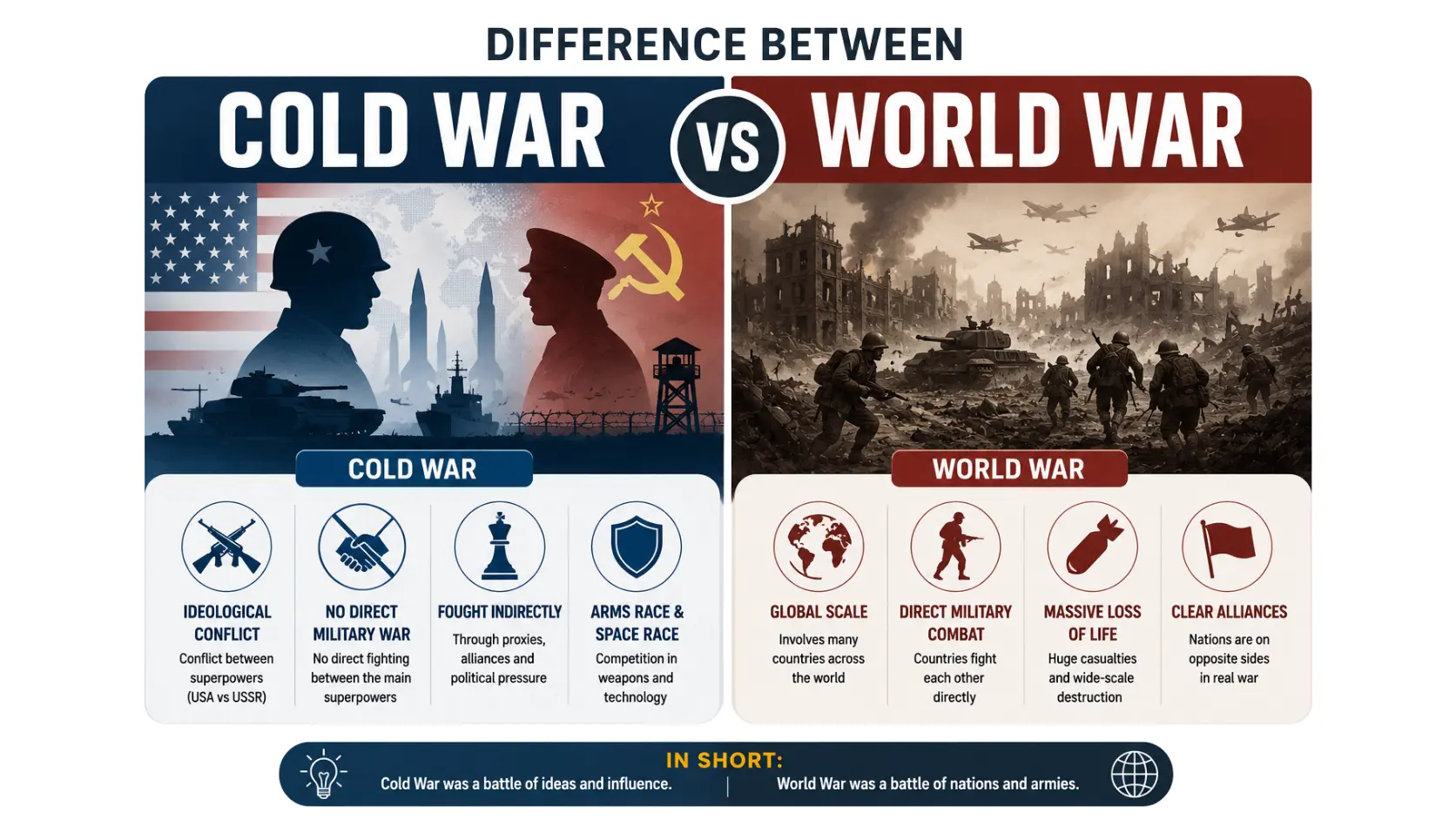
A World War is a direct, large-scale armed conflict fought between major world powers, involving actual combat, invasions and huge numbers of military casualties, such as World War One and World War Two. The Cold War was a prolonged period of political tension, rivalry and competition, mainly between the United States and the Soviet Union, in which the two superpowers never fought each other directly but competed through proxy wars, propaganda and an arms race instead.
Cold War and World War Comparison Table
| Feature | Cold War | World War |
|---|---|---|
| Type of conflict | Political and ideological tension, no direct combat between superpowers | Direct, large-scale armed conflict |
| Main powers involved | United States and Soviet Union | Multiple nations across several continents |
| Direct combat | None between the two superpowers directly | Extensive, involving armies, navies and air forces |
| Time period | Roughly 1947 to 1991 | Distinct periods, e.g. 1914 to 1918 and 1939 to 1945 |
| Main methods | Propaganda, espionage, proxy wars, arms race, space race | Military invasion, battles, bombing campaigns, occupation |
| Casualties | Relatively low between the superpowers themselves | Extremely high, often in the tens of millions |
What Is a World War?
A World War is a direct, large-scale armed conflict involving multiple major nations, fought with active combat across land, sea and sometimes air. World Wars involve real battles, invasions, occupations and enormous numbers of military and civilian casualties.
World War One, fought between 1914 and 1918, involved the major European powers along with allies from across the globe, triggered by a complex web of alliances, militarism, imperial rivalry and nationalism. World War Two, fought between 1939 and 1945, involved even more countries and introduced new levels of destruction, including the Holocaust and the first use of nuclear weapons in warfare.
Both World Wars ended with clear military outcomes, formal surrenders, and treaties that reshaped national borders and global power structures.
What Is the Cold War?
The Cold War was a prolonged period of political tension, suspicion and rivalry, mainly between the United States and the Soviet Union, that lasted from roughly 1947 until the collapse of the Soviet Union in 1991.
Unlike a World War, the two main superpowers never engaged in direct military combat with each other. Instead, the Cold War was fought through political influence, propaganda, espionage, economic competition, and an intense arms race to build more powerful weapons than the other side.
The tension frequently escalated into smaller, indirect conflicts known as proxy wars, where the superpowers supported opposing sides in other countries rather than fighting each other directly. This is one of the clearest ways to explain the difference between Cold War and World War in an exam answer.
The Key Differences Explained
The single biggest difference between Cold War and World War is direct combat. A World War involves actual fighting between the major powers themselves. The Cold War involved intense rivalry and competition, but the two main superpowers never directly fought one another on the battlefield.
The scale of casualties reflects this difference clearly. World Wars caused tens of millions of deaths through direct combat and bombing campaigns. The Cold War itself caused comparatively few casualties between the superpowers, though the proxy wars it fueled, such as Korea and Vietnam, were extremely deadly for the countries involved.
The methods used were also different in nature. World Wars were fought with tanks, aircraft and infantry on defined front lines. The Cold War was fought with propaganda broadcasts, spy networks, economic sanctions, and a race to build nuclear weapons and reach space first.
Why This Difference Matters in History
Understanding the difference between Cold War and World War helps explain why the second half of the twentieth century looked so different from the first half. After the devastation of World War Two, no major power wanted to risk another direct global war, especially once nuclear weapons made full-scale conflict potentially catastrophic for everyone involved.
This fear of mutual destruction is part of why the Cold War stayed cold rather than turning hot. Both superpowers built up huge militaries and nuclear arsenals, but avoided direct confrontation, choosing instead to compete through influence, ideology and indirect conflict in other parts of the world.
Real World Examples
The Cuban Missile Crisis in 1962 brought the United States and the Soviet Union closer to direct war than at any other point in the Cold War, after Soviet nuclear missiles were discovered in Cuba, just miles from the American coastline.
The Vietnam War is a classic Cold War proxy war, where the United States supported South Vietnam and the Soviet Union and China supported North Vietnam, without the superpowers ever fighting each other directly.
The Berlin Wall, built in 1961 and torn down in 1989, physically divided a city between capitalist West Berlin and communist East Berlin, becoming one of the most powerful symbols of Cold War division in Europe.
Memory Trick
Remember it as “WORLD War means Weapons fired, COLD War means Cautious watching.” A WORLD War involves Weapons actually being fired between major powers. The COLD War involved Cautious watching, spying and rivalry, without the two superpowers ever firing directly at each other. If you remember “weapons fired” versus “cautious watching,” the difference between Cold War and World War becomes far easier to explain clearly in an exam answer.
Test Yourself: Cold War and World War Quiz
1. Which conflict involved direct combat between major powers?
2. Which two superpowers were the main rivals in the Cold War?
3. What is a proxy war?
4. Which event brought the Cold War closest to direct conflict?
5. Roughly how long did the Cold War last?
6. Which type of conflict generally caused far higher casualties?
Common Mistakes Students Make
The most common mistake students make with the difference between Cold War and World War is assuming the Cold War involved no fighting anywhere at all. There was extensive fighting during the Cold War era, but it happened in proxy wars such as Korea and Vietnam, not directly between the two main superpowers.
Another common mistake is forgetting that the Cold War is not one single event but a decades-long period made up of many smaller crises, treaties and conflicts, all connected by the same underlying rivalry between capitalism and communism.
Students also sometimes confuse the causes of the Cold War with the causes of World War Two. While both involve major world powers and ideological tension, the Cold War specifically refers to the postwar rivalry between the United States and the Soviet Union, not the events leading up to 1939.
Frequently Asked Questions
What is the main difference between Cold War and World War?
The main difference between Cold War and World War is direct combat. A World War involves actual armed fighting between major powers, while the Cold War was a decades-long period of political tension and rivalry in which the two main superpowers never fought each other directly.
Why is it called the Cold War if no one fought?
It is called the Cold War because the two superpowers never engaged in direct “hot” combat with one another, even though tension, rivalry and indirect conflict continued for decades through propaganda, espionage and proxy wars.
When did the Cold War start and end?
The Cold War is generally dated from around 1947, shortly after the end of World War Two, until 1991, when the Soviet Union collapsed.
What is a proxy war?
A proxy war is a conflict in which two rival powers support opposing sides in another country’s war, rather than fighting each other directly. The Korean War and the Vietnam War are both classic Cold War proxy wars.
Did the Cold War cause fewer deaths than World War Two?
Direct fighting between the two main Cold War superpowers caused very few deaths, since they never fought each other directly. However, the proxy wars fueled by the Cold War, such as Korea and Vietnam, caused millions of deaths in the countries where the fighting actually took place.
For more detail on twentieth century conflict, History.com’s Cold War resources are a reliable place to continue your revision. You might also want to look at our guide to WW1 and WW2 to compare the two World Wars directly, or revisit Democracy and Dictatorship to understand the political systems that drove Cold War rivalry.
Once you can confidently explain the difference between Cold War and World War, you have a reliable way to answer one of the most commonly confused topics in GCSE History. A World War means direct combat between major powers on a massive scale. The Cold War means decades of rivalry, competition and indirect conflict, without the two main superpowers ever fighting each other head on.
Keep the “Weapons fired versus cautious watching” memory trick close at hand during revision, work through the quiz above until every answer feels automatic, and always back up your answer with named examples such as the Cuban Missile Crisis or the Vietnam War, since specific events consistently earn higher marks than general descriptions.
