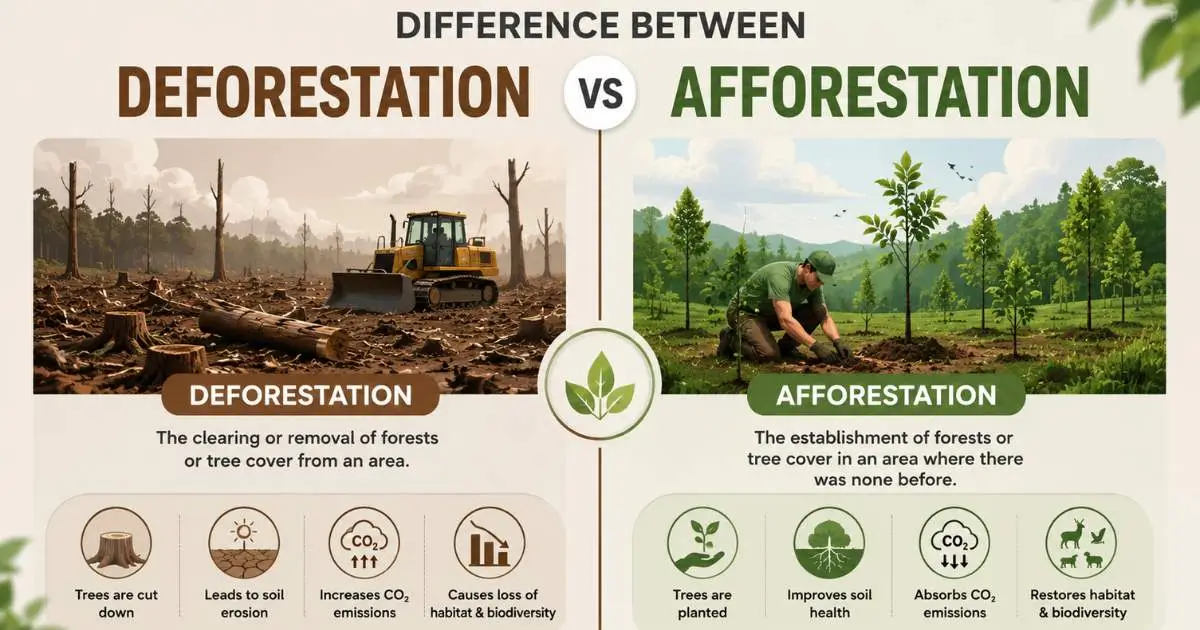
Ask a class what deforestation means and almost every hand goes up. Ask what afforestation means and the room usually goes quiet. It is one letter different, but the difference between deforestation and afforestation is actually the difference between destroying a forest and creating one from scratch.
This topic comes up constantly in GCSE Geography, from case studies on the Amazon rainforest to questions about how countries are trying to fight climate change. Once you understand the difference between deforestation and afforestation, you can confidently explain both the causes of forest loss and the strategies used to reverse it.
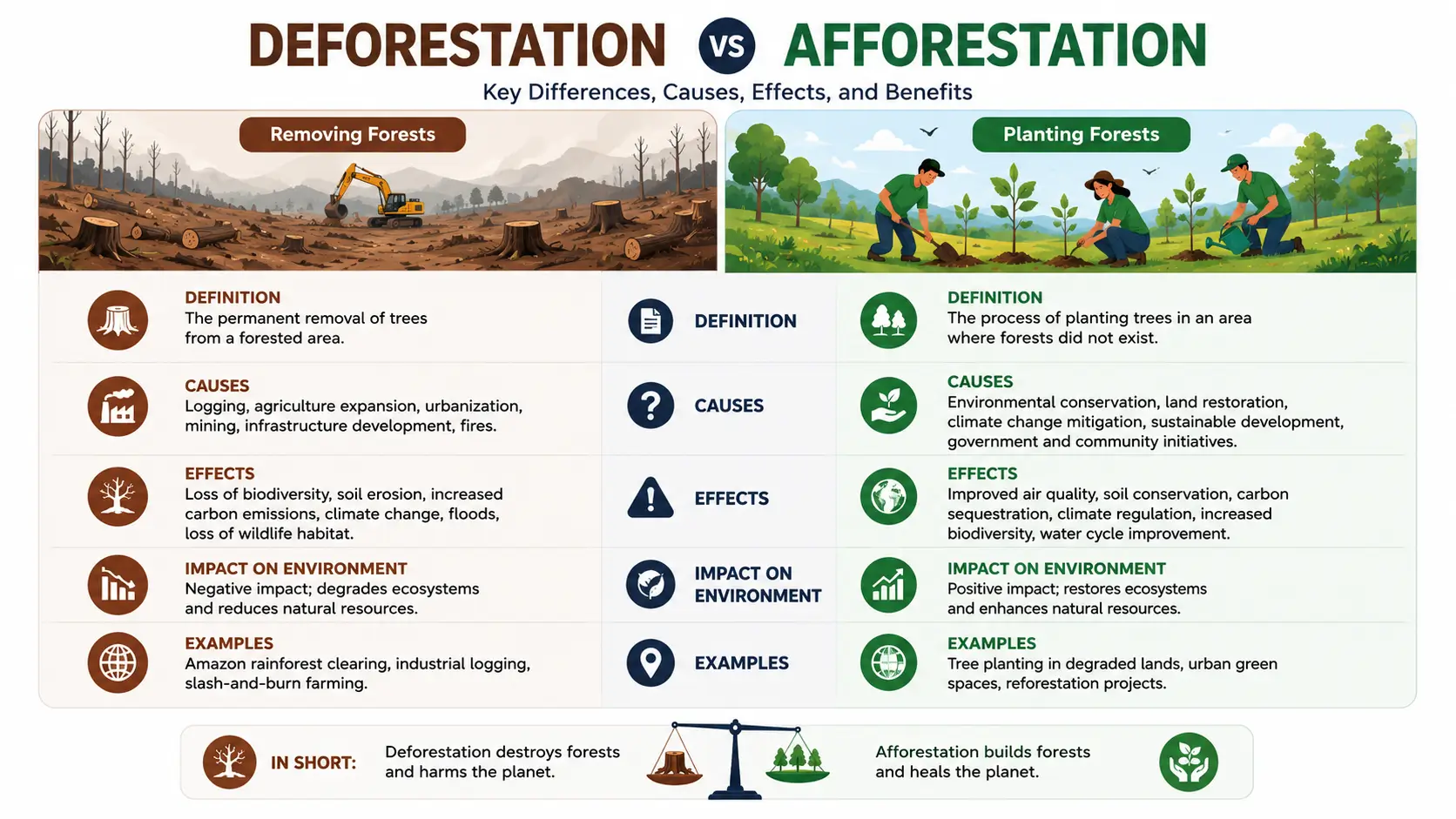
This guide breaks the difference between deforestation and afforestation down clearly, with a comparison table, a diagram, real examples and a memory trick to help it stay with you long after the exam.
Quick Verdict
Deforestation is the clearing or destruction of existing forests, usually to make way for farming, mining or urban development. Afforestation is the planting of new trees in an area that had no recent forest cover, often done deliberately to restore land or fight climate change. One removes trees, the other adds them.
Deforestation and Afforestation Comparison Table
| Feature | Deforestation | Afforestation |
|---|---|---|
| Definition | The clearing or removal of existing forest | The planting of new trees on land with no recent forest |
| Effect on tree cover | Decreases tree cover | Increases tree cover |
| Common causes | Farming, logging, mining, urban expansion | Government policy, conservation programmes, carbon offset schemes |
| Impact on carbon | Releases stored carbon dioxide into the atmosphere | Absorbs and stores carbon dioxide from the atmosphere |
| Impact on biodiversity | Reduces habitats, often decreasing biodiversity | Can create new habitats, potentially increasing biodiversity over time |
| Typical example | The Amazon rainforest, Brazil | The Great Green Wall, Africa |
What Is Deforestation?
Deforestation is the large-scale clearing or destruction of forests, usually so the land can be used for something else. Trees are cut down or burned, and the land is converted for farming, cattle ranching, logging, mining or expanding towns and cities.
Deforestation happens fastest in tropical regions, particularly rainforests, because warm, wet climates support valuable timber and fertile soil that is attractive for agriculture once cleared.
The effects of deforestation reach far beyond the local area. Removing trees releases the carbon dioxide they had stored, destroys habitats for wildlife, increases the risk of soil erosion, and can disrupt local and even global rainfall patterns.
What Is Afforestation?
Afforestation is the deliberate planting of trees in an area that has had no forest for a long time, or possibly never had forest cover at all. This is different from simply letting an existing forest regrow.
Afforestation is usually carried out on purpose by governments, charities or organisations, often as part of a wider strategy to fight climate change, prevent soil erosion, or restore damaged land.
As the new trees grow, they begin absorbing carbon dioxide from the atmosphere, stabilising soil with their root systems, and gradually creating new habitats for wildlife to return to.
The Key Differences Explained
The core difference between deforestation and afforestation is direction. Deforestation removes trees and reduces forest cover. Afforestation adds trees and increases forest cover. They are, in effect, opposite processes with opposite environmental outcomes.
Deforestation is usually driven by short-term economic pressure, such as the need for farmland, timber or space to build. Afforestation is usually driven by long-term environmental planning, aimed at reversing damage or preventing future problems.
The two processes can even happen in the same country at the same time. A nation might be clearing rainforest in one region for agriculture while planting new woodland in another region as part of a conservation programme.
Why This Difference Matters for Climate Change
Understanding the difference between deforestation and afforestation is essential for understanding climate change debates. Forests act as carbon sinks, meaning they absorb and store carbon dioxide rather than releasing it. Deforestation reverses this process, releasing stored carbon back into the atmosphere and removing a natural system that helps regulate global temperature.
Afforestation is one of the main strategies used to offset carbon emissions. By planting new trees, countries and organisations aim to absorb some of the carbon dioxide produced by industry, transport and energy use, helping to slow the pace of climate change.
Real World Examples
The Amazon rainforest is one of the most studied examples of deforestation. Large areas are cleared every year for cattle ranching and soybean farming, and this loss is linked to reduced rainfall, habitat destruction and rising carbon emissions.
The Great Green Wall in Africa is a major afforestation project, aiming to plant a wall of trees stretching across the width of the continent to combat desertification along the edge of the Sahara Desert.
China’s Grain for Green programme is another well-known afforestation effort, converting farmland on steep slopes back into forest to reduce soil erosion and flooding.
Memory Trick
Remember it as “DE takes away, A adds on.” DEforestation takes trees away, just like “de-” often means removal, as in “defrost” or “deflate.” AFforestation Adds forest that was not there before. If you remember those two prefixes, you can work out the difference between deforestation and afforestation even under exam pressure.
Test Yourself: Deforestation and Afforestation Quiz
1. Which process removes trees from an area?
2. Which process is the Great Green Wall an example of?
3. Which process releases stored carbon dioxide into the atmosphere?
4. What is a common cause of deforestation?
5. Which term describes planting trees on land that had no recent forest?
Common Mistakes Students Make
The most common mistake students make with the difference between deforestation and afforestation is confusing afforestation with reforestation. Afforestation means planting trees where there was no recent forest, while reforestation means replanting trees in an area that was recently forest before it was cleared. They are related but not the same process.
Another common mistake is assuming deforestation only happens in poorer, developing countries. While tropical deforestation gets the most attention, forest loss also happens in developed countries through logging, urban expansion and land conversion.
Students also sometimes forget that afforestation takes years or even decades to have a meaningful impact, since trees need time to grow before they can absorb significant amounts of carbon dioxide or support established ecosystems.
Frequently Asked Questions
What is the main difference between deforestation and afforestation?
The main difference between deforestation and afforestation is direction. Deforestation removes existing trees and reduces forest cover, while afforestation plants new trees and increases forest cover in an area that had none recently.
What is the difference between afforestation and reforestation?
Afforestation means planting trees in an area with no recent forest cover, while reforestation means replanting trees in an area that was forest until it was recently cleared.
Why does deforestation increase carbon dioxide levels?
Trees store carbon dioxide in their wood, leaves and roots. When trees are cut down or burned, that stored carbon dioxide is released back into the atmosphere, contributing to climate change.
Where does most deforestation happen?
Most large-scale deforestation happens in tropical regions, particularly rainforests such as the Amazon in South America, the Congo Basin in Africa, and parts of Southeast Asia.
Can afforestation reverse the effects of climate change?
Afforestation can help offset some carbon emissions and slow the pace of climate change, but it cannot fully reverse it on its own. It works best alongside reducing emissions from other sources such as fossil fuels.
For more detail on global deforestation trends, National Geographic’s deforestation resources are a reliable place to continue your revision. You might also want to look at our guide to Overpopulation and Underpopulation to see how population pressure drives land use change, or revisit Developed and Developing Countries to see how economic development connects to deforestation and afforestation policy.
Once you can confidently explain the difference between deforestation and afforestation, you can tackle almost any exam question on forests, land use or climate change with confidence. Deforestation removes trees and the benefits they provide, while afforestation deliberately adds trees back to restore land and absorb carbon dioxide.
Keep the “DE takes away, A adds on” memory trick close at hand during revision, work through the quiz above until every answer feels automatic, and use named examples like the Amazon rainforest and the Great Green Wall whenever you can, since specific case studies consistently earn higher marks than general statements.
