Whenever I introduce this topic in class, I ask students a simple question. Can a country have too many people, or too few? Most assume more people is always a problem. The truth is more interesting, and the difference between overpopulation and underpopulation shows that both too many people and too few people can cause serious challenges for a country.
Understanding the difference between overpopulation and underpopulation helps you explain why some countries struggle to feed their citizens while others struggle to find enough workers. It is one of the most exam-friendly topics in GCSE Geography, because it connects directly to development, resources and population structure.
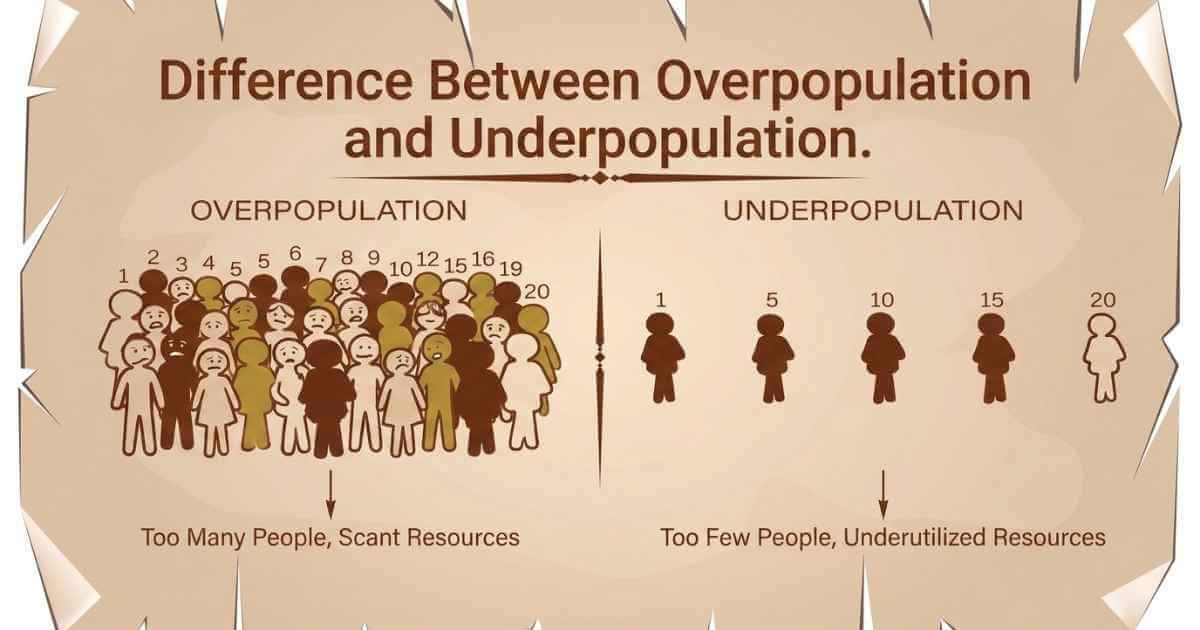
This guide breaks the difference between overpopulation and underpopulation down clearly, with a comparison table, a diagram, real examples and a memory trick to help it stick before the exam.
Quick Verdict
Overpopulation happens when there are too many people for the resources and services a region can support. Underpopulation happens when there are too few people to make full use of the resources and land that are available. Both are about balance between population size and available resources, not simply about a country being “big” or “small.”
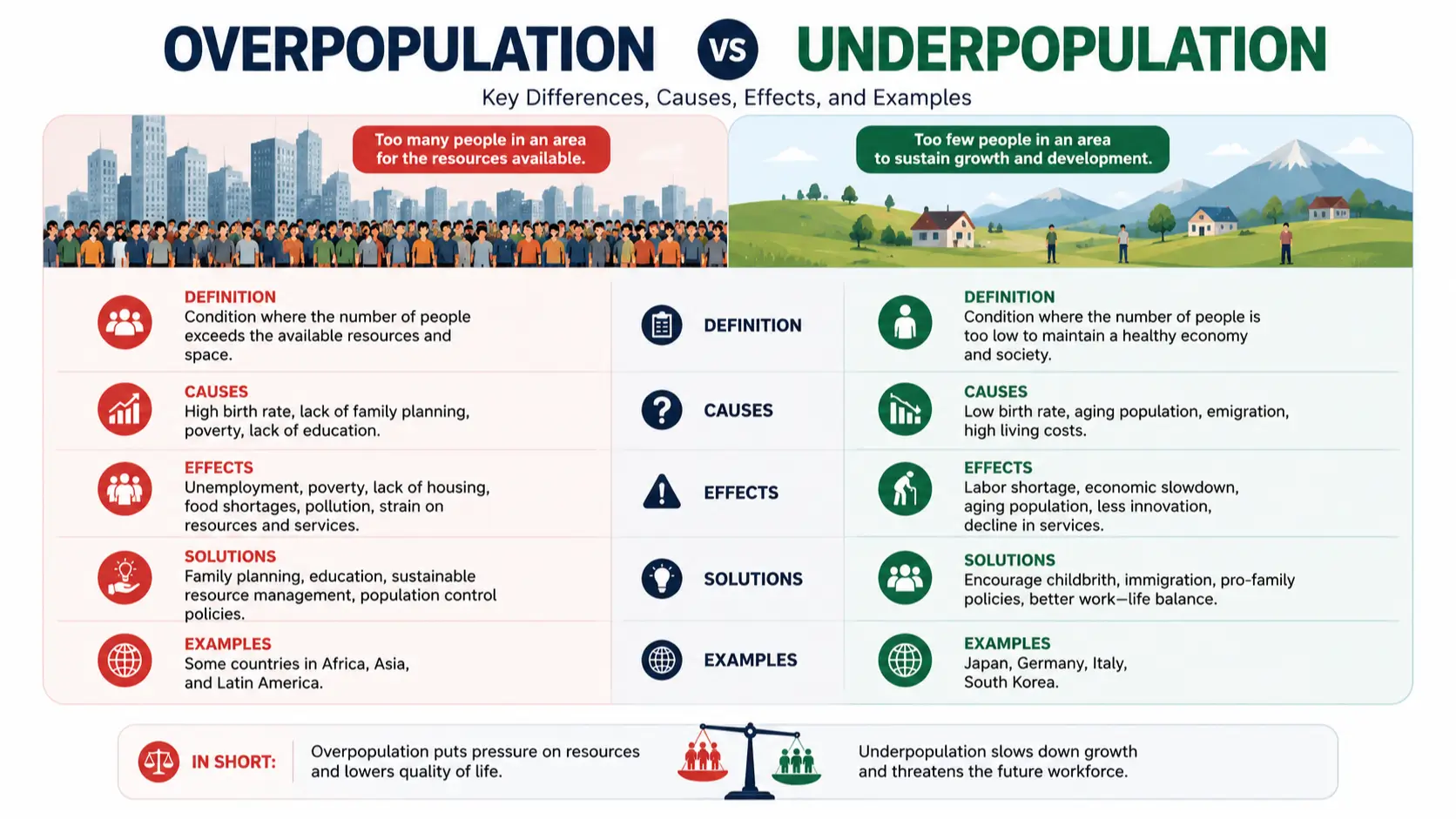
Overpopulation and Underpopulation Comparison Table
| Feature | Overpopulation | Underpopulation |
|---|---|---|
| Definition | Too many people for the resources available | Too few people to use the resources available fully |
| Common cause | High birth rates and rapid population growth | Low birth rates, ageing population or emigration |
| Pressure on services | High pressure on housing, healthcare and schools | Services may be underused or hard to sustain |
| Workforce impact | High competition for jobs, possible unemployment | Labour shortages, not enough workers |
| Typical examples | Bangladesh, Nigeria | Canada, Australia |
| Economic effect | Resources spread too thinly, lower income per person | Resources not fully exploited, lower total economic output |
What Is Overpopulation?
Overpopulation happens when the number of people living in an area is greater than the resources, land and services can comfortably support. This does not simply mean a country has a large population. It means the population has outgrown what the environment and infrastructure can provide.
Overpopulation is usually linked to high birth rates and rapid population growth, often seen in developing countries that are still early in the demographic transition model. Common effects include pressure on housing, food supply, clean water, healthcare and school places.
Bangladesh is a frequently used example of overpopulation, because it has one of the highest population densities in the world, which places enormous strain on land, farming and infrastructure.
What Is Underpopulation?
Underpopulation happens when there are too few people in an area to make full use of the resources, land and economic opportunities available. This might sound like a good problem to have, but it creates its own serious challenges.
Underpopulation is often linked to low birth rates, an ageing population, or high rates of emigration, where people leave a country faster than new people arrive. This leaves fewer working-age people to fill jobs, pay taxes and support essential services.
Canada is a commonly used example of underpopulation, since it has a huge land area and abundant natural resources but a relatively small population to develop and use them fully.
The Key Differences Explained
The core difference between overpopulation and underpopulation is the relationship between people and resources, not population size on its own. A country can have millions of people and still be underpopulated if its land and resources could comfortably support many more.
Overpopulation typically creates pressure and competition. Housing becomes expensive, unemployment can rise, and services such as hospitals and schools struggle to keep up with demand. Underpopulation typically creates the opposite problem: a shortage of workers, underused land, and difficulty generating enough economic output to fund services.
Both situations can be measured using population density and the ratio of people to available resources, which is exactly why examiners often ask students to compare specific countries rather than just define the terms.
Why This Difference Matters for Development
Understanding the difference between overpopulation and underpopulation helps explain real government decisions. Overpopulated countries often introduce policies to slow population growth, such as family planning programmes or education campaigns, while investing heavily in housing and infrastructure to keep up with demand.
Underpopulated countries often do the opposite, encouraging immigration or offering incentives for larger families, to grow their workforce and make fuller use of their land and resources. Both types of policy exist because governments are trying to bring population size back into balance with what their country can support.
Real World Example
China’s former one-child policy is a real world example of a government responding to overpopulation, aiming to slow rapid population growth and ease pressure on resources. In contrast, countries like Japan now face underpopulation, with such low birth rates that the government offers financial incentives to encourage families to have more children and support an ageing workforce.
Memory Trick
Remember it as “OVER means too many, UNDER means too few, both mean out of balance.” OVERpopulation is OVER the limit resources can support. UNDERpopulation is UNDER the number needed to use resources fully. If you remember that both terms describe an imbalance rather than just a population size, you can answer almost any exam question on the difference between overpopulation and underpopulation.
Test Yourself: Overpopulation and Underpopulation Quiz
1. Which term describes too many people for the available resources?
2. Which country is a common example of underpopulation?
3. Which situation usually causes labour shortages?
4. What is the main factor that defines both terms?
Common Mistakes Students Make
The most common mistake students make with the difference between overpopulation and underpopulation is assuming a country with a huge total population must be overpopulated. Population size alone does not decide this. A country can have a large population and still comfortably support everyone if it has enough resources.
Another common mistake is forgetting that underpopulation is a real problem, not simply the “opposite” of a problem. Too few people can mean labour shortages, an ageing population, and difficulty funding public services just as seriously as overpopulation can.
Students also sometimes confuse overpopulation with high population density. The two are related but not identical, since density describes how tightly packed people are, while overpopulation describes whether that number exceeds what resources can support.
Frequently Asked Questions
What is the main difference between overpopulation and underpopulation?
The main difference between overpopulation and underpopulation is the balance between people and resources. Overpopulation means there are too many people for the available resources, while underpopulation means there are too few people to use those resources fully.
Which countries are examples of overpopulation?
Bangladesh and Nigeria are commonly used examples of overpopulation, both dealing with high population density and pressure on housing, food and services.
Which countries are examples of underpopulation?
Canada and Australia are commonly used examples of underpopulation, since both have large amounts of land and resources relative to their population size.
Is overpopulation always caused by a high birth rate?
A high birth rate is the most common cause, but overpopulation can also be made worse by limited resources, poor infrastructure, or a lack of investment in services, even where population growth is only moderate.
Can a country move from overpopulation to underpopulation?
Yes. As countries develop, birth rates typically fall due to factors such as better education and access to contraception. Some developed countries have shifted from historic overpopulation concerns to underpopulation concerns as birth rates dropped and populations aged.
For more detail on global population trends, Royal Geographical Society teaching resources are a reliable place to continue your revision. You might also want to look at our guide to Birth Rate and Death Rate to see what drives population change, or revisit Developed and Developing Countries to see how population pressure connects to a country’s level of development.
Once you can confidently explain the difference between overpopulation and underpopulation, you can tackle population questions from almost any angle in the exam. Both terms come down to the same underlying idea: whether the number of people in an area is balanced with the resources available to support them.
Keep the “OVER means too many, UNDER means too few” memory trick close at hand during revision, work through the quiz above until every answer feels automatic, and use real country examples like Bangladesh and Canada whenever you can, since examiners consistently reward answers that go beyond the definition.

1 thought on “Difference Between Overpopulation and Underpopulation With Diagram: 6 Essential Facts That Are Surprisingly Easy to Understand”
Comments are closed.